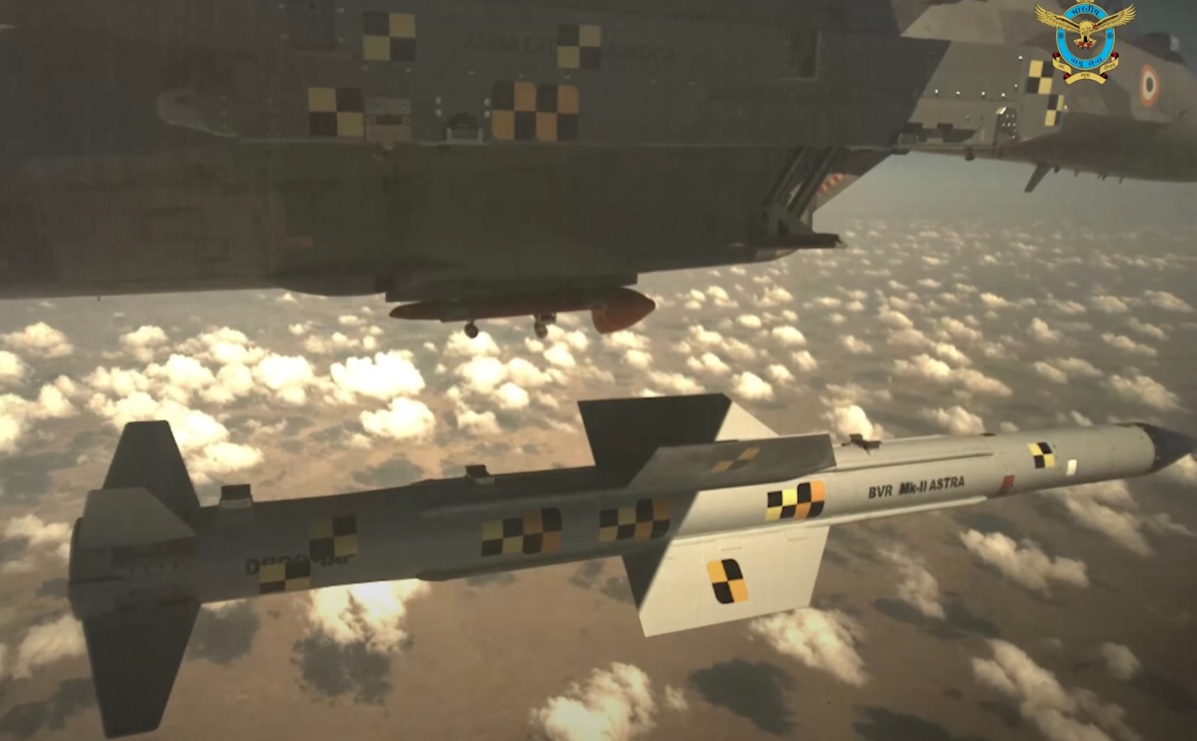
NEW DELHI — April 16, 2026 : India’s Defence Research and Development Organisation (DRDO) has successfully completed preliminary trials of the Astra Mk2 beyond-visual-range air-to-air missile (BVRAAM), validating key performance parameters including aerodynamics, propulsion, and guidance systems. The missile, designed as an extended-range variant of the Astra family, is intended to provide the Indian Air Force (IAF) with a long-range air combat capability of approximately 240 km.
Subsystem Validation and Flight Performance
The preliminary trials assessed the missile’s performance across multiple flight conditions, focusing on core subsystems. DRDO confirmed aerodynamic stability, including controlled maneuverability at high speeds and varied engagement profiles. The propulsion system, based on a dual-pulse solid rocket motor, demonstrated consistent thrust delivery across two phases of flight, enabling improved energy management and extended engagement range. Guidance and control systems, including the onboard seeker and datalink, were also validated for accuracy and reliability.
Propulsion and Guidance Enhancements
The Astra Mk2 incorporates a smokeless dual-pulse solid rocket motor, which differs from conventional single-pulse systems by reserving energy for a second thrust phase during terminal engagement. This configuration enhances the missile’s no-escape zone and maintains higher kinetic energy against maneuvering targets at long distances.
The missile is equipped with an indigenous Active Electronically Scanned Array (AESA) radar seeker operating in the Ku-band, integrated with electronic counter-countermeasure (ECCM) capabilities. This enables improved resistance to jamming and enhances target acquisition and tracking in contested environments. A two-way datalink supports mid-course updates from the launch aircraft or networked platforms, enabling real-time trajectory corrections before terminal guidance activation.
Integration and Production Timeline
Following successful preliminary trials, the Astra Mk2 will proceed to integrated user trials with the Indian Air Force. These trials, involving live-fire testing on operational platforms, are scheduled for completion by the end of 2026. Limited series production is expected to begin around July 2026, subject to successful validation during this phase.
Initial integration will be carried out on the Su-30MKI fighter aircraft, followed by the Light Combat Aircraft (LCA) Tejas Mk1A. Integration activities for the Astra family on Tejas platforms are already underway, including captive and planned firing trials. The missile is also expected to be compatible with future IAF fighter platforms. It supports both direct hot-launch and cold-ejection modes, allowing flexibility across different aircraft configurations.
Design, Specifications, and Compatibility
The Astra Mk2 weighs approximately 170–175 kg and includes a laser proximity fuze designed to support a high single-shot kill probability in beyond-visual-range engagements under all-weather conditions. The missile retains compatibility with existing Astra Mk1 production infrastructure, facilitating a smoother transition to manufacturing through established supply chains and industrial partners such as Bharat Dynamics Limited (BDL).
Procurement and Strategic Context
The Indian Air Force is expected to procure a substantial number of Astra Mk2 missiles, with reported plans indicating up to 700 units to equip its fighter fleet. The system is positioned to become a primary BVR weapon within the IAF inventory, offering extended standoff engagement capability comparable to contemporary global systems.
The Astra Mk2 builds on the operational Astra Mk1, which has a range exceeding 110 km and is already deployed on the Su-30MKI platform. The Mk2 introduces advancements in propulsion, seeker technology, and datalink integration to address evolving air combat requirements. The program aligns with India’s broader effort to strengthen indigenous defense manufacturing under the Atmanirbhar Bharat initiative and reduce dependence on imported long-range air-to-air missile systems.
DRDO officials have indicated that the Astra Mk2 program remains on schedule, with full user trials and production clearance expected following the completion of integrated testing. Future development within the Astra series includes the Astra Mk3, which is projected to incorporate Solid Fuel Ducted Ramjet (SFDR) technology for further range enhancement.
——— End of Article ———