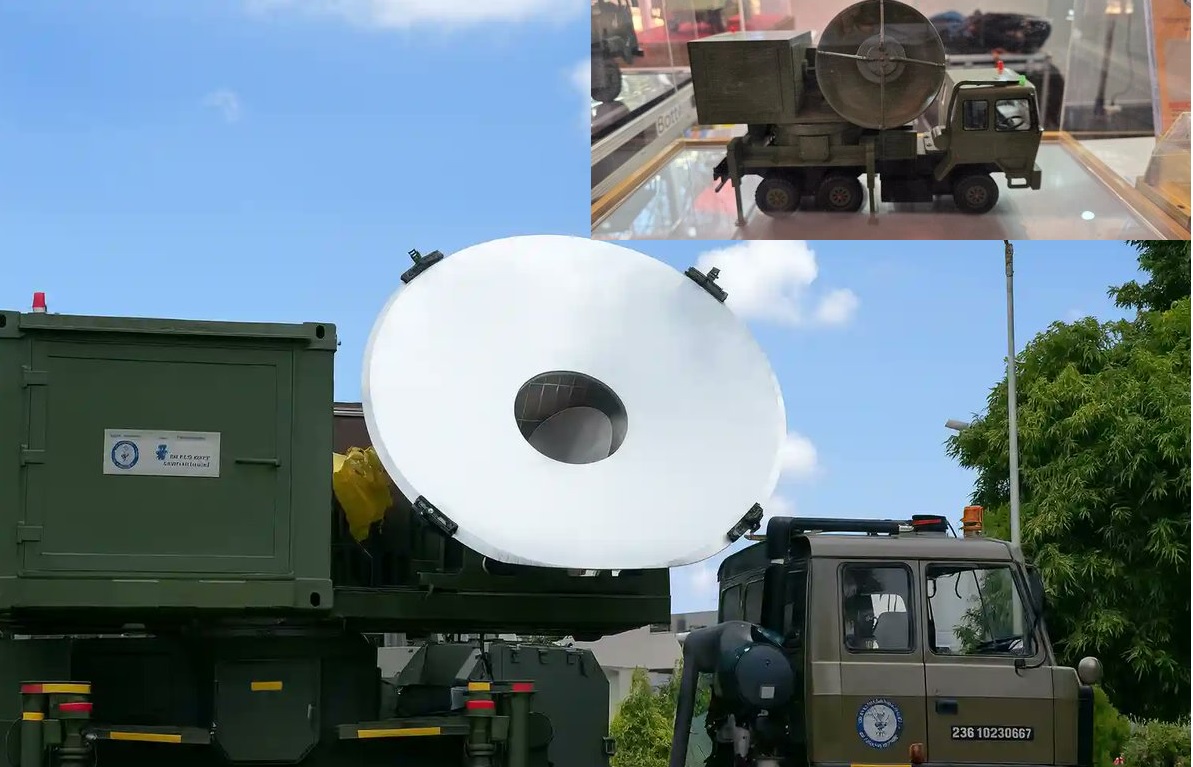
BENGALURU : India’s Defence Research and Development Organisation (DRDO) has unveiled a high-power microwave (HPM) directed-energy weapon system under development to counter hostile drone swarms, marking a major advance in the country’s efforts to address the rapidly evolving unmanned aerial threat.
The prototype system was revealed during an international defence and technology conference held in India from January 20 to 22, where senior DRDO officials confirmed that the project has been in development for approximately six years. Designed as a non-kinetic counter-drone solution, the weapon is intended to disable multiple unmanned aircraft systems (UASs) simultaneously through the use of concentrated microwave energy rather than conventional missiles or gunfire.
Design and Operational Concept
The DRDO HPM system is mounted on a mobile truck platform, allowing it to be rapidly deployed to protect air bases, critical infrastructure, command centres and other high-value targets. Instead of physically destroying drones, the system delivers a “soft kill” by emitting powerful microwave pulses that penetrate airframes and disrupt or permanently damage onboard electronics.
Operating in the S-band frequency range, the weapon targets critical components such as navigation sensors, data links and flight-control processors. Once exposed to the microwave burst, affected drones may lose control, suffer system failure or crash, effectively neutralising the threat without creating explosive debris or widespread collateral damage.
Trial Results and Performance
According to DRDO officials, the prototype has already demonstrated a confirmed kill range of up to one kilometre during field trials. The system features a tunable beam width, enabling operators to adjust the area of effect depending on whether they are engaging a single drone or a dense swarm.
Although key technical parameters, including peak power output and pulse characteristics, remain classified, DRDO has stated that real-time trials have successfully disabled aerial targets under operational conditions. Target detection and engagement are supported by integrated radar systems, allowing the weapon to rapidly acquire and track incoming drones before firing microwave bursts.
Advantages Over Conventional Defences
Directed-energy weapons such as high-power microwave systems are increasingly viewed as cost-effective solutions against drone swarms and saturation attacks. Unlike interceptor missiles, which are expensive and finite in number, the HPM system has a deep magazine limited primarily by onboard power generation and cooling capacity.
The absence of kinetic projectiles also reduces the risk to civilians and infrastructure, particularly in urban or sensitive areas. This makes the system well suited for homeland defence roles, including the protection of airports, government facilities and strategic installations.
Roadmap to Induction and Future Development
DRDO officials said all remaining developmental and user trials are expected to be completed within the next six months. Following this phase, the system is planned to move toward induction into service with the Indian armed forces.
At the same time, work is already under way on an upgraded version with a significantly extended engagement range. The next development goal is to achieve a kill range of up to five kilometres, which would greatly enhance the system’s ability to counter stand-off drone attacks and layered swarm tactics.
Strategic Context
The unveiling of the HPM weapon comes as militaries worldwide confront the growing use of low-cost drones and coordinated swarms in modern conflicts. Such systems have been used for surveillance, precision strikes and mass attacks designed to overwhelm traditional air-defence networks.
By advancing indigenous directed-energy technologies, India is positioning itself among a small group of nations developing non-kinetic, scalable and sustainable counter-drone solutions. If inducted as planned, the DRDO high-power microwave weapon could become a cornerstone of India’s future short-range air-defence architecture, addressing one of the most pressing challenges of contemporary warfare.
——— End of Article ———