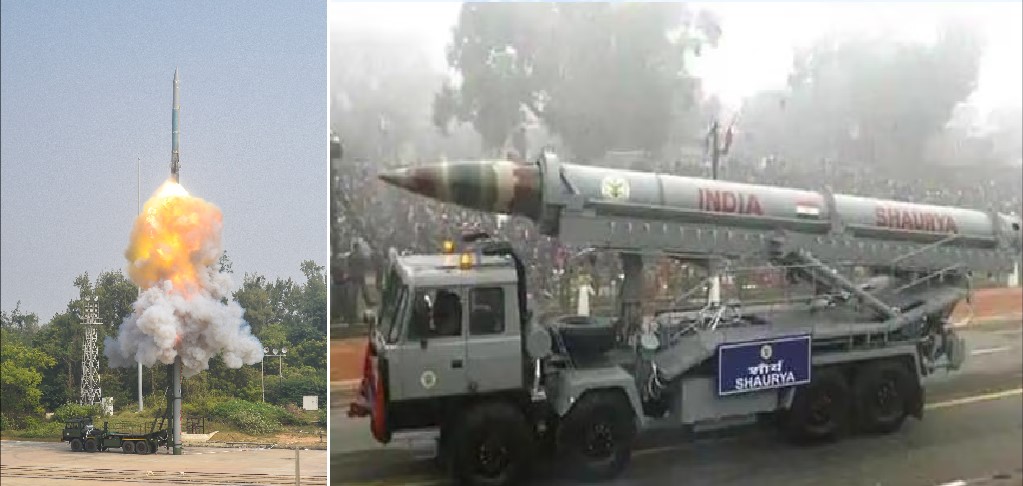
NEW DELHI — March 27, 2026 : The Defence Research and Development Organisation (DRDO) is preparing to conduct a test of the Shaurya Next Generation (NG), an upgraded hypersonic surface-to-surface missile designed to improve survivability against modern air defence systems while maintaining precision strike capability.
Technical Upgrades Focus on Evasion and Accuracy
The Shaurya NG introduces significant enhancements in flight profile and terminal-phase performance. Unlike traditional ballistic missiles that follow predictable parabolic trajectories, the system employs a quasi-ballistic trajectory, allowing mid-course adjustments and high-G manoeuvres during the final phase of flight.
This manoeuvrability reduces predictability and complicates interception by advanced anti-ballistic missile (ABM) systems. The missile is specifically engineered to evade modern layered air defence networks through these unpredictable flight paths.
To maintain accuracy under such conditions, DRDO has integrated an indigenous multi-mode seeker combining Imaging Infra-Red (IIR) and active radar guidance. The system is designed to operate effectively despite the extreme thermal and plasma conditions generated during hypersonic flight, ensuring sustained target lock throughout the terminal phase.
Speed, Range, and Launch Configuration
Powered by a two-stage solid-fuel rocket motor, the Shaurya NG is capable of speeds exceeding Mach 7. The missile has an operational range estimated between 700 and 1,000 kilometres.
The system is canisterised, meaning it is stored and transported in a sealed, climate-controlled launch tube that also functions as the launch platform. This configuration supports long-term storage with minimal maintenance requirements.
Operational deployment is based on road-mobile transporter erector launcher (TEL) vehicles. The system is designed for rapid response, with launch readiness achievable in under five minutes. A gas generator mechanism ejects the missile from the canister before ignition of the main rocket motor, improving launch safety and reliability.
Background and System Evolution
The Shaurya missile family forms part of India’s broader strategic missile programme and is derived from the K-15 Sagarika submarine-launched ballistic missile (SLBM), though the programmes have been described as distinct in certain official contexts.
The original Shaurya missile, first successfully tested in 2011, is a two-stage solid-fuel system approximately 10 metres in length and 0.74 metres in diameter, with a launch weight of around 6.2 tonnes. It is capable of carrying payloads ranging from 200 to 1,000 kilograms, including both conventional and nuclear warheads.
Earlier variants demonstrated ranges between 700 and 1,900 kilometres depending on configuration and achieved speeds of up to Mach 7.5.
Next-Generation Enhancements and Test Objectives
The Shaurya NG incorporates multiple upgrades over earlier versions, including improved terminal manoeuvrability, the integration of the multi-mode seeker, and enhanced resistance to plasma interference during hypersonic flight.
The upcoming test will focus on validating these improvements, particularly the seeker performance, manoeuvrability under high-G conditions, and overall effectiveness against modern air defence threats.
No official date for the test has been announced. The system is intended to strengthen India’s precision-strike capabilities, with emphasis on rapid deployment, survivability, and effectiveness in contested operational environments.
——— End of Article ———