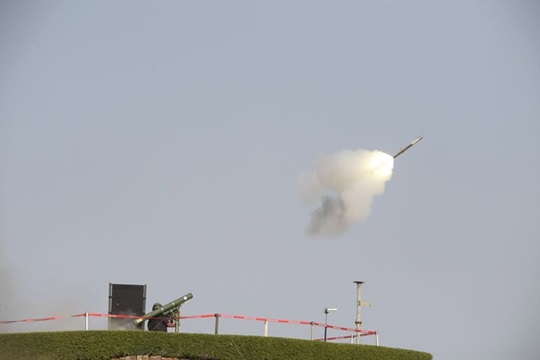
CHANDIPUR, ODISHA : The Defence Research and Development Organisation (DRDO) on Friday successfully carried out three consecutive flight trials of the indigenously developed Very Short Range Air Defence System (VSHORADS) from the Integrated Test Range (ITR) at Chandipur, off the Odisha coast. The trials were conducted in the system’s final deployment configuration and validated its capability to intercept high-speed aerial threats under varied operational conditions.
According to the Ministry of Defence, the tests were aimed at revalidating the missile system’s performance parameters against targets flying at different speeds, ranges and altitudes. During the trials, the missiles successfully intercepted and destroyed high-speed aerial targets simulating enemy unmanned aerial vehicles (UAVs), helicopters and fighter aircraft across multiple threat scenarios.
The launch operations were executed by field operators to simulate real-time battlefield conditions. Target acquisition, tracking and missile firing procedures were carried out as per operational protocols. Comprehensive flight data was recorded through telemetry systems, electro-optical tracking instruments and radar assets deployed at ITR Chandipur. The collected data confirmed the missile’s accuracy, seeker performance, propulsion response and control system effectiveness at extreme engagement ranges.
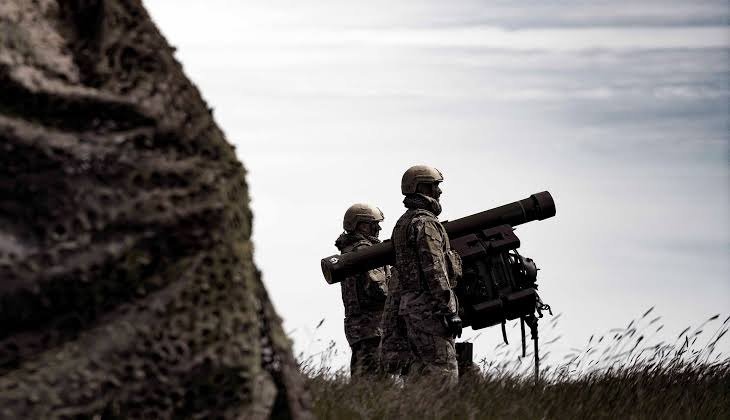
The VSHORADS missile tested during the trials has a weight of 20.5 kilograms and is designed for short-range air defence with an operational range of up to 6 kilometres. The missile is capable of achieving speeds up to Mach 1.5 and can engage aerial targets at launch altitudes of up to 3.5 kilometres above mean sea level.
It is equipped with a 2-kilogram pre-fragmented (PF) warhead designed to ensure effective target neutralisation. The missile uses an Imaging Infrared (IIR) seeker for terminal guidance, enabling accurate tracking of heat signatures in varied environmental conditions. The propulsion system consists of a dual-thrust solid rocket motor that supports rapid acceleration and sustained flight stability. The system employs digital electro-mechanical actuators with reaction control for precise manoeuvrability during engagement.
The launcher configuration is man-portable and tripod-based, enabling quick deployment in forward operational areas. The system is designed to meet the close-air defence requirements of the Indian Army, Indian Navy and Indian Air Force, particularly against low-altitude aerial threats.
The VSHORADS has been designed and developed by Research Centre Imarat (RCI), a Hyderabad-based DRDO laboratory, in collaboration with other DRDO facilities and domestic industry partners. The development programme forms part of India’s broader efforts to strengthen indigenous air defence capabilities and reduce dependence on imported systems.
Defence Minister Rajnath Singh congratulated DRDO, the Armed Forces and industry partners on the successful completion of the three flight trials. He stated that the consecutive successful tests indicate that the system is progressing towards induction into the armed forces.
Secretary, Department of Defence Research and Development and Chairman of DRDO, Dr. Samir V. Kamat, also commended the scientists, engineers and associated teams involved in the design, development and testing of the system.
With the completion of these three consecutive validation trials at ITR Chandipur, the VSHORADS missile system moves closer to operational deployment as a short-range air defence solution for India’s armed forces.
——— End of Article ———