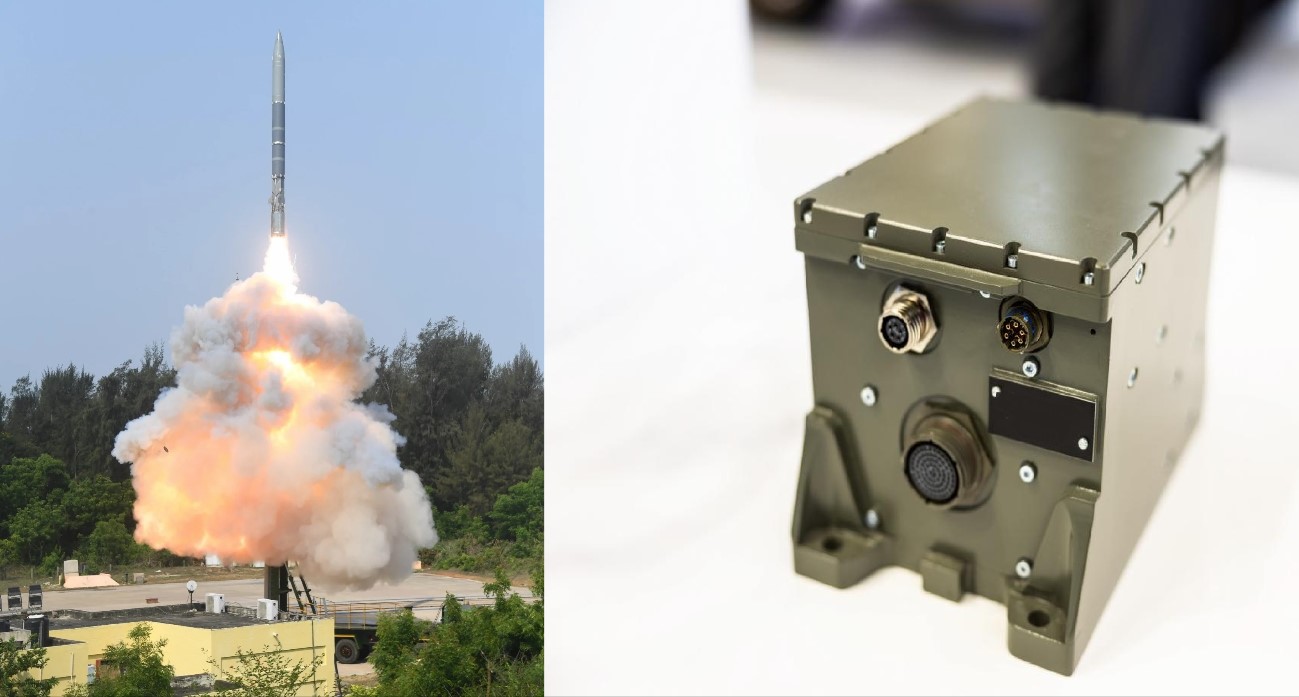
NEW DELHI : India’s missile programmes are set to receive a major survivability upgrade as the Defence Research and Development Organisation (DRDO) moves to integrate a new generation of miniaturised Inertial Navigation System (INS) modules into missiles that are under development as well as those already in production. The initiative is aimed at ensuring that Indian missiles remain accurate and fully operational in environments dominated by electronic warfare, where satellite navigation signals are increasingly at risk of jamming, spoofing or complete denial.
Officials familiar with the development say the decision reflects a growing recognition that future conflicts will be fought in highly contested electromagnetic conditions. By reinforcing missile guidance with a robust, self-contained navigation backbone, DRDO is seeking to preserve mission effectiveness even when external navigation aids are degraded or unavailable.
A Shift Away From Satellite Dependence
Modern precision-guided weapons often rely on satellite navigation for mid-course updates and terminal accuracy. However, recent conflicts have demonstrated how vulnerable these signals can be to hostile electronic attack. Adversaries equipped with advanced jamming and spoofing capabilities can distort navigation data, forcing missiles off course or significantly reducing their accuracy.
The miniaturised INS module being rolled out by DRDO is designed to mitigate this vulnerability. Unlike satellite-based systems, an inertial navigation system operates independently, using only onboard sensors to determine a missile’s position and orientation throughout its flight. This makes it inherently resistant to external interference, as it neither receives nor transmits navigation signals once the missile is launched.
How the Technology Works
At its core, the INS relies on a tightly integrated set of accelerometers and gyroscopes. Accelerometers measure changes in linear motion along multiple axes, while gyroscopes track rotational movement and orientation. Starting from a precisely known launch position, onboard processors continuously integrate this data to calculate the missile’s velocity, direction and location in real time.
Advances in micro-electromechanical systems (MEMS), sensor fabrication and digital signal processing have allowed DRDO scientists to dramatically reduce the size of these components without sacrificing precision. Improved calibration techniques and error-compensation algorithms have also reduced long-standing issues such as navigation drift, enabling high levels of accuracy over the missile’s entire flight duration.
Broad Integration Across Missile Programmes
One of the most significant aspects of the initiative is its scope. The integration of the new INS modules is not limited to next-generation missile designs. Instead, DRDO is applying the upgrade across a wide spectrum of programmes, including missiles already entering serial production.
This approach allows existing systems to receive incremental improvements rather than waiting for entirely new variants, ensuring that frontline inventories benefit quickly from enhanced resistance to electronic countermeasures. The compact form factor of the new INS module makes it compatible with multiple missile classes, from short-range tactical weapons to long-range precision strike systems, without affecting payload capacity or aerodynamic performance.
Lessons From Modern Warfare
The renewed emphasis on inertial navigation is closely tied to lessons drawn from modern warfare, where electronic warfare has emerged as a decisive factor. In several theatres, precision-guided munitions have reportedly lost effectiveness after satellite navigation signals were disrupted. These experiences have reinforced the need for guidance systems that can operate reliably in denied environments.
By prioritising an INS-centric architecture, Indian missile designers aim to ensure that guidance remains stable and predictable even against technologically sophisticated adversaries. In practice, the INS can also be integrated with complementary navigation aids, such as terrain-referenced navigation or intermittent satellite updates when available, creating a layered guidance approach with the inertial system as the trusted core.
Boost to Indigenous Defence Capability
The programme also aligns with India’s broader push for self-reliance in critical defence technologies. Developing and deploying indigenous INS modules reduces dependence on foreign navigation solutions, many of which are subject to export controls or security constraints. Domestic control over hardware, software and encryption allows for tighter security oversight and faster upgrade cycles tailored to operational needs.
Officials indicate that further refinements are already under way, including enhanced resistance to extreme vibration and acceleration, as well as more powerful onboard processing to support complex flight profiles. Over time, the miniaturised INS is expected to become a standard feature across India’s missile arsenal.
As electronic warfare becomes an increasingly central element of modern combat, DRDO’s move to harden missile navigation underscores a strategic shift toward resilience and autonomy. By ensuring that missiles can navigate accurately even in the absence of satellite signals, India is reinforcing the credibility and reliability of its precision strike capabilities in future conflicts.
——— End of Article ———