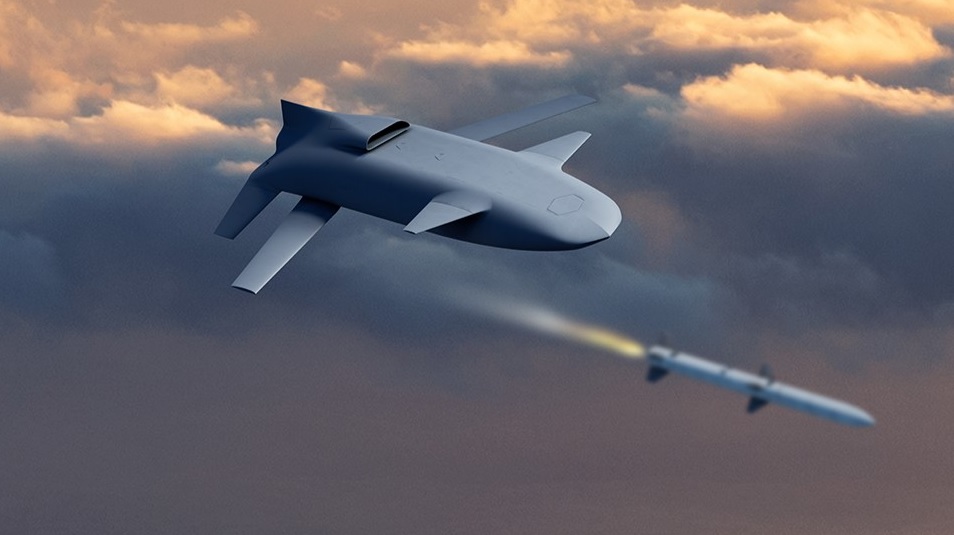
WASHINGTON : The U.S. Defense Advanced Research Projects Agency (DARPA) has confirmed that its LongShot program, designated the X-68A, has completed a series of technical milestones as it progresses toward initial flight testing planned before the end of 2026. The uncrewed air vehicle, developed in partnership with General Atomics Aeronautical Systems Inc. (GA-ASI), is currently undergoing ground-based and integration evaluations following validation of critical subsystems.
Launched in 2020, the LongShot initiative has transitioned from conceptual design and risk-reduction studies to the structured flight-test phase of an operationally relevant prototype. The program is designed to provide U.S. Air Force aircraft—and potentially allied platforms—with the ability to deploy air-to-air weapons from extended standoff distances, increasing survivability and expanding effective missile employment zones in contested airspace.
Program Objective and Operational Concept
The X-68A is intended to function as an air-launched missile carrier deployed from a host aircraft. Under the operational concept, a crewed aircraft carries the uncrewed vehicle to a designated release point outside high-threat zones. Once released, the X-68A proceeds forward into contested airspace and launches its own air-to-air munitions against adversarial targets.
By pushing the missile launch point closer to hostile aircraft, the system effectively increases the missile’s no-escape zone while reducing exposure of high-value crewed assets. Platforms such as the F-15 Eagle are expected to serve as initial host aircraft during flight demonstrations. The architecture, however, is designed to remain platform-agnostic, allowing for potential integration with other fighters, bombers, and alternative launch methods.
The concept addresses constraints in magazine depth and aircraft survivability in environments where advanced surface-to-air missile systems can reach engagement ranges beyond 200 kilometers.
Airframe and Propulsion Design
The X-68A features a chined forward fuselage, reverse-swept main wings, small deployable canards, and an inverted V-tail configuration. The canards are designed to fold during carriage beneath a host aircraft and deploy after release. The vehicle is powered by a single Williams WJ38-15 turbojet engine, enabling high-subsonic transit speeds appropriate for safe separation and sustained forward penetration.
Its configuration supports internal or semi-recessed carriage of air-to-air munitions, minimizing aerodynamic penalties while maintaining structural compatibility with underwing pylons.
Aerodynamic and Structural Testing
DARPA reported that the X-68A has completed full-scale wind tunnel testing at facilities including the Arnold Engineering Development Complex. These tests validated aerodynamic stability and control across the expected flight envelope, with particular emphasis on transonic regimes critical for safe separation from a host aircraft operating at medium to high subsonic speeds.
Separation dynamics testing examined airflow interactions between the host platform and the uncrewed vehicle during release. Results confirmed predictable stability characteristics and structural integrity under expected aerodynamic loads.
Parachute Recovery and Prototype Reusability
To support early test phases, the X-68A incorporates a parachute recovery system. Ground and deployment trials of this system have been successfully conducted. The recovery mechanism enables controlled descent and post-flight retrieval of the prototype, allowing engineers to inspect structural loads, propulsion performance, and subsystem reliability without expending the vehicle after each sortie.
This approach supports iterative testing and data collection during the flight-test campaign.
Weapons Integration and Release Validation
The program has completed captive-carry evaluations and ejection testing to verify safe separation of sub-munitions from the X-68A. These tests ensure precise release dynamics under expected flight conditions and are prerequisites to live-fire demonstrations.
The vehicle is designed to carry air-to-air weapons such as the AIM-120 Advanced Medium-Range Air-to-Air Missile (AMRAAM), which employs an active radar seeker for fire-and-forget engagement and has a range exceeding 100 kilometers under optimal conditions.
Integration of the AIM-120 onto the uncrewed platform required validation of mechanical interfaces, electrical integration, and safe separation sequencing.
Networking and Command Architecture
The X-68A operates within a network-centric framework. The system relies on secure, jam-resistant datalinks to receive targeting information from the launching aircraft, airborne early warning platforms, or other command-and-control nodes.
During engagement, mid-course guidance updates are transmitted to the missile until its onboard active radar seeker transitions to terminal homing. This decoupled architecture allows crewed aircraft to remain outside the lethal engagement range of advanced surface-to-air systems while maintaining control of the engagement process.
Reliable communications are a central requirement for operational viability. The system’s performance depends on resilient, secure connectivity in contested electromagnetic environments.
Platform Flexibility and Joint Participation
Although early flight tests are expected to use the F-15 as the primary host platform, the LongShot design allows for broader integration. The system could be adapted for carriage by other tactical aircraft or bombers. Additionally, a roll-on/roll-off palletized deployment concept is under consideration, enabling mobility aircraft to release LongShot vehicles from rear cargo ramps.
Such flexibility would require standardized mechanical interfaces, electrical compatibility, and secure networking integration across multiple aircraft types.
Development of the X-68A involves collaboration across multiple U.S. defense organizations, including the Air Force Research Laboratory (AFRL), the Naval Air Warfare Center Aircraft Division (NAWCAD), and several Army test entities. This interservice participation reflects the program’s cross-domain implications and potential applicability across joint air operations.
Remaining Technical Considerations
As the program advances toward first flight, several constraints remain under evaluation. These include onboard fuel limitations affecting endurance and reach, dependence on secure communications networks, and integration into established air tasking and rules-of-engagement frameworks, particularly in coalition environments.
If validated through flight testing, the X-68A could serve as either a recoverable or expendable asset within future air superiority constructs. The concept aligns with broader Department of Defense initiatives focused on distributed combat power and complements parallel efforts such as Collaborative Combat Aircraft (CCA) programs that integrate crewed and uncrewed systems.
DARPA has indicated that upcoming 2026 flight tests will focus on validating separation safety, propulsion performance, networked weapon employment, and overall mission integration under representative operational conditions.
——— End of Article ———