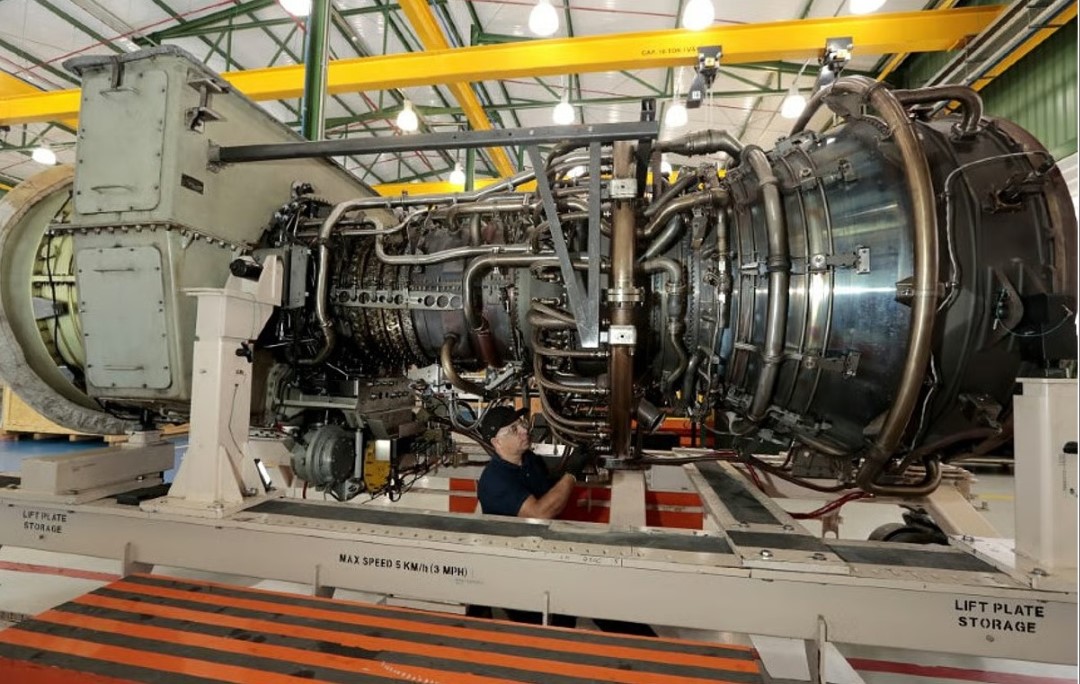
NEW DELHI : According to Report, the Defence Acquisition Council (DAC) has granted Acceptance of Necessity (AoN) for capital acquisition proposals worth ₹3.60 lakh crore, marking one of the largest modernization clearances in recent years. The approval includes procurement of 114 Rafale fighter aircraft under the Multi-Role Fighter Aircraft (MRFA) program and six additional P-8I maritime reconnaissance aircraft, alongside sanction for development of a 4 MW Marine Gas Turbine-based Electric Power Generator under the Make-I category of the Defence Acquisition Procedure (DAP) 2020.
The 4 MW marine gas turbine generator project is designed to establish an indigenous marine turbine ecosystem and reduce reliance on foreign suppliers for critical propulsion and shipboard power systems.
The 4 MW Marine Gas Turbine Program
The approved system falls within the 4-megawatt class of marine gas turbines used globally for high-performance naval applications. In international benchmarks, the General Electric LM500 marine gas turbine produces approximately 4.6 MW and is deployed on patrol vessels and as auxiliary power units on larger warships.
India’s naval fleet has historically depended on foreign-origin gas turbines and propulsion systems. The Indian Navy operates LM2500 turbines supplied by General Electric for several destroyers and aircraft carriers. Older platforms have used turbines from Zorya-Mashproekt of Ukraine, while diesel and mixed propulsion solutions have been sourced from Russian and British suppliers for smaller vessels.
The new 4 MW generator is intended primarily for shipboard electric power generation rather than main propulsion. The project has been categorized under Make-I of DAP 2020, under which the government funds up to 70 percent of prototype development costs, promoting indigenous design and development.
Technical Scope and Strategic Rationale
Defence officials consider the 4 MW class a technically manageable starting point for domestic turbine development. Smaller turbines operate at comparatively lower temperature and stress thresholds than 25 MW-class propulsion units, enabling industry to build capability in high-temperature metallurgy, precision casting, blade cooling technologies, and combustion systems.
The program will also require development of Full Authority Digital Engine Control (FADEC) systems and specialized marinization processes to protect turbines from salt-laden maritime environments. These competencies are essential for scaling toward larger 24–28 MW indigenous marine turbines currently under planning and evaluation.
Modern naval vessels increasingly depend on high-capacity onboard electric power for advanced systems such as Active Electronically Scanned Array (AESA) radars, electronic warfare suites, and integrated combat management systems. A compact 4 MW gas turbine generator provides high power density within limited shipboard space, supporting next-generation surface combatants.
Expected Naval Applications
The 4 MW marine gas turbine generator is expected to support several upcoming naval platforms. These include Next-Generation Missile Vessels (NGMV), which require high power-to-weight ratios for sustained high-speed operations. Advanced corvette programs may integrate the turbine either as a primary generator or alongside conventional diesel generators to meet increasing electrical load demands.
The system may also facilitate Integrated Electric Propulsion (IEP) architectures, enabling ships to operate on electric drive for efficiency during cruising while reserving higher-output systems for operational requirements.
Industry Participation and Recent Developments
The approval follows industry-level developments earlier this year. In February 2025, Triveni Engineering and Industries Limited signed a memorandum of understanding with Rolls-Royce Marine to collaborate on 4 MW marine gas turbine generators. The agreement reflects private-sector participation under the Make-I framework.
Under this category, the government funds a majority portion of prototype development, reducing financial exposure for participating firms while maintaining oversight of technology transfer and indigenous content requirements.
Financial Context Within the ₹3.6 Lakh Crore Package
Of the total ₹3.60 lakh crore AoN approvals, approximately ₹3.25 lakh crore has been linked to the Rafale MRFA procurement program. The acquisition of six additional P-8I maritime patrol aircraft will enhance long-range surveillance and anti-submarine warfare capabilities.
The inclusion of the 4 MW naval gas turbine program within this broader capital acquisition package reflects simultaneous emphasis on frontline combat platforms and core propulsion technologies.
Program Specifications
- Output: 4.0 Megawatts (MW)
- Category: Make-I (Indigenous Design and Development)
- Primary Application: Shipboard Electric Power Generation
- Strategic Objective: Reduction of dependency on foreign suppliers, including U.S. and Ukrainian turbine manufacturers
Implementation Timeline
Following the grant of Acceptance of Necessity (AoN), the project will move into the prototype development phase under the Make-I funding structure. Subsequent stages will include ground testing, sea trials, certification, and platform integration on designated naval vessels.
The development of a domestic 4 MW marine gas turbine generator is expected to build capabilities in turbine design, materials engineering, digital engine control systems, and naval systems integration, supporting future indigenous propulsion initiatives within India’s defence modernization framework.
——— End of Article ———