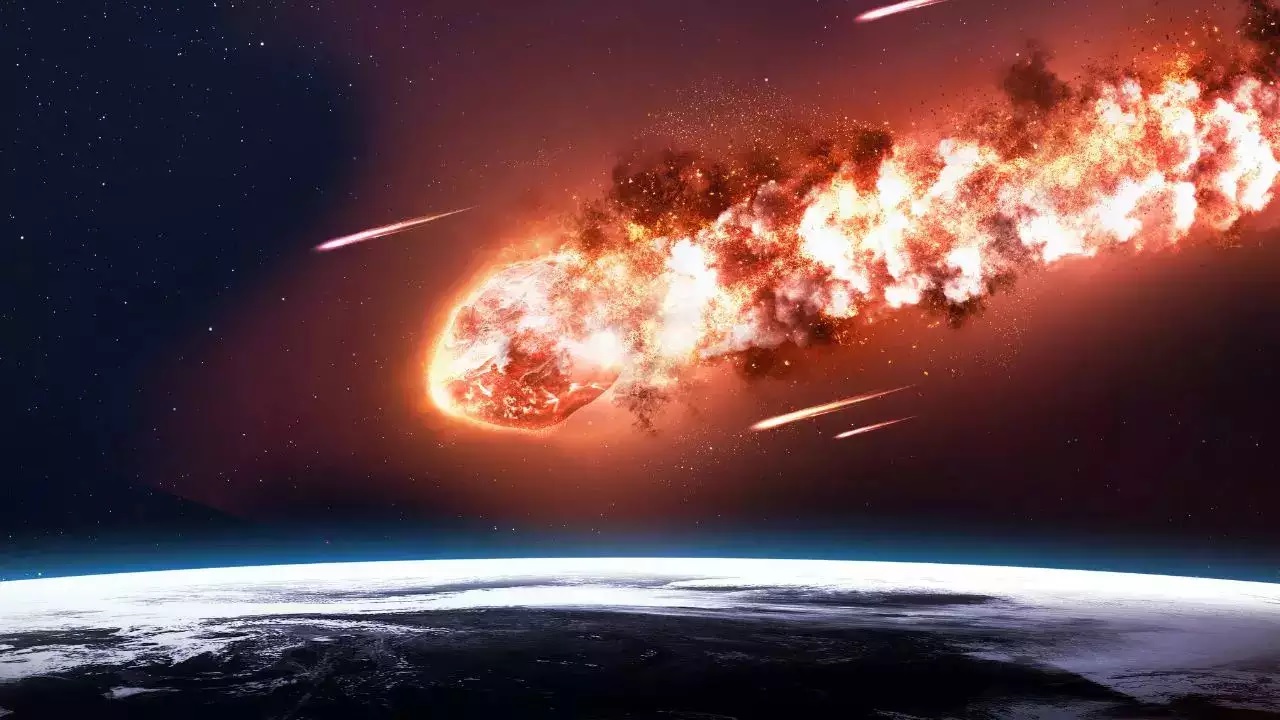
On April 13, 2029, Earth will witness an extraordinary celestial event — the close approach of asteroid Apophis, often referred to as the "God of Destruction." Named after the Egyptian deity Apep, associated with chaos, this asteroid has sparked both fascination and fear among scientists and space enthusiasts alike. Apophis, which is nearly as tall as the Empire State Building, will pass just 19,000 miles (30,600 kilometers) from Earth, a distance so small that it will be visible to the naked eye.
Though NASA has assured the world that Apophis poses no immediate threat of collision with Earth during this passage, new research introduces a chilling hypothetical: What if other smaller space rocks collide with Apophis, changing its trajectory? Such a scenario could turn this close encounter into a nightmare, increasing the chances of Apophis hitting Earth in the future.
The Risk of Collisions in Space
Research led by astronomer Paul Wiegert from the University of Western Ontario raises an intriguing possibility — small space objects, like meteors, could strike Apophis, potentially redirecting its path. Apophis will be largely unobservable from now until 2027, due to its position in the daytime sky, making it impossible for astronomers to monitor its course during this period. If a smaller asteroid collides with Apophis when no one is watching, it could shift the asteroid's trajectory enough to turn a near-miss into a direct hit on a future passage.
Wiegert explains that while such a collision is extremely unlikely, it’s not impossible. In his calculations, a small asteroid about 60 centimeters (24 inches) in diameter could shift Apophis onto a post-2029 collision course. Larger asteroids, about 3 meters (10 feet) wide, would have a more substantial effect, potentially leading to a direct impact during Apophis' 2029 flyby. Still, the odds of this happening are astronomically low, with estimates putting the chances of such a scenario at about 1 in a million for post-2029 impacts and an even slimmer 1 in 2 billion for a 2029 collision.
Potential Devastation of an Apophis Impact
While the likelihood of Apophis striking Earth remains low, the consequences of such an event would be catastrophic. Estimates suggest that an Apophis impact could release energy equivalent to 1,000 megatons of TNT, far exceeding the power of any nuclear weapon ever detonated. The devastation would stretch over hundreds of miles, with millions of lives at risk if the asteroid were to hit a densely populated area.
Although this wouldn’t compare to the extinction-level event caused by the asteroid that wiped out the dinosaurs, the damage to human infrastructure, ecosystems, and the global economy would be beyond imagination.
Deflection Strategies and Future Monitoring
The good news is that space agencies are actively exploring ways to prevent such a disaster. NASA’s Double Asteroid Redirection Test (DART), which successfully altered the orbit of the asteroid Dimorphos in 2022, demonstrates that human intervention could redirect a threatening asteroid. If necessary, a similar mission could be deployed to nudge Apophis off a collision course. However, the exact logistics of deflecting an asteroid the size of Apophis are still being worked out.
Other proposed deflection methods include using nuclear weapons to alter Apophis' course or even more unconventional strategies like painting one side of the asteroid black to increase solar radiation absorption, subtly shifting its trajectory.
A Global Milestone in Space Defense
Even if Apophis poses no immediate danger in 2029, its close approach will offer scientists a unique opportunity to study a large asteroid up close. Spacecraft and satellites are being prepared to rendezvous with Apophis during its near-Earth pass, gathering crucial data that could help refine planetary defense strategies for the future.
As Wiegert points out, Apophis' approach marks a significant milestone for humanity. We now have the technology to anticipate and potentially prevent catastrophic asteroid impacts, something that was impossible in the past. The upcoming passage of Apophis will not only serve as a scientific event but also as a reminder that the global community must continue to develop robust strategies for planetary defense.
In the end, while Apophis may not live up to its apocalyptic name in 2029, its visit will offer an invaluable learning experience that could one day save the planet from a more serious threat.
——— End of Article ———