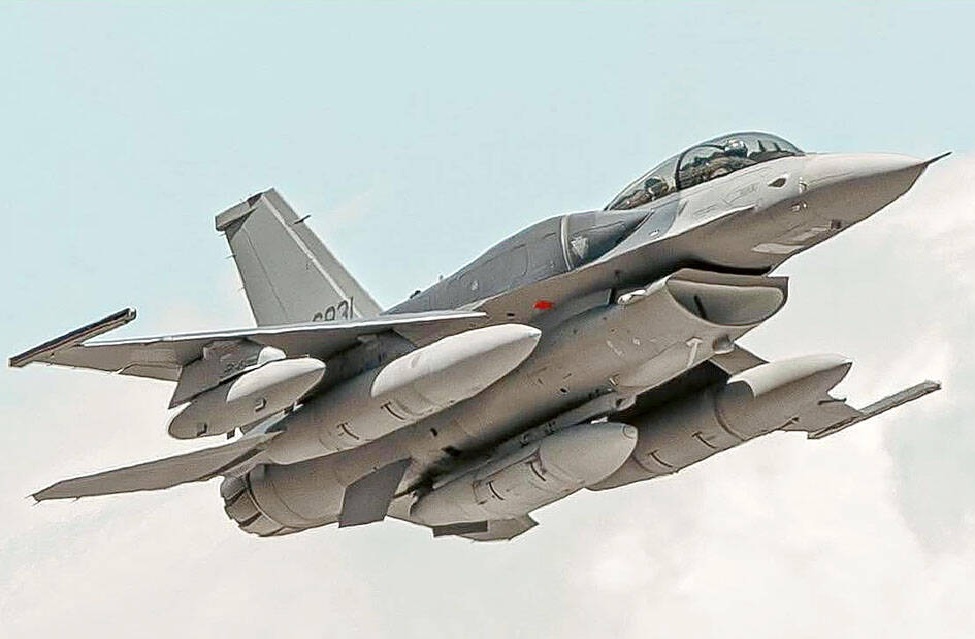
Fort Worth, Texas, — June 16, 2026 : The first F-16D Block 70 fighter aircraft built for the Republic of China (Taiwan) Air Force has been observed conducting pre-delivery test flights near Naval Air Station Joint Reserve Base Fort Worth, Texas. The aircraft, carrying tail number 6831, was seen equipped with an extensive fuel configuration consisting of two conformal fuel tanks (CFTs) mounted along the upper fuselage and three external drop tanks under the wings and fuselage.
The sighting provides an early look at how Taiwan’s new-generation F-16 Block 70 fighters will be configured to support long-range operations. The aircraft's fuel arrangement reflects the increasing importance of extended endurance and operational reach, particularly for missions across the Indo-Pacific region.
Maximum Fuel Configuration
The aircraft was fitted with a total of five external fuel tanks, including two conformal fuel tanks and three conventional drop tanks. Combined with the F-16’s internal fuel capacity, the configuration significantly increases the aircraft’s operational range.
| Fuel Source | Capacity / Weight |
|---|---|
| Internal Fuel | Approximately 3,248 kg |
| Conformal Fuel Tanks (2) | 1,703 liters additional fuel |
| External Drop Tanks (3) | Approximately 4,595 kg |
| Total Fuel Load | Approximately 7,844 kg |
Analysts estimate that with this configuration, the F-16 Block 70 can achieve a range of approximately 2,200 nautical miles (4,100 kilometers). Such endurance would support long-distance ferry flights and extended patrol missions. The aircraft is expected to undertake a trans-Pacific delivery flight to Hualien Air Base in Taiwan with aerial refueling support.
Development of Conformal Fuel Tanks
While external drop tanks have long been used on F-16 fighters, conformal fuel tanks represent a more recent enhancement designed to increase range without occupying underwing weapon stations.
The concept was first tested in 1994 as part of the proposed F-16ES (Enhanced Strategic) program. Lockheed Martin later formalized the design in 2002. The first operational F-16s equipped with conformal fuel tanks were the F-16E/F Block 60 aircraft delivered to the United Arab Emirates in 2004.
Since then, the system has been adopted or offered on advanced export variants operated by countries including Israel, Greece, Poland and Singapore. The Block 70/72 series is designed to accommodate conformal fuel tanks as an optional capability.
Operational Advantages and Limitations
Conformal fuel tanks increase aircraft endurance while preserving underwing hardpoints for weapons, sensors and electronic warfare equipment. Compared with conventional drop tanks, they generate less aerodynamic drag during subsonic flight and allow aircraft to carry a full combat load while maintaining extended range.
However, the system also introduces operational trade-offs. Unlike drop tanks, conformal fuel tanks cannot be jettisoned during flight. Their permanent structural weight increases aircraft inertia and can reduce acceleration, climb performance and sustained turning capability. Additionally, conformal fuel tanks generate greater aerodynamic drag during supersonic flight than a clean aircraft configuration.
Taiwan’s F-16 Block 70 Program
Taiwan signed a contract in 2019 for the purchase of 66 F-16C/D Block 70 fighters valued at approximately $8.2 billion. The program has experienced manufacturing and software integration delays, resulting in deliveries extending beyond the original 2026 target schedule.
Once delivered, the new aircraft are expected to be based at Chihhang Air Base in Taitung, where they will operate alongside Taiwan’s upgraded F-16V fleet. The Block 70 variant features advanced avionics, the AN/APG-83 Active Electronically Scanned Array (AESA) radar, a modernized cockpit and enhanced mission systems.
The extensive fuel configuration observed during testing highlights Taiwan’s focus on maximizing the operational reach of its future fighter fleet. Increased endurance will support longer patrol missions and sustained air operations over the Taiwan Strait and surrounding areas.
The sighting of tail number 6831 marks another step in the delivery process for Taiwan’s newest fighter aircraft as final testing continues ahead of its transfer to the Republic of China Air Force.
——— End of Article ———