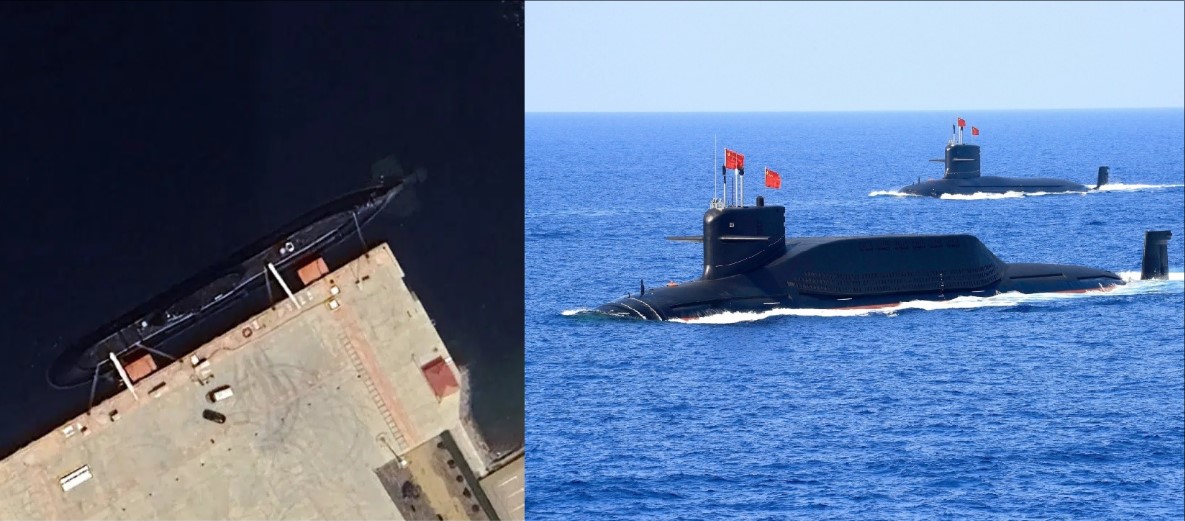
HULUDAO, China : Satellite imagery captured in early February 2026 confirms the rollout of China’s first Type 09V nuclear-powered attack submarine (SSN), also designated Type 095, at Bohai Shipbuilding Heavy Industry in Huludao. The vessel was observed in a flooded drydock before being moved toward the launch bay, marking a transition from the iterative Type 09III “Shang”-class lineage to a new baseline design.
Initial lower-resolution Sentinel-2 L2A imagery dated February 9 indicated the submarine could have been another Type 09IIIB (093B) guided-missile nuclear submarine (SSGN). Since 2022, Bohai has launched an estimated seven to eight Type 09IIIB hulls for the People’s Liberation Army Navy (PLAN). However, higher-resolution Synthetic Aperture Radar (SAR) imagery dated February 11 revealed structural characteristics that distinguish the new platform from earlier Type 09III-family boats.
Commercially available imagery shows the submarine positioned in a flooded drydock awaiting relocation to a fitting-out pier. High-resolution optical imagery has not been publicly released, and several technical aspects remain preliminary assessments based on observable external features.
Dimensions and Hull Configuration
The Type 09V measures approximately 110–115 meters in length, comparable to earlier Type 09III submarines. The principal change lies in the increased beam, estimated at 12–13 meters, compared to the narrower hulls of previous Shang-class variants. Based on these dimensions, analysts estimate a submerged displacement between 9,000 and 10,000 tons, a notable increase over the approximately 7,000-ton displacement of the Type 09III family.
The broader beam indicates expanded internal volume, potentially accommodating updated propulsion systems, combat systems, and missile launch capacity. The hull displays a high waterline with visible red-painted lower sections, suggesting reduced reserve buoyancy compared to earlier Chinese submarine designs. This has led to assessments that the Type 09V may adopt a single-hull configuration, departing from the double-hull arrangement used on all previous PLAN submarines, both nuclear and conventional.
Single-hull construction can increase internal space efficiency and reduce structural complexity but requires more refined hydrodynamic shaping. Whether the Type 09V employs a fully single-hull or hybrid configuration remains unconfirmed.
Stern Design and Control Surfaces
A prominent design departure is the introduction of an X-form stern control arrangement. The submarine features large control surfaces arranged in an X-tail configuration, marking the first known use of this arrangement on a Chinese nuclear-powered submarine. Previous PLAN nuclear submarines used conventional cruciform stern layouts.
The X-tail configuration is associated with improved maneuverability and potential acoustic management benefits, particularly during low-speed operations. A similar configuration was observed on a smaller submarine under construction at Wuchang Shipbuilding in Wuhan in 2024, informally referred to in Western analysis as the “Type 041” or “Zhou-class.”
No forward dive planes are visible on the sail structure in available imagery. The absence of sail-mounted control surfaces suggests likely use of retractable hull-mounted dive planes, differing from the fairwater planes used on earlier Chinese nuclear and conventional submarines, except for imported Russian Kilo-class boats. Retractable hull-mounted planes are standard on several Western SSNs and reduce hydrodynamic resistance when retracted.
Vertical Launch System (VLS) and Combat Systems
Imagery reveals an unfinished open compartment behind the sail, assessed as a probable vertical launch system (VLS) module intended for anti-ship missiles (AShM) and land-attack cruise missiles (LACM). The precise configuration is not yet visible. The arrangement may resemble the Type 09IIIB SSGN, reported to carry 18 vertical launch cells in a three-abreast configuration.
An alternative interpretation is that the open section relates to reactor compartment work. Until fitting-out advances, the exact cell count and missile loadout remain unconfirmed.
Details concerning torpedo tube arrangement, sonar arrays, electronic warfare systems, and combat management systems are not discernible from available imagery. These elements are expected to become clearer during later fitting-out and sea trial phases.
Propulsion System
The available SAR imagery does not clearly reveal the propulsion unit. However, the Type 09V is assessed to almost certainly utilize pump-jet propulsion rather than a traditional skewback propeller. Pump-jet systems reduce acoustic signature at higher speeds and align with contemporary SSN design practices.
China previously tested pump-jet technology on the Type 032 test submarine at Xiaopingdao, supporting development of both the Type 09IIIB and Type 09V programs. Adoption of pump-jet propulsion would indicate continued emphasis on noise reduction and sustained submerged performance.
Shipyard Expansion and Production Capacity
Bohai Shipbuilding Heavy Industry has expanded significantly since 2022, including larger construction halls, upgraded drydock facilities, and expanded fitting-out infrastructure. The yard constructs both nuclear-powered attack submarines (SSNs) and ballistic missile submarines (SSBNs) for the PLAN.
The movement of the first Type 09V hull into the launch bay and entry into the fitting-out stage indicates that the program has advanced beyond prototype fabrication. Bohai’s expanded facilities suggest potential for serial production once trials and validation processes are completed.
Connection to Type 09VI (Type 096)
The wider beam and revised hull architecture of the Type 09V are assessed to provide a potential foundation for China’s next-generation Type 09VI (Type 096) ballistic missile submarine. The new hull baseline could support a larger missile compartment and improved acoustic performance for future SSBN development.
Design commonality between SSN and SSBN platforms may reduce development timelines and streamline production processes.
Regional Considerations
The emergence of the Type 09V underscores continued modernization of the PLAN’s nuclear submarine fleet. The combination of increased displacement, revised hull architecture, pump-jet propulsion, X-tail controls, and potential VLS integration reflects a shift from incremental upgrades toward a redesigned attack submarine platform.
Regional naval planners are expected to factor the new class into long-term undersea capability assessments. Australia continues to pursue a nuclear-powered submarine capability under the AUKUS agreement, while Japan and South Korea have debated nuclear propulsion options and expanded anti-submarine warfare (ASW) investments. States not operating nuclear submarines are likely to enhance conventional submarine fleets and maritime patrol capabilities.
With the Type 09V entering the fitting-out stage at Huludao, the PLAN is positioned to expand and modernize its SSN fleet over the coming decade. Further information regarding performance characteristics, armament configuration, and operational timelines is expected to emerge during sea trials and subsequent production phases.
——— End of Article ———