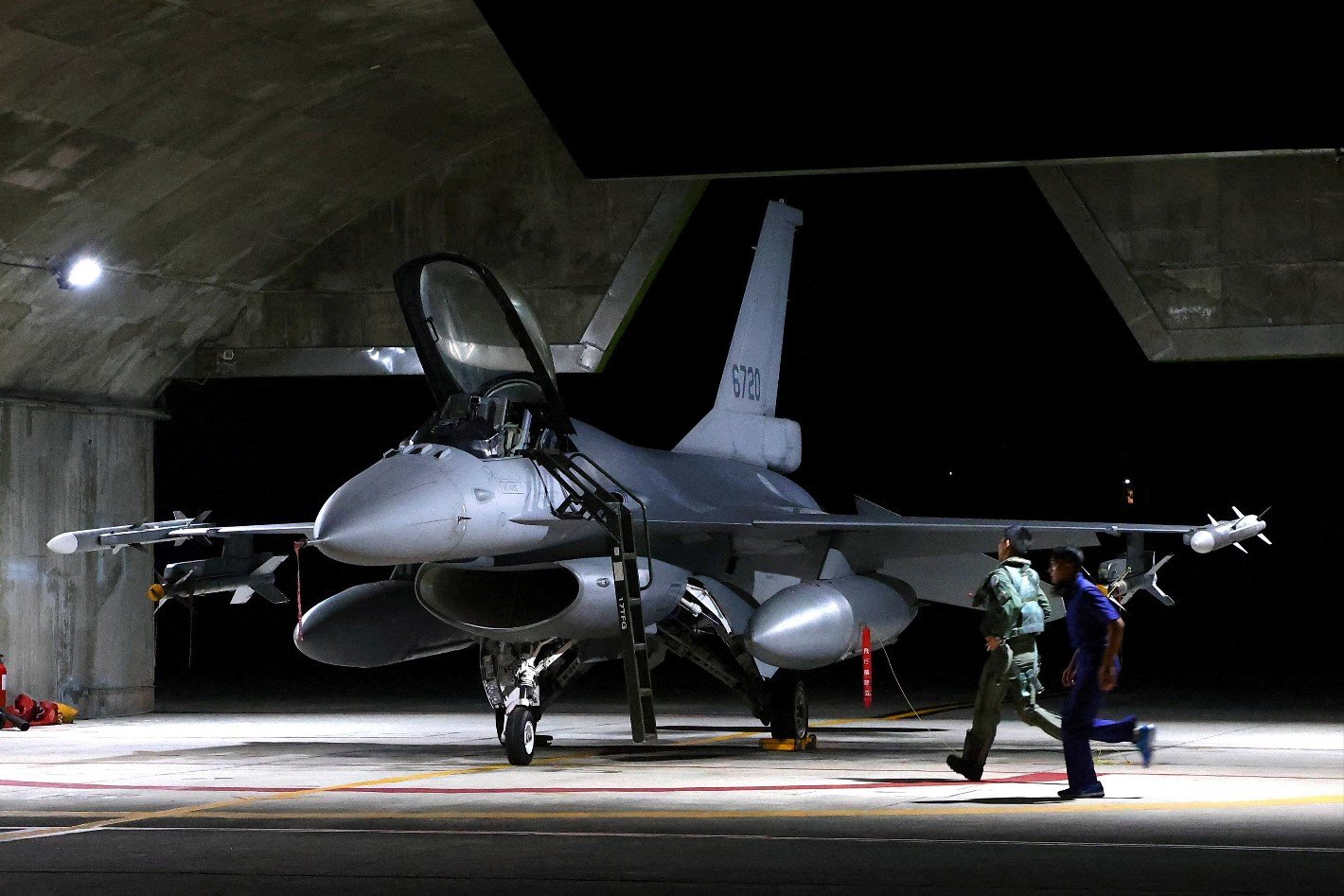
Chinese state broadcaster CCTV has published details suggesting the Shenyang J-35 carrier-capable stealth fighter can carry as many as 12 air-to-air weapons in some configurations — reportedly including at least six PL-15 long-range missiles, two PL-10 short-range missiles, and four CM-98 standoff/stealth cruise weapons. The CCTV piece and subsequent reporting present this as a mixed internal-and-external loadout rather than all-internal carriage.
The J-35’s internal bay design is generally described in open sources as able to accommodate six medium/long-range missiles (for example, PL-10/PL-15 family missiles) in stealthy internal carriage; additional stores such as cruise missiles or further missiles are normally carried externally on hardpoints when stealth is not the priority. Open reporting therefore treats the “12-weapon” figure as a total loadout (internal + external) rather than a purely internal stealth load.
The PL-15 is widely reported as China’s primary beyond-visual-range (BVR) missile and is the long-range component in these counts. Publicly available sources estimate the PL-15’s maximum launch/intercept envelope in the hundreds of kilometres (commonly cited figures are in the ~200–300+ km class for the domestic variants), and export variants are reported with reduced range. The PL-15 also exists in folding-fin versions intended for internal carriage in stealth fighters.
The short-range PL-10 is described in multiple open sources as a modern Chinese short-range infrared-guided missile with lock-on-after-launch and imaging IR seeker characteristics; public specifications commonly put its effective engagement range in the order of ~30 km against airborne targets.
The CM-98 (sometimes reported as CM-102/CM-98 family depending on reporting) is a Chinese air-launched cruise/standoff weapon that Chinese media and trade reporting place at roughly a ~200–300 km standoff range, designed for strikes at stand-off distances and intended to give carrier fighters greater strike reach when stealth can be partially traded off for range.
How that compares with the U.S. F-22 and Russia’s Su-57
• F-22 Raptor (U.S.) — internal stealth loadout: The official U.S. Air Force fact sheet notes the F-22’s standard air-to-air stealth configuration carries six AIM-120 AMRAAMs (BVR) internally and two AIM-9 Sidewinders (short-range) — six medium-range and two short-range in its internal bays. The F-22 can carry four additional missiles externally on hardpoints when stealth is not required, but doing so degrades low observability.
• Su-57 (Russia) — internal carriage profile: Open-source descriptions of the Su-57 show four beyond-visual-range missiles in the two main internal bays (two per bay) and two short-range missiles in side bays, for a typical internal air-to-air loadout of four BVR + two short-range. The Su-57 also has Six external hardpoints for larger loads when stealth is not the priority.
In short, the commonly cited internal-weapons counts put the F-22 at six BVR + two short-range internally, the Su-57 at four BVR + two short-range internally, and the J-35 at about six missiles internally (by many accounts), with CCTV and related reporting describing total (internal+external) mission loads that can be higher — hence the figure of up to 12 in some mission profiles.
Operational and design implications
There are a few practical tradeoffs behind these numbers:
-
Stealth vs payload: Modern stealth fighters are designed to carry their primary air-to-air load internally for radar cross-section reduction. External carriage increases overall missile count but reduces stealth and thereby changes tactics and survivability. The J-35’s reported 12-weapon figure implies mission flexibility: internal stealthy loads for high-survivability intercepts and larger external loads for non-stealth strike or patrol missions.
-
Missile types and roles: PL-15s are long-reach BVR interceptors; PL-10s are short-range dogfight missiles; CM-98 cruise weapons are standoff strike missiles rather than pure air-to-air arms. Mixing these types gives a single aircraft the ability to conduct air dominance, short-range engagements, and standoff strike missions depending on loadout choice.
-
Folding-fin/quad-pack trends: Several Chinese missiles have folding-fin variants to better fit inside internal bays; this is similar to Western approaches (e.g., quad-pack adapters for smaller missiles). Such measures affect how many missiles a bay can carry without changing bay geometry.
Notes on open reporting and verification
Public reporting about modern combat aircraft and weapons frequently mixes official statements, state media claims, imagery analysis, and industry reporting. The CCTV report and subsequent articles summarize what Chinese state media and analysts are saying about the J-35’s design and mission flexibility, but independent technical verification of exact internal bay geometry, operational doctrine, and missile-specific performance is limited in open sources. Differences between internal stealth-preserving loads and maximum total loads with external pylons are important to distinguish when comparing aircraft.
CCTV’s reporting that the J-35 can carry up to 12 air-to-air/standoff weapons appears to describe a mixed internal-and-external loadout that prioritises mission flexibility. When compared on internal stealthy carriage alone, the F-22’s internal air-to-air loadout (six AMRAAMs + two Sidewinders) remains among the highest, while the Su-57 is typically characterized with four BVR + two short-range missiles internally. The J-35 — as reported — aligns with other stealth designs in keeping most air-to-air missiles internally (commonly around six) but can carry additional weapons externally when stealth is less critical.
——— End of Article ———