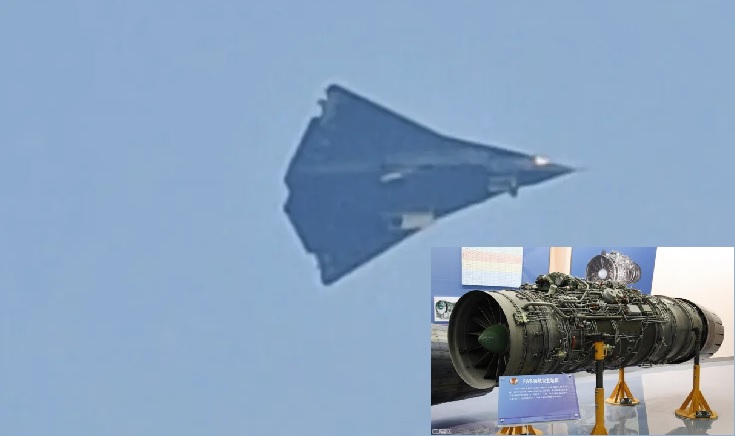
China’s aviation industry has long been striving to secure its place as a leader in advanced military aircraft technology. The J-36, touted as a sixth-generation fighter, is the latest addition to this ambitious pursuit. However, the platform's reliance on the WS-10C engines has raised critical questions about its capabilities, particularly in achieving true stealth and operational superiority.
The J-36: Specifications and Design Features
The J-36 incorporates many hallmarks of sixth-generation fighter technology, aimed at surpassing fifth-generation aircraft like the F-22 and Su-57. These features include:
- Advanced Avionics: Equipped with next-generation sensors and data fusion capabilities, the J-36 is designed to operate seamlessly in network-centric warfare.
- Stealth-Oriented Design: The aircraft features a sleek airframe with a focus on reduced radar cross-section (RCS). Its angular lines, internal weapon bays, and radar-absorbent materials aim to lower detectability.
- Three-Engine Configuration: The J-36 is powered by three WS-10C engines, intended to provide increased thrust and redundancy in combat scenarios.
- AI and Autonomous Systems: The aircraft reportedly integrates artificial intelligence for decision support and potentially autonomous combat operations.
WS-10C Engines: A Double-Edged Sword
The WS-10C engines, despite being an improved iteration of the WS-10 family, represent a critical bottleneck in the J-36’s performance and stealth capabilities.
1. Stealth Limitations
True stealth depends heavily on controlling heat signatures and minimizing radar reflections. The WS-10C engines, which lack advanced thrust-vectoring nozzles and sufficient heat-dissipation technologies, present challenges:
- Higher Infrared Signature: The engines generate significant heat, making the aircraft more vulnerable to detection by infrared search and track (IRST) systems.
- Nozzle Design: The lack of serrated or stealth-optimized nozzles contributes to radar reflections, undermining the aircraft's RCS.
- Exhaust Management: Without advanced exhaust cooling, the J-36 struggles to achieve thermal stealth, a critical factor in modern aerial combat.
2. Thrust and Efficiency Issues
The WS-10C engines are also limited in terms of thrust-to-weight ratio and fuel efficiency:
- Limited Supercruise: The engines fall short in delivering sustained supersonic flight without afterburners, a key sixth-generation requirement.
- Higher Fuel Consumption: Inefficient fuel burn reduces operational range and loiter time, constraining mission flexibility.
Operational Implications
The shortcomings of the WS-10C engines ripple through the J-36’s operational effectiveness:
- Compromised Survivability: Higher detectability reduces survivability in contested airspace, particularly against advanced adversaries with IRST and integrated air defense systems.
- Reduced Mission Scope: Limited range and endurance affect the J-36's ability to perform extended patrols or deep-penetration missions.
- Increased Dependence on Force Multipliers: The aircraft may rely heavily on aerial refueling and support systems to compensate for its deficiencies.
Comparative Analysis
When compared to other emerging sixth-generation platforms like the U.S. NGAD or the European FCAS, the J-36 shows promise in certain areas but lags in critical metrics:
- Stealth: The NGAD and FCAS incorporate advanced engine designs and thermal management systems, ensuring true stealth capabilities.
- Engine Performance: Competing platforms utilize next-generation engines with superior thrust-to-weight ratios and integrated features like variable cycle technology.
China’s Path Forward
The J-36 represents an important step in China’s military modernization efforts, but overcoming its engine-related limitations is essential. Efforts to develop the WS-15 engine, a more advanced powerplant with higher thrust and stealth optimization, may provide a solution. However, integrating such engines remains years away, leaving the J-36 as an interim platform with significant constraints.
Conclusion
China’s J-36 reflects its growing ambitions in aerospace technology but also highlights the challenges of achieving true sixth-generation capabilities. While the aircraft boasts advanced avionics and network-centric features, its reliance on the WS-10C engines exposes vulnerabilities that limit its effectiveness in stealth and high-performance operations. As China continues to address these challenges, the J-36 serves as a testament to the complexity of modern fighter development and the critical role of propulsion systems in defining aerial supremacy.
——— End of Article ———