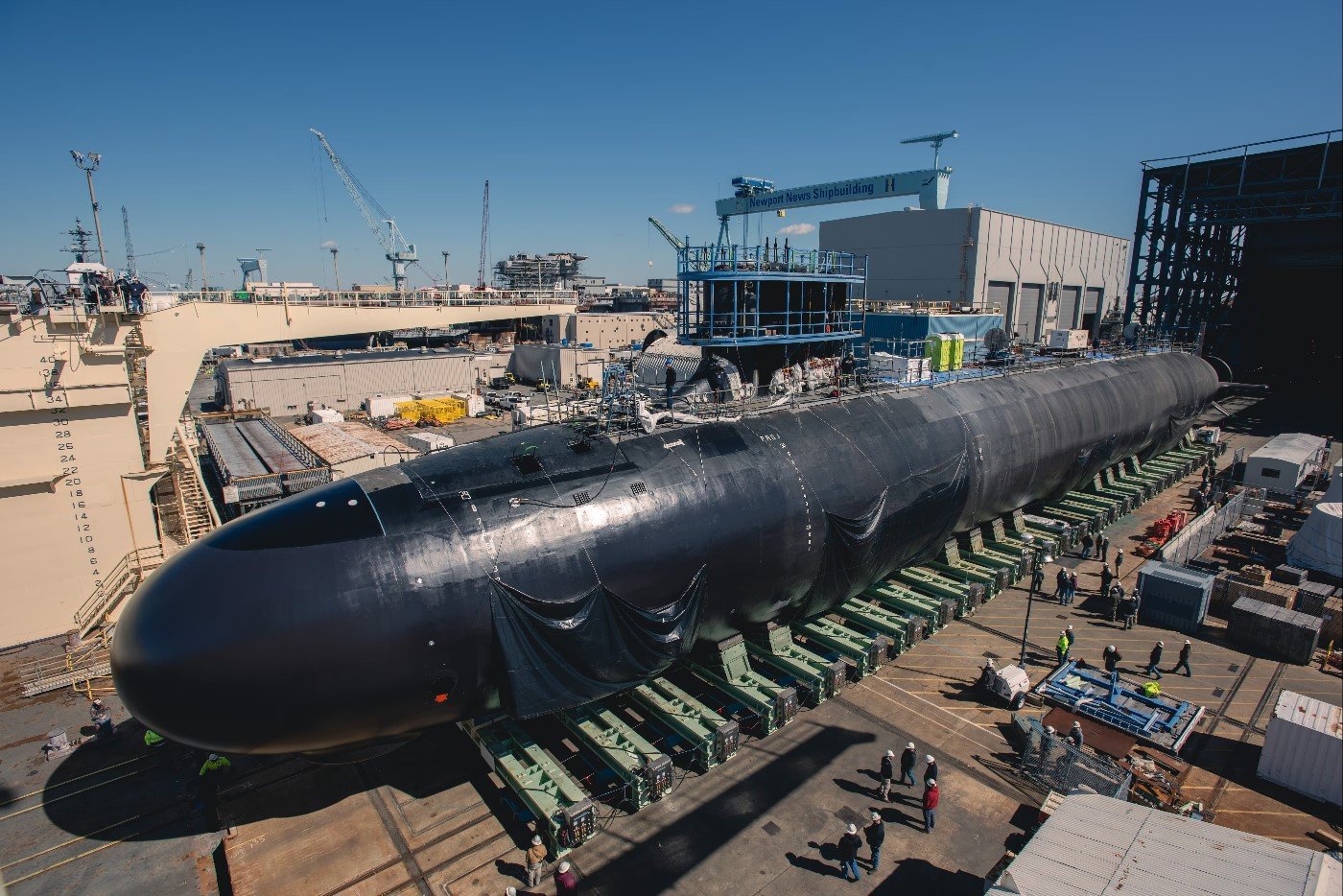
WASHINGTON — The U.S. Navy is implementing a four-pillar strategy to increase submarine production and reach its planned “1+2” production rate of one Columbia-class nuclear-powered ballistic missile submarine (SSBN) and two Virginia-class nuclear-powered attack submarines (SSNs) each year.
Vice Adm. Robert “Rob” Gaucher, the Navy’s Director of Submarine Programs, outlined the strategy at the Combined Naval Event 2026 (CNE26) in the United Kingdom. Gaucher, who also serves as the Direct Reporting Portfolio Manager for Submarines and Program Acquisition Executive for Undersea Warfare, is often referred to as the Navy’s “sub tsar.”
Chief of Naval Operations Adm. Daryl Caudle said in May that the Navy expects to reach the higher production rate around 2032. The Navy’s May 11 shipbuilding plan identified the 1+2 rate as its top industrial-base priority.
Gaucher is pursuing a faster timeline, targeting delivery of the lead Columbia-class submarine, USS District of Columbia (SSBN-826), in 2028, one Columbia per year by 2030 and two Virginia-class submarines per year by 2031.
The submarine programs rely mainly on General Dynamics Electric Boat in Groton, Connecticut, and Huntington Ingalls Industries’ Newport News Shipbuilding in Newport News, Virginia. The Navy plans to build 12 Columbia-class submarines, while the Virginia class has a planned total of 70 boats, with 44 additional submarines currently being built or planned.
Because both classes use the same shipyards, workforce and facilities, Gaucher said they cannot be managed separately. “You can’t look at Virginia and Columbia in a vacuum because you’re sharing workforce, it’s the same shipyard, you’re sharing footprint,” he said.
Four Pillars of the Strategy
1. Locking in submarine designs
Gaucher has ordered a “pencils down” approach for Virginia-class design changes. Changes will generally be allowed only when required for safety or critical operational needs, such as a major acoustic-signature problem. Major modifications or new equipment require his approval, while routine construction adjustments remain delegated to working-level personnel. The approach is particularly important during the transition between the later Virginia-class variants, Blocks VII and VIII.
2. Focusing the main shipyards on major work
Electric Boat and Newport News are being encouraged to focus on module outfitting, hull assembly and final testing. More component assembly is to be moved outside the two main shipyards so that major modules can arrive more fully outfitted and ready for integration.
3. Expanding the wider industrial base
The Navy is also expanding its supplier network to increase capacity and reduce pressure on the two prime shipyards. Gaucher highlighted Rhoads Industries in Pennsylvania, Austal USA in Alabama and BAE Systems in Jacksonville.
Rhoads Industries has a long-term agreement with Electric Boat valued at about $2.5 billion, covering steel fabrication, structural assembly and outfitting through 2035. Austal has also expanded its Mobile, Alabama, facilities to support production and outfitting of command-and-control modules and other sections for Virginia- and Columbia-class submarines.
4. Designing SSN-X for producibility
The fourth pillar focuses on the future SSN-X attack submarine. The Navy is considering how to balance combat capability with the time, cost and complexity required to build each submarine.
Gaucher said that, at a certain point, having two submarines with fewer additional features could be preferable to spending significantly more time and money on one submarine with additional capability.
Gaucher has said his immediate focus is on the second and third pillars—improving production at the main shipyards and expanding the wider industrial base. The Navy is also working on workforce growth, supply-chain resilience and advanced manufacturing methods, including additive manufacturing.
The scale of the challenge is illustrated by Virginia-class production. Earlier boats required roughly 13 million man-hours, while more recent Block IV and Block V submarines require about 70 million man-hours.
The four-pillar strategy is intended to address these industrial constraints and help the Navy move toward its target of producing one Columbia-class and two Virginia-class submarines annually.
——— End of Article ———