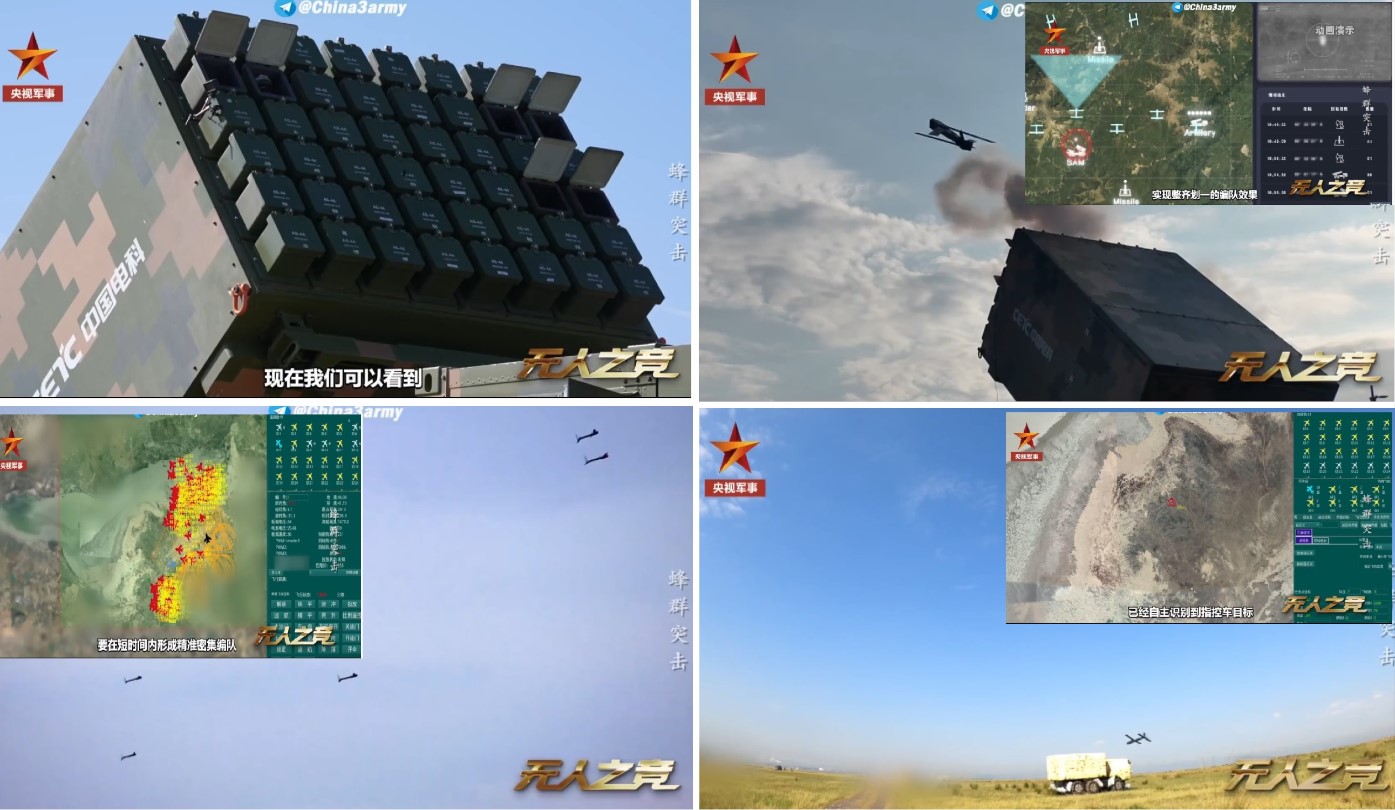
BEIJING, — March 25, 2026 : Chinese state media has released the first full-process demonstration of the domestically developed “Atlas” drone swarm operations system, providing a detailed view of how coordinated unmanned formations are being integrated into a single, software-driven combat architecture.
The demonstration, aired on March 25 through outlets including CCTV’s military channel and the Global Times, presented a complete operational sequence linking target identification, launcher activation, drone deployment, and precision strike execution. The system—described in some reports as a “steel swarm”—highlights China’s focus on algorithm-enabled warfare, where centralized software systems manage large numbers of autonomous platforms with minimal human intervention.
Integrated System Architecture
The Atlas system is structured as a modular, scalable complex designed for coordinated swarm deployment. Footage from the demonstration indicates links to the China Electronics Technology Group Corporation (CETC), whose branding appeared on the launch platform.
The system consists of three primary components. The Swarm-2 ground combat vehicle serves as the launch platform, equipped with a detachable launcher capable of carrying and deploying up to 48 fixed-wing drones, identified in reports as ATLUSS-A140 barrage munitions. This vehicle was first publicly displayed at Airshow China 2024 in Zhuhai.
A centralized command vehicle forms the operational core of the system, enabling a single operator to supervise and manage up to 96 drones simultaneously. Rather than controlling individual units, the operator assigns mission parameters, while onboard algorithms handle execution, including navigation, coordination, and engagement decisions.
Supporting these elements is a transport and loading vehicle, which carries additional combat-ready launchers and enables rapid reloading and redeployment of the system in field conditions.
Demonstration of the Operational Sequence
The March 2026 test focused on presenting a complete “kill chain” within a unified system. In the demonstration scenario, three visually similar targets were placed within the strike area, requiring the swarm to autonomously identify and engage the designated objective.
The sequence began with launcher activation and drone deployment. UAVs were launched at fixed three-second intervals to ensure safe separation and stable flight paths. Following deployment, the swarm conducted autonomous reconnaissance using onboard electro-optical sensors, distinguishing the intended command vehicle from decoys without direct human input.
Once the target was identified, the drones established a mid-air target lock and executed a coordinated precision strike. Throughout the process, the swarm maintained real-time communication, sharing data and adjusting formation spacing to account for environmental factors such as airflow disturbances. The system also demonstrated resilience, with algorithms enabling surviving drones to reorganize and continue the mission if some units were lost.
This approach reflects a compressed operational cycle, shifting from the traditional “detected → reported → coordinated → struck” sequence to a streamlined “detected → algorithm → struck” model.
Autonomous Coordination and Control
Chinese reports describe the swarm-control system as providing each drone with a “smart brain,” enabling distributed decision-making within a centrally guided framework. The drones are capable of real-time data exchange, cooperative targeting, and collision avoidance, allowing nearly 100 high-speed units to operate in dense formations.
The Atlas system reduces the human role to mission-level supervision. The operator defines objectives and constraints, while algorithms manage task allocation, route planning, target discrimination, and engagement. This structure is intended to address the limitations of human operators in managing large numbers of simultaneous platforms.
Payload Flexibility and Layered Deployment
The ATLUSS-A140 drones are designed as multi-role platforms capable of carrying a range of payloads, including electro-optical reconnaissance systems, electronic warfare modules, communications relay equipment, and kinetic strike munitions. This flexibility allows the Atlas system to adapt to different mission profiles.
The demonstration highlighted a layered deployment concept. In a typical configuration, reconnaissance drones are launched first to gather intelligence and establish situational awareness. These may be followed by electronic warfare units tasked with suppressing or disrupting enemy radar and communication systems. Strike drones are then deployed to engage identified targets.
The order, composition, and timing of these deployments can be adjusted dynamically depending on operational requirements, enabling the system to perform reconnaissance, suppression, or direct attack missions using the same platform.
Saturation and Penetration Capabilities
Analysts cited in Chinese media emphasize the system’s potential for saturation attacks against air defense networks. By deploying large numbers of drones in coordinated waves from multiple directions, the Atlas system is designed to exceed the tracking and interception capacity of conventional air defense systems.
In addition to saturation tactics, the drones’ ability to loiter over target areas provides persistent surveillance and engagement flexibility. Unlike ballistic or cruise missiles, which follow fixed trajectories, the swarm can adapt to changing conditions, track mobile targets, and delay engagement until optimal conditions are achieved.
The drones are also designed for low-altitude, low-speed flight with relatively small radar cross-sections, which may reduce detectability and enable operations deeper within contested environments.
Role of Artificial Intelligence and System Development
Chinese military analysts, including commentary cited by Global Times, attribute the system’s capabilities to advances in artificial intelligence and large-model algorithms. These technologies enable autonomous target recognition, distributed task execution, and adaptive behavior in complex and dynamic environments.
The Atlas system is presented as a flexible combat architecture rather than a single-purpose weapon, integrating multiple drone types and roles within a unified command framework. The emphasis on software-driven coordination reflects broader trends in unmanned systems development observed in recent Chinese demonstrations, including larger-scale swarm control tests earlier in 2026.
The March 25 demonstration focused on validating the integrated operational process rather than introducing new hardware components. The system remains under development and testing, and no official timeline for operational deployment has been disclosed.
——— End of Article ———