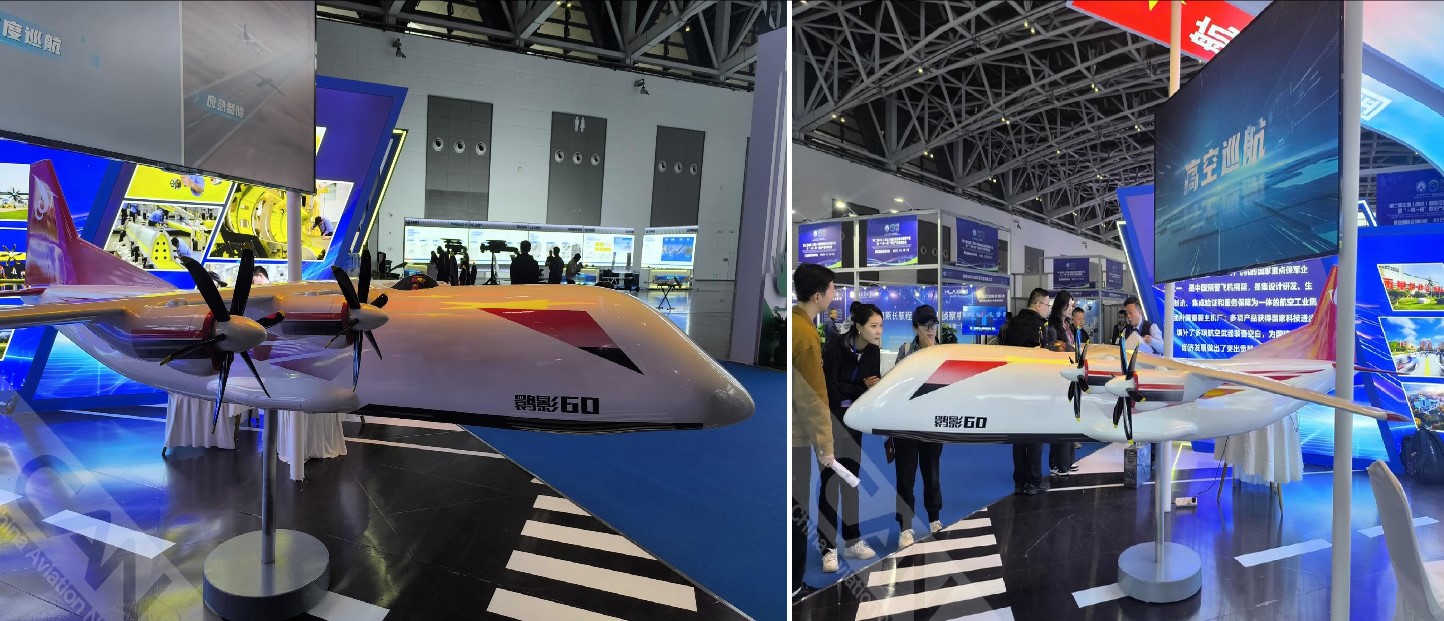
At the 7th China Helicopter Exposition held in Tianjin in October 2025, China introduced a groundbreaking concept: the Ibis Shadow 60, an unmanned cargo aircraft poised to become the world's largest of its kind. This ambitious project underscores China’s commitment to revolutionizing logistics and tactical airlift capabilities through unmanned systems.
Design and Specifications
The Ibis Shadow 60 is an unmanned variant of the Shaanxi Y-9, a medium-lift military transport aircraft. Retaining the Y-9's robust airframe, the Ibis Shadow 60 is reconfigured without a cockpit or crew compartments, enabling it to achieve a maximum take-off weight exceeding 60 tons. This substantial payload capacity positions it as a formidable asset for transporting large military vehicles, helicopters, and potentially fighter aircraft, especially in contested or hard-to-access environments.
While detailed performance metrics remain undisclosed, the Y-9's specifications provide a reference point:
-
Length: Approximately 35 meters
-
Wingspan: Approximately 38 meters
-
Maximum Takeoff Weight: Over 60 tons
-
Payload Capacity: Up to 20 tons
-
Cruising Speed: 500–550 km/h
These dimensions suggest that the Ibis Shadow 60 will have a similarly imposing presence, capable of carrying oversized cargo over extended distances.
Development and Manufacturing
The Ibis Shadow 60 is being developed by Shaanxi Aircraft Corporation, a subsidiary of the state-owned Aviation Industry Corporation of China (AVIC). AVIC has a history of producing unmanned aerial vehicles (UAVs) for both military and civilian applications. The development of the Ibis Shadow 60 aligns with China’s broader strategy to integrate unmanned systems into logistics, surveillance, and combat operations.
Budget and Program Status
While specific budgetary allocations for the Ibis Shadow 60 program have not been publicly disclosed, the project's scale and ambition suggest significant investment. The development of such a large UAV involves substantial costs related to research and development, testing, and manufacturing. Given China's increasing defense budget and emphasis on technological advancement, it's likely that the Ibis Shadow 60 is part of a broader initiative to enhance unmanned capabilities within the People's Liberation Army (PLA).
As of October 2025, the Ibis Shadow 60 remains in the concept phase, with no confirmed timeline for its first flight or operational deployment. However, its unveiling at the China Helicopter Exposition indicates that the project is progressing, and further developments can be anticipated soon.
Strategic Implications
The introduction of the Ibis Shadow 60 represents a significant advancement in unmanned aviation, particularly in heavy-lift logistics. Its potential to transport large and heavy cargo autonomously could transform military logistics, enabling rapid deployment of equipment and personnel in areas where traditional manned aircraft might be vulnerable or less efficient.
Furthermore, the development of such advanced UAVs positions China at the forefront of unmanned aviation technology, setting a benchmark for other nations. The Ibis Shadow 60 exemplifies China's growing capabilities in autonomous systems and its strategic focus on enhancing military logistics and operational flexibility.
——— End of Article ———