China — A research team from the China Aerodynamics Research and Development Centre (CARDC) has developed an aerodynamic model for a large flying-wing passenger aircraft designed to carry more than 800 passengers.
The concept is part of China’s broader research into large commercial aircraft and alternative airliner configurations. Technical details of the design were published in the Chinese-language Journal of Aerospace Power in June.
Flying-Wing Design
Unlike conventional passenger aircraft, which have a separate fuselage, wings and tail, the flying-wing configuration combines much of the aircraft into a single lifting structure.
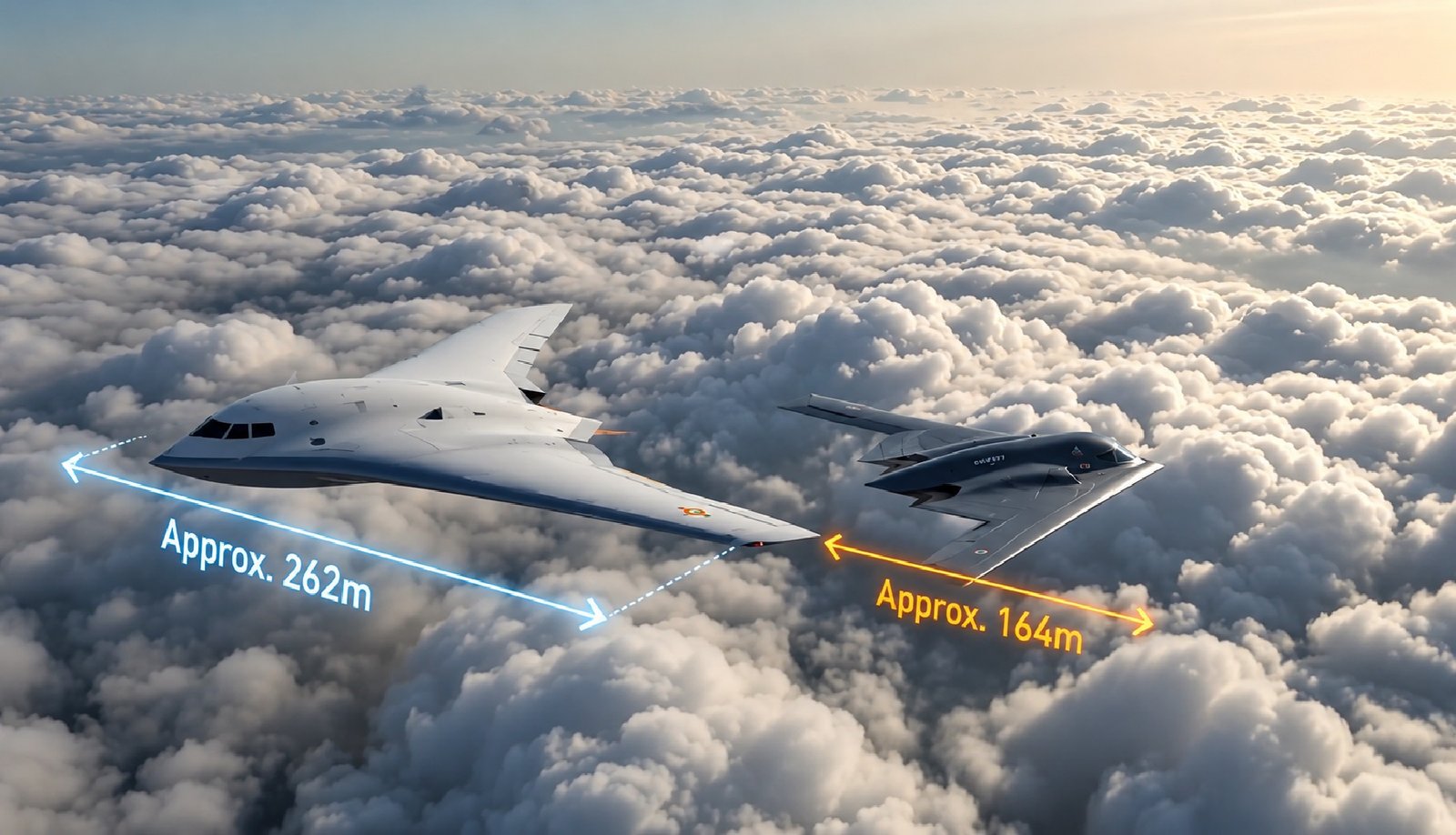
The proposed aircraft has a wingspan of 85 metres (280 feet) and a length of 43 metres. It has a reference wing area of about 1,395 square metres (15,015 square feet), with a 37-degree leading-edge sweep and a 28-degree trailing-edge sweep. The target cruise speed is Mach 0.8, while the planned passenger capacity is more than 800.
The wingspan would be approximately 1.6 times that of the U.S. B-2 Spirit, another aircraft that uses a flying-wing configuration. However, unlike the B-2, the Chinese design is intended for civil aviation.
For comparison, the Airbus A380, currently the largest passenger aircraft in commercial service, typically accommodates about 555 passengers.
Development by CARDC
The project was developed by CARDC, a national aerodynamics research institute that has contributed to major Chinese aviation programmes, including the C919 narrowbody passenger aircraft and the Y-20 military transport aircraft.
The research team, led by aerodynamics researcher Li Yonghong, described the high-aspect-ratio flying-wing configuration as having aerodynamic advantages, including a high lift-to-drag ratio and low induced drag. These characteristics are being studied for their potential to reduce energy consumption and support longer-range operations.
The design was initially developed as a 250-seat aircraft comparable in capacity to aircraft such as the Airbus A330 and Boeing 767. It was later expanded into the 800-passenger class as part of research connected with China's efforts to develop large twin-aisle widebody aircraft.
Wind Tunnel Testing
A full-scale aircraft has not been built. The research has so far focused on a 1:52 stainless-steel scale model.
The model measures approximately 0.8 metres in length and has a wingspan of 1.6 metres. It was tested in CARDC’s 2.4-metre transonic wind tunnel at speeds between Mach 0.4 and Mach 0.8.
Researchers examined the model’s aerodynamic performance, boundary-layer transition, measurement accuracy, lateral and longitudinal stability, and structural deformation.
The team reported a maximum lift-to-drag ratio of about 20 at speeds below Mach 0.7. At Mach 0.8, the lift-to-drag ratio was reported at 17.6.
According to the researchers, the test results demonstrated strong aerodynamic performance and allowed the model to serve as a benchmark for research into large, slender flying-wing configurations.
The data will also support further research into flow mechanisms, aeroelasticity and wind-tunnel testing methods.
Part of China's Wider Commercial Aviation Programme
The flying-wing project is being developed alongside other Chinese commercial aviation programmes.
China’s C919 narrowbody passenger aircraft is already in commercial service, while development of the C929 long-range widebody aircraft is continuing. The C929 is designed for around 280 passengers and is targeted for a first flight around 2030.
China is also studying the C949 supersonic passenger aircraft concept.
The flying-wing passenger aircraft remains at the research and testing stage and does not yet have a public name. No full-scale prototype has been built.
The current work is focused on aerodynamic research and testing, providing data for further studies of the configuration rather than representing a completed commercial aircraft.
China’s R&D Investment
The project is also part of a wider increase in Chinese investment in research and development. OECD data show that China spent about $1.028 trillion on R&D in 2024, compared with $1.009 trillion by the United States, giving China a reported $19 billion lead in total R&D spending that year.
For the flying-wing project, however, the immediate focus remains aerodynamic research. The wind-tunnel results are expected to provide a technical basis for continued studies of the aircraft configuration and its aerodynamic and structural characteristics.
The proposed 800-plus-passenger aircraft therefore remains a research concept rather than an aircraft ready for commercial operation.
——— End of Article ———