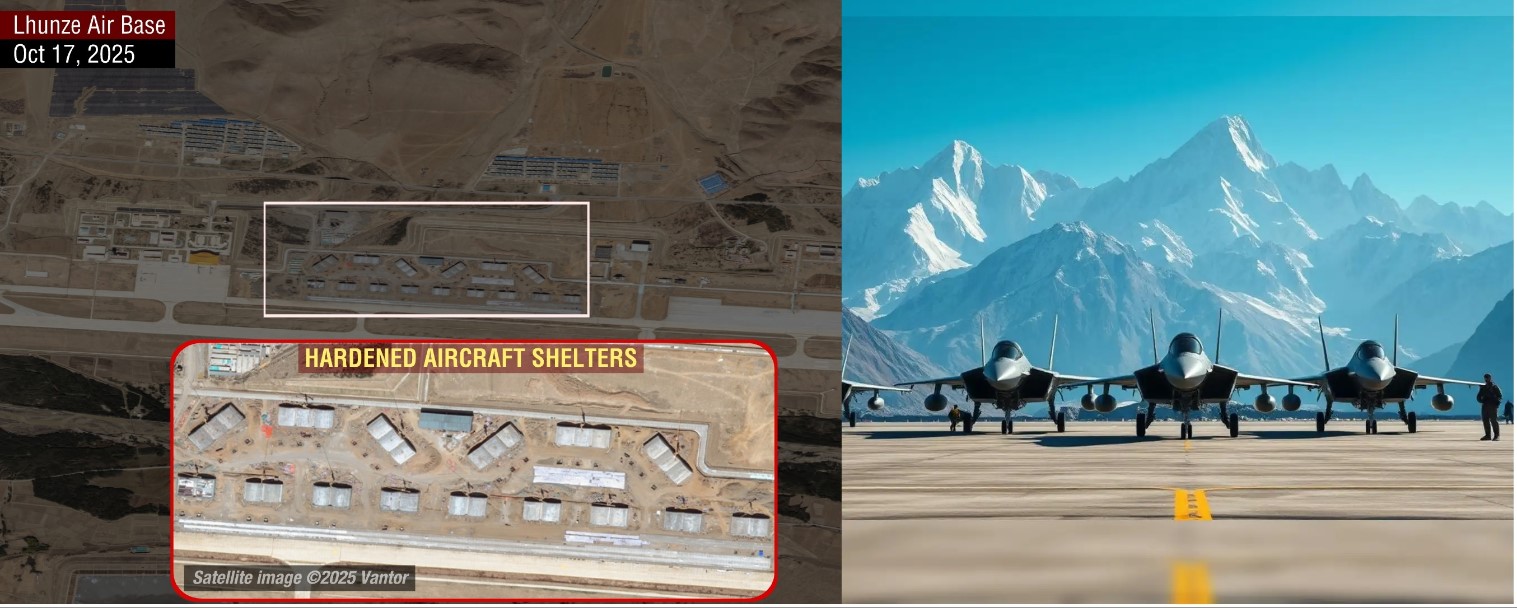
China is rapidly expanding its military footprint across the Tibetan plateau, constructing and upgrading a network of high-altitude airbases designed to enhance Beijing’s ability to project power along the contested border with India. A new analysis of more than 100 satellite images by The Wall Street Journal reveals a significant acceleration in military infrastructure development, including at least 16 newly built or modernized airfields and heliports, many located above 14,000 feet.
A Network of High-Altitude Military Hubs
The satellite review shows long, newly paved runways — some stretching up to 14,850 feet — and more than 70 hardened aircraft shelters in various stages of construction. These shelters allow China to permanently base fighter jets, helicopters, transport aircraft, and drones in positions much closer to the Line of Actual Control (LAC) than before.
At several bases, including Lhunze near Arunachal Pradesh, satellite imagery confirms that dozens of new aircraft shelters have already been completed. In some cases, entire mountain slopes have been leveled to create the needed flat terrain, with construction teams working under severe altitude and weather constraints.
Expansion of Drone Operations
China is also integrating a wide variety of unmanned systems into its high-altitude strategy. Several Tibetan facilities now support advanced UAVs, including:
-
GJ-11 Sharp Sword stealth combat drones
-
WZ-7 Soaring Dragon high-altitude reconnaissance drones
-
CH-4 and CH-5 long-endurance drones for surveillance and strike missions
These platforms expand China’s ability to conduct continuous intelligence, surveillance, and reconnaissance (ISR) missions over Indian deployments, as well as rapid precision-strike capabilities without risking pilots in the thin air of the Himalayan frontier.
Beijing officially labels many of these airports as “dual-use”, but the ongoing militarization — particularly the movement of stealth drones to bases like Shigatse — underscores their strategic intent.
Training a New Generation of “Plateau Eagles”
Operating at extreme altitudes remains a formidable challenge. Aircraft engines lose thrust in low-density air, requiring longer take-off distances, and pilots face risks of acute mountain sickness, oxygen deprivation, and disorientation. Ground crews also struggle with freezing temperatures, fierce winds, and intense UV exposure.
Despite these obstacles, China is investing heavily in specialized mountain aviation units. The PLA Air Force has begun training “Plateau Eagles,” pilots and technicians equipped with supplemental oxygen systems, specialized cold-weather gear, and tailored physiological training designed to support continuous operations above 14,000 feet.
Strategic Shift After 2020 Galwan Clash
Beijing’s infrastructure surge accelerated sharply after the 2020 Galwan Valley clashes, which exposed the logistical weaknesses of relying solely on ground forces in rugged Himalayan terrain. China has since pursued an explicit strategy to turn high-altitude geography — once a natural barrier — into a platform for rapid troop movement and persistent air dominance.
The new network of high-altitude air hubs allows China to:
-
Surge troops, armour, and supplies to frontier zones in hours instead of days
-
Maintain near-continuous drone surveillance across Ladakh, Arunachal Pradesh, and Sikkim
-
Pre-position aircraft in hardened shelters to withstand strikes or sabotage
-
Rapidly escalate or respond to border incidents
For India, the development erodes what was once considered a natural advantage: the difficulty of sustaining air operations on the Tibetan plateau. With new hardened shelters, longer runways, and stealth UAVs, China has begun to normalize high-altitude airpower in a region where such capability was previously limited.
India Watches “With Growing Concern”
Indian military planners have closely tracked China’s new bases, especially those located 40–60 km from the LAC. New Delhi has responded with its own infrastructure drive — expanding runways at Nyoma and Leh, reinforcing air-defense systems, and upgrading surveillance capabilities.
Yet analysts warn that the sheer scale and pace of China’s build-up could alter the long-term balance of power across the Himalayas, allowing Beijing to maintain a persistent, real-time presence over the border region.
A New Era of Himalayan Militarization
The transformation of the Tibetan plateau into a dense grid of airpower nodes marks one of China’s most ambitious military construction efforts in decades. As these bases become fully operational, the Himalayan frontier — once shaped by mountain passes and difficult terrain — is shifting into an arena where drones, hardened shelters, and long runways define strategic advantage.
——— End of Article ———