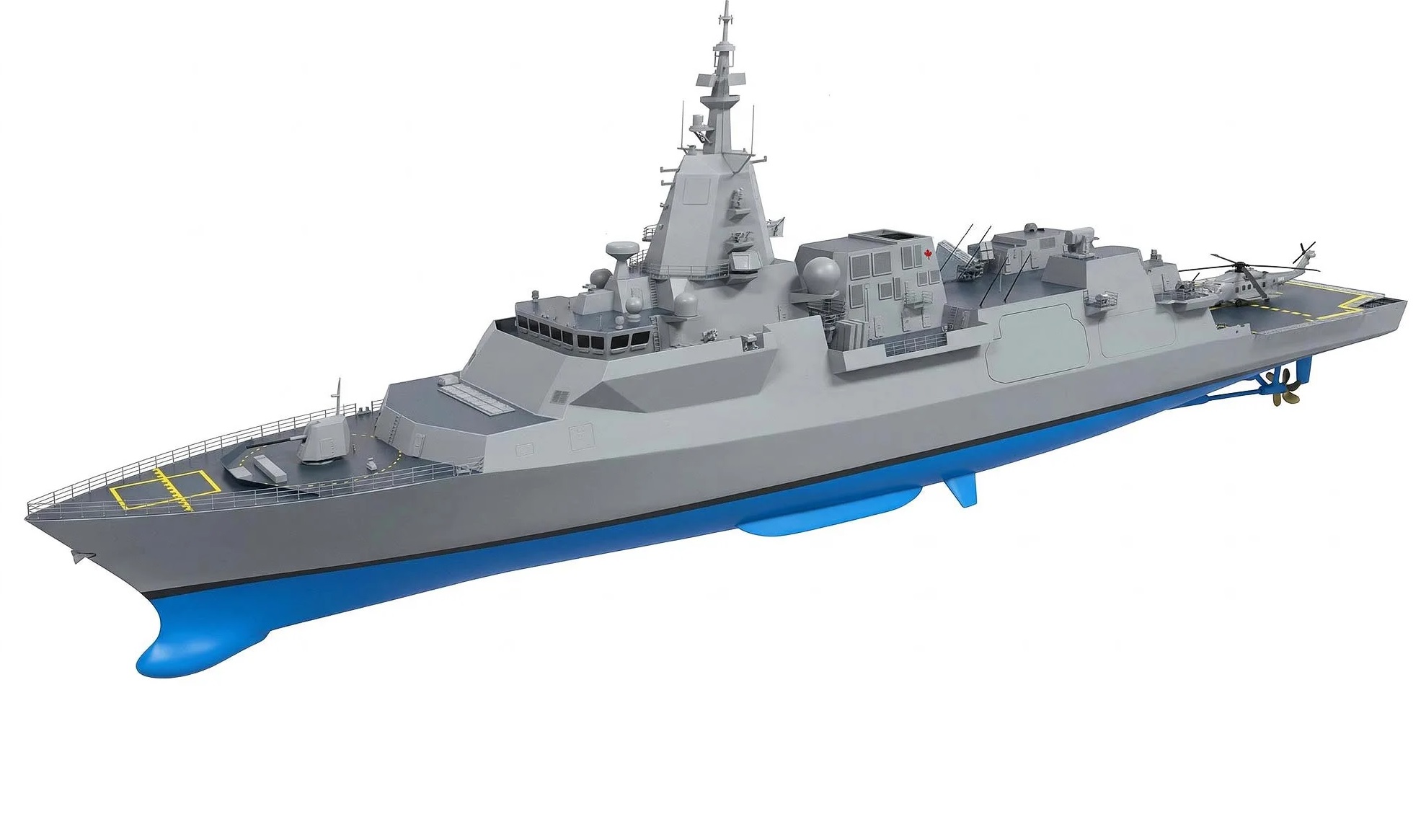
OTTAWA — March 28, 2026 : The Royal Canadian Navy (RCN) has presented a refined design for its future River-class destroyers, incorporating a series of targeted updates to the ships’ sensor suite, combat systems, and overall configuration. The updated scale model was unveiled at National Defence Headquarters on March 23–24, 2026, by senior naval leadership, reflecting design adjustments made since the initial concept was revealed in June 2024.
Presentation Highlights and Design Approach
The presentation was led by Rear Admiral Dan Charlebois, Deputy Commander of the Royal Canadian Navy, alongside Captain Luc Joseph Pierre Tremblay, Director of Naval Major Crown Projects (Combatant). Officials emphasized that the revised configuration represents incremental refinements rather than structural redesign.
The River-class destroyers continue to be based on the British Type 26 frigate platform. Core aspects of the naval architecture—including hull geometry, propulsion system, and overall platform design—remain unchanged. The updates primarily address system integration, topweight distribution, electromagnetic compatibility, and alignment with allied naval standards.
Sensor Suite and Mast Redesign
One of the most visible changes is the redesign of the ship’s main mast and sensor arrangement. The primary mast has been streamlined and now integrates the AN/SPY-7(V)3 active electronically scanned array (AESA) radar, operating in the E/F band. This solid-state 3D radar is intended to enhance detection range and tracking capability while improving system integration within the ship’s structure.
A secondary radar system featuring a disc-enclosed rotating antenna has been installed atop the navigation bridge. This replaces a previously planned fire-control antenna and is intended to improve surface and navigation radar coverage while reducing electromagnetic interference across onboard systems.
Changes to Main Gun and Close-In Weapons
The updated design includes a revision to the ship’s primary naval gun. The originally selected Leonardo 127 mm/64 LW gun has been replaced by the BAE Systems Mk 45 Mod 4 127 mm gun. The Mk 45 Mod 4 is lighter—approximately 22–24 tonnes compared to the estimated 30–35 tonnes of the Leonardo system—supporting improved topweight balance and stability.
The change also aligns Canada’s configuration with the United Kingdom’s Type 26 and Australia’s Hunter-class programs, contributing to interoperability and shared logistics. The Mk 45 Mod 4 features an automated ammunition handling system.
For close-in defense, the design replaces previously considered Italian systems with MSI-DS Mk 38 Mod 4 30 mm stabilized naval gun systems. These provide short-range engagement capability against surface and asymmetric threats.
Vertical Launch System and Air Defense Configuration
Adjustments have been made to the ship’s vertical launch system (VLS) layout. Two Mk 41 ExLS modules that were initially planned aft of the funnel have been removed. The forward VLS configuration now consists of three eight-cell Mk 41 strike-length modules, totaling 24 cells.
These cells are capable of deploying a range of munitions, including Evolved Sea Sparrow Missile (ESSM) Block II, Standard Missile 2 (SM-2), and Tomahawk land-attack cruise missiles. The design also retains reserved space for a potential future expansion with an additional eight-cell module.
To strengthen point air defense, a 24-cell launcher for the RIM-116 Rolling Airframe Missile (RAM) system has been added on the starboard side of the hangar roof. This provides a dedicated close-in missile defense layer against incoming threats such as anti-ship missiles and aircraft.
Anti-Ship Missiles and Countermeasure Enhancements
The Naval Strike Missile (NSM) launchers have been repositioned to the starboard side in an athwartships (perpendicular) configuration. This adjustment ensures that missile exhaust does not interfere with the operation of the RAM system.
Electronic warfare and decoy capabilities have also been enhanced. The number of BAE Systems Mk 53 Nulka decoy launchers has been increased and positioned amidships to improve defense against incoming guided threats. The ships will also be equipped with the AN/SLQ-32(V)6 electronic warfare suite and expendable acoustic countermeasures.
Hull, Propulsion, and General Characteristics
The River-class destroyers will have a standard displacement of approximately 7,800 tonnes, a length of 151.4 meters, a beam of 20.75 meters, and a maximum navigational draught of around 8 meters. The ships are designed for a maximum speed of 27 knots and a range of approximately 7,000 nautical miles.
Propulsion is based on a combined diesel-electric or gas (CODLOG) system. This includes one Rolls-Royce MT30 gas turbine, two General Electric electric motors, and four Rolls-Royce MTU diesel generators, providing both efficiency and quiet operation for anti-submarine warfare missions.
Combat Systems and Mission Capabilities
The ships will be equipped with the Aegis combat management system, integrated with a Canadian-developed tactical interface. Anti-submarine warfare capabilities include the Ultra Electronics S2150 hull-mounted sonar and a towed low-frequency active and passive sonar system.
Each vessel will feature a reconfigurable mission bay capable of handling boats, containers, and mission-specific equipment. Aviation facilities include a flight deck and hangar designed to support one CH-148 Cyclone helicopter, along with remotely piloted systems.
The crew complement is expected to be approximately 210 personnel.
Program Status and Timeline
The River-class destroyer program is part of Canada’s National Shipbuilding Strategy and represents the country’s largest naval procurement initiative. The fleet is intended to replace both the retired Iroquois-class destroyers and the aging Halifax-class frigates.
An implementation contract for the first three ships—HMCS Fraser, HMCS Saint-Laurent, and HMCS Mackenzie—was awarded to Irving Shipbuilding on March 8, 2025. Construction of the lead vessel, HMCS Fraser, began in April 2025 at the Halifax shipyard, with full-rate production currently underway following the initial steel cutting.
The first ship is scheduled for delivery in the early 2030s. A total of up to 15 River-class destroyers are planned, with the final vessel expected to be delivered by 2050.
Ongoing Design Work
According to officials, the current refinements account for less than one percent of total displacement and reflect accumulated configuration decisions over the past two years. The updates address integration challenges, deck space optimization, system compatibility, and long-term sustainment considerations.
Further design work will continue in parallel with construction as the program progresses toward final review milestones.
——— End of Article ———