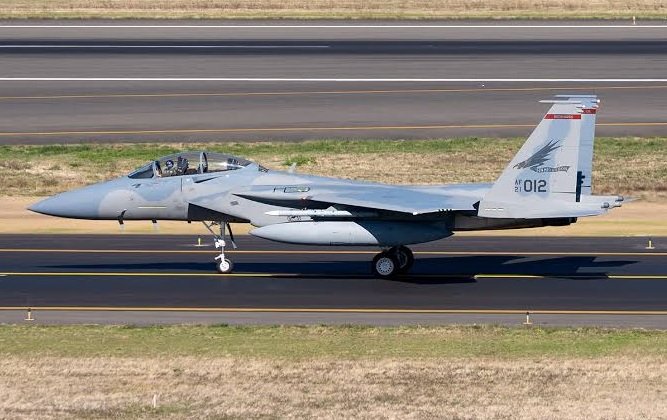
WASHINGTON / KUWAIT CITY, — March 2, 2026 : U.S. Central Command (CENTCOM) has confirmed that three U.S. Air Force F-15E Strike Eagle fighter jets were shot down over Kuwait on March 1 in what officials described as a friendly fire incident involving allied air defense systems. All six crew members aboard the aircraft ejected safely and were recovered in stable condition.
According to CENTCOM, the aircraft were operating in support of Operation Epic Fury when the incident occurred at approximately 11:03 p.m. ET. The jets were conducting combat missions amid ongoing Iranian missile and drone attacks across the Gulf region when they were mistakenly engaged by Kuwaiti air defenses.
Operational Context
At the time of the shootdown, Kuwaiti air defense forces were actively intercepting a large wave of incoming Iranian drones and ballistic missiles targeting multiple locations in the country. Engagements were reported near areas including Rumaithiya and Salwa, and air defense units were operating at high tempo for the third consecutive day.
U.S. officials indicated that indicators strongly suggest the aircraft were struck by Patriot surface-to-air missile batteries operated by Kuwaiti forces. Kuwait’s Ministry of Defense acknowledged the incident and confirmed that joint technical coordination and immediate search-and-rescue operations were conducted in cooperation with U.S. forces.
CENTCOM stated that Iran was not responsible for the downing of the aircraft. Iranian state-linked media outlets had claimed that the Islamic Revolutionary Guard Corps (IRGC) shot down at least one of the jets. U.S. and Kuwaiti authorities rejected those claims, citing radar telemetry, engagement data, and geographic limitations.
Independent defense analysts noted that Iran does not possess ground-based air defense systems with sufficient range to track and destroy maneuvering fighter aircraft operating deep within Kuwaiti airspace from Iranian territory. Available Iranian long-range air defense systems are not assessed to have engagement envelopes capable of reaching targets over Kuwait from launch sites inside Iran.
Crew Recovery and Status
The F-15E Strike Eagle is operated by a two-person crew consisting of a pilot and a Weapon Systems Officer (WSO). CENTCOM confirmed that all six aviators successfully activated their ejection systems after their aircraft were hit.
Recovery operations were initiated immediately by Kuwaiti authorities and coalition forces. The aircrew were transported to military medical facilities for evaluation and remain in stable condition. Photos and video circulating on social media show at least one aircraft descending near Ali Al Salem Air Base, with the pilot ejecting prior to impact.
Identification and Air Defense Procedures
Modern air defense systems rely on Identification Friend or Foe (IFF) protocols to distinguish allied aircraft from hostile targets. The process involves three primary steps:
Ground-based radar systems transmit an encrypted electronic interrogation signal to an aircraft.
The aircraft’s onboard transponder automatically responds with a secure, cryptographically coded reply.
If the transmitted code matches the daily authentication keys, the radar display identifies the aircraft as friendly.
Military officials explained that in high-intensity combat environments involving large numbers of simultaneous tracks — including drones, cruise missiles, and ballistic missiles — multiple technical and operational factors can degrade identification reliability.
Radar saturation can occur when systems track hundreds of incoming objects at once, placing strain on both software and human operators. Electronic interference, signal congestion, or electronic warfare activity may disrupt interrogation signals or prevent transponder replies from being received. Additionally, aircraft maneuvering angles, temporary transponder malfunction, or synchronization issues with cryptographic keys can result in an aircraft being labeled “unknown.”
If a track is classified as hostile or unidentified within an active engagement zone, automated or semi-automated systems such as the Patriot air defense system may initiate a firing sequence.
Similar incidents have occurred in previous conflicts. During the 2003 Iraq War, a U.S. Army Patriot missile battery mistakenly shot down a U.S. Navy F/A-18C Hornet following an IFF failure.
Broader Conflict Environment
The friendly fire incident occurred during an escalation of hostilities under Operation Epic Fury, a U.S.-led campaign against Iran. The operation began following strikes on Iranian leadership and military infrastructure. Iranian state media reported more than 200 deaths from the initial strikes, including civilians.
In response, Iran launched ballistic missiles and drones targeting U.S. bases and facilities in Kuwait, Bahrain, Qatar, the United Arab Emirates, Jordan, and Saudi Arabia. Some projectiles were intercepted by regional air defenses, while others caused localized damage.
U.S. officials also confirmed that a fourth U.S. service member died from injuries sustained during Iranian strikes in the past 24 hours, bringing the reported U.S. fatality count in the conflict to four as of March 2.
Investigation Underway
CENTCOM and Kuwait’s Ministry of Defense stated that a joint technical investigation is underway to determine the precise sequence of events, including radar data review, IFF signal logs, and engagement authorization procedures.
U.S. officials emphasized continued coordination with Kuwaiti forces and stated that the incident does not alter ongoing coalition operations in the region. Both sides indicated that findings from the investigation will be used to refine deconfliction procedures and prevent similar incidents in active air defense environments.
——— End of Article ———