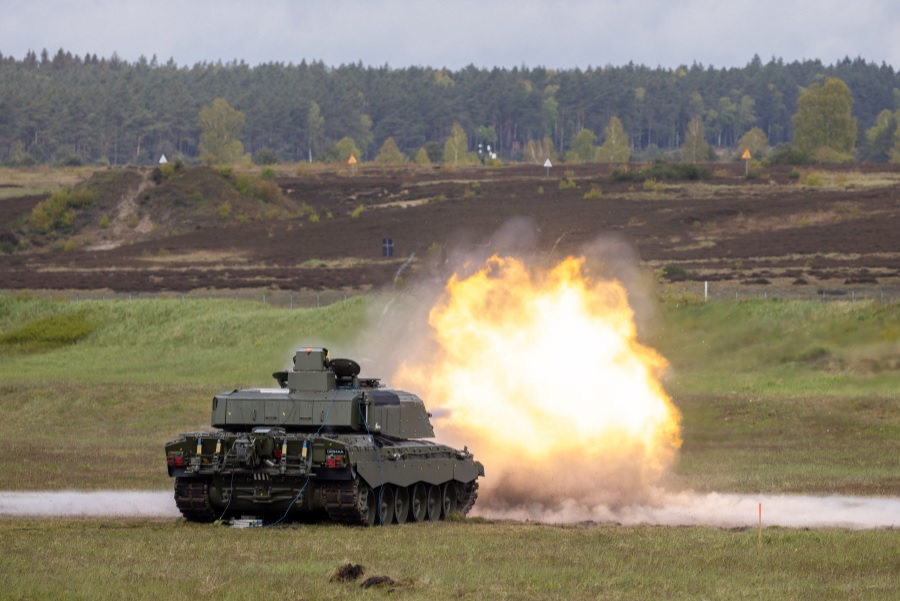
TELFORD, United Kingdom — May 28, 2026 : The United Kingdom’s Challenger 3 main battle tank programme has entered a major stage of testing and development following recent mobility and live-fire milestones, as the British Army moves forward with plans to modernize its armored fleet to meet evolving NATO operational requirements.
Managed by Rheinmetall BAE Systems Land (RBSL) under an £800 million contract with the UK Ministry of Defence, the programme will upgrade 148 existing Challenger 2 tanks to the Challenger 3 standard. The modernization is intended to improve battlefield lethality, survivability, interoperability, and digital integration while retaining key elements of the Challenger 2 chassis to reduce logistical complexity.
Firepower And Lethality Upgrades
At the center of the Challenger 3 modernization is the integration of the Rheinmetall Rh-120 L55A1 120mm smoothbore cannon, replacing the Challenger 2’s L30A1 rifled gun. The transition aligns the British Army with NATO-standard ammunition used by platforms such as the Leopard 2 and M1A2 Abrams, improving ammunition commonality and interoperability with allied armored forces.
The L55A1 smoothbore gun is designed to deliver greater muzzle energy, improved armor penetration, enhanced long-range accuracy, and extended engagement ranges against modern battlefield threats. The weapon system also supports advanced kinetic energy penetrators and programmable multipurpose ammunition.
To further enhance firepower, the United Kingdom and Germany signed a statement of intent to jointly develop an Enhanced Kinetic Energy (EKE) armor-piercing round optimized for Challenger 3’s new weapon system.
Digital Architecture And Battlefield Integration
The Challenger 3 incorporates a redesigned turret featuring advanced digital architecture and an open-system design intended to support future upgrades and network-enabled warfare. The digital structure enables faster data exchange between reconnaissance assets, artillery units, drones, infantry formations, and armored vehicles operating in contested environments.
The upgraded tank is equipped with the Thales Orion commander sight and the Day/Night Gunner And Panoramic Sight (DNGS T3), improving target acquisition, tracking, and engagement capabilities during both day and night operations.
The enhanced sensor suite enables crews to identify threats more efficiently while sharing targeting information in near real time, reducing sensor-to-shooter timelines and improving coordination with NATO partner forces.
Survivability And Mobility Enhancements
To address evolving battlefield threats—including anti-tank guided missiles, loitering munitions, armed drones, and precision-guided strikes—the Challenger 3 incorporates a newly developed modular armor system intended to improve protection levels.
The platform is also configured to integrate the Trophy Active Protection System (APS), a radar-based defensive system designed to detect and intercept incoming projectiles before impact.
Although retaining elements of the Challenger 2 chassis, mobility improvements are being introduced through the Heavy Armour Automotive Improvement Project (HAAIP). Planned upgrades include a third-generation hydrogas suspension system, hydraulic track tensioners, an electric cold-start system, improved engine cooling, updated electronics, improved power distribution, and maintainability enhancements to support the platform’s increased weight and operational demands.
Testing Milestones And Programme Progress
The Challenger 3 programme has recently completed several important testing milestones.
In September 2025, RBSL completed initial mobility trials involving nearly 800 kilometers of testing across multiple terrain conditions in the United Kingdom. The trials gathered performance data related to vehicle vibration, noise, crew interfaces, off-road maneuvering, and the effects of movement on onboard ammunition and internal systems.
Following the mobility phase, Challenger 3 completed its first crewed live-firing trials in January 2026 at a UK Ministry of Defence training centre. The event marked the first crewed firing activity involving a newly developed British main battle tank in more than three decades and evaluated operation of the Rh-120 L55A1 smoothbore cannon.
Additional reliability growth trials, crewed firing activities, and battlefield mission serials are planned throughout 2026 to evaluate crew coordination, communications, maneuver performance, and target engagement capabilities under operational conditions.
The programme remains in its demonstration and qualification phase, with a forthcoming System Qualification Review expected to establish manufacturing standards for production vehicles before full-rate production advances.
Industrial Base And Strategic Context
Production and conversion work is centered at RBSL’s Telford facility, supported by a £40 million investment aimed at modernizing manufacturing infrastructure.
The £800 million programme supports approximately 200 to 300 skilled jobs directly at RBSL and around 450 additional positions across the UK supply chain, including facilities in the West Midlands, Glasgow, Newcastle upon Tyne, and the Isle of Wight.
The Challenger 3 programme reflects a broader NATO shift toward conventional armored warfare and territorial defence following decades of focus on counterinsurgency operations. The platform is intended to provide the British Army with a digitally integrated, interoperable, and highly protected capability for operations in contested environments involving drones, electronic warfare, precision fires, and networked battlefield systems.
Initial operating capability is targeted for 2027, while full operating capability remains planned for 2030. However, defence industry reporting in May 2026 has highlighted potential schedule pressures linked to modernization timelines and concerns over the availability of serviceable Challenger 2 hulls for conversion, factors that may influence the final fleet size and Britain’s NATO armored force commitments.
Recent mobility and live-fire milestones nevertheless indicate continued technical progress as the British Army advances the Challenger 3 programme toward operational deployment.
——— End of Article ———