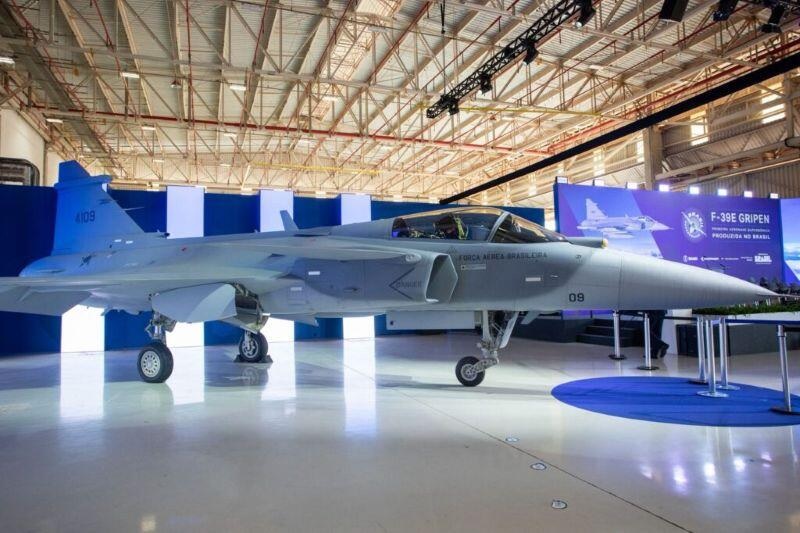
GAVIÃO PEIXOTO, Brazil — March 26, 2026 : Brazil has formally presented the first Gripen E multirole fighter jet assembled domestically, marking a significant milestone in the country’s long-running F-39E program and its broader effort to establish an indigenous defense-industrial capability. The aircraft was unveiled on March 25 at Embraer’s industrial facility in Gavião Peixoto, São Paulo state, in a joint presentation involving Embraer, Swedish defense company Saab, and the Brazilian Air Force (Força Aérea Brasileira, FAB).
The rollout reflects a transition from initial foreign-built deliveries to local assembly, supported by a technology transfer agreement signed in 2014 between Brazil and Saab. The program is part of a $4 billion contract covering 36 aircraft, including 28 single-seat Gripen E fighters and eight two-seat Gripen F variants.
Leadership Presence and Program Context
The ceremony was attended by Brazilian President Luiz Inácio Lula da Silva, Sweden’s Ambassador to Brazil Karin Wallensten, Defense Minister José Múcio Monteiro Filho, Brazilian Air Force Commander Lt. Brig. Marcelo Kanitz Damasceno, Saab President and CEO Micael Johansson, Embraer President and CEO Francisco Gomes Neto, and Embraer Defense & Security CEO Bosco da Costa Junior.
Saab noted that this is the first time since its establishment in 1937 that a fighter aircraft has been manufactured outside Sweden. Brazilian officials stated that the program contributes to the country’s ability to produce and sustain advanced combat aircraft domestically.
Aircraft Specifications and Systems
The Gripen E, designated F-39E in Brazilian service, is a single-engine multirole combat aircraft designed for air defense, reconnaissance, and strike missions. It has a maximum take-off weight of 16,500 kilograms and is powered by a GE F414 engine generating approximately 98 kilonewtons of thrust. The aircraft can reach speeds of up to Mach 2 (approximately 2,470 km/h).
The platform includes ten hardpoints for carrying weapons and mission equipment and supports air-to-air refueling, extending operational range and endurance. Saab states that the aircraft’s combat turnaround time ranges from 15 to 25 minutes, enabling rapid redeployment.
The Gripen E integrates an Active Electronically Scanned Array (AESA) radar, an Infrared Search and Track (IRST) system, and advanced electronic warfare and communications systems. These systems are designed to support sensor fusion, situational awareness, and networked operations in contested environments.
Production Structure and Industrial Participation
Final assembly of the aircraft is conducted at Embraer’s Gavião Peixoto facility. Aerostructures are produced at Saab’s plant in São Bernardo do Campo, also in São Paulo state, reflecting a combined Brazilian and international supply chain.
Prior to this rollout, 11 Gripen aircraft had been delivered from Sweden starting in 2020. Under the current contract, a total of 15 aircraft will be assembled in Brazil, including the newly unveiled unit and 14 additional fighters that will follow the same production model after functional checks and flight testing.
The program includes provisions for technology transfer, enabling Brazilian industry to participate in assembly, systems integration, and long-term maintenance.
Operational Deployment and Airspace Coverage
The Gripen E has already entered operational service within the Brazilian Air Force. On March 6, 2026, Saab confirmed that the aircraft began Quick Reaction Alert (QRA) missions from Anápolis Air Base, where it is assigned to the First Air Defense Group (1º GDA).
From Anápolis, the aircraft is positioned to respond rapidly to aerial threats and support the monitoring and protection of Brazil’s airspace. This includes coverage of major urban centers, critical infrastructure, offshore economic zones, and the Amazon region. Saab stated that the aircraft can reach the Central Plateau within minutes, supporting defense requirements around the federal capital and surrounding areas.
The newly presented aircraft is expected to join operational units following completion of testing and evaluation.
Strategic and Regional Implications
Brazil’s domestic assembly of the Gripen E places it among a limited number of countries capable of manufacturing advanced supersonic combat aircraft. The program strengthens national control over defense production and reduces reliance on external supply chains.
Brazil is currently the only country in Latin America assembling a modern fighter aircraft of this class. Saab has indicated that the Brazilian production line could serve as a potential export hub for the Gripen platform in the region, depending on future agreements.
The F-39E is expected to serve as a central component of Brazil’s air defense and deterrence posture, supporting sovereignty enforcement and long-range operational requirements across the country’s extensive territory.
——— End of Article ———