NASHVILLE, Tenn. — April 16, 2026 : Boeing on April 15, 2026, presented a computer-generated concept for deploying swarms of launched effects from the CH-47 Chinook during the Army Aviation Warfighting Summit held by the Army Aviation Association of America in Nashville, Tennessee. The concept outlines a potential evolution of the heavy-lift platform into a forward operational node capable of supporting reconnaissance, threat detection, and manned-unmanned teaming in contested environments.
The presentation aligns the Chinook with ongoing U.S. Army modernization priorities, including distributed operations, survivability enhancements, and faster decision-making cycles across the battlefield.
Rear-Ramp Launch Concept and Deployment Mechanics
The concept video depicts a reconnaissance and special operations scenario in which the Chinook releases launched effects through its rear ramp using an internal palletized dispenser. The system is visually configured as a 16-cell launcher, indicating a structured, high-capacity deployment mechanism rather than a conventional payload drop approach.
Boeing officials, including Kathleen Jolivette, vice president and general manager of the company’s Vertical Lift division, stated that the initiative is currently funded through internal investment, with assessments underway for a future physical demonstration phase. As of April 2026, launched effects have not been physically tested from the Chinook platform.
Industry specifications referenced in the concept indicate that larger launched effects compatible with the Chinook could weigh up to 225 pounds, significantly exceeding standard 25-pound systems. These systems are projected to achieve operational ranges between 350 and 650 kilometers, with flight endurance of up to one hour. The increased payload capacity is enabled by the aircraft’s internal volume and heavy-lift design.
Integration with CH-47F Block II Modernization
The concept is directly linked to the CH-47F Block II modernization roadmap. The Block II configuration incorporates structural, propulsion, and avionics upgrades designed to support modular mission systems and future capability integration.
Key upgrades include a strengthened fuselage, redesigned fuel tanks, and an improved drivetrain. The avionics suite integrates the Common Avionics Architecture System cockpit along with the Digital Automatic Flight Control System (DAFCS), supporting enhanced situational awareness and flight control precision.
The aircraft retains a maximum gross weight of 54,000 pounds and a useful load capacity of 27,700 pounds. Performance specifications include a mission radius of 165 nautical miles and a top speed of 170 KTAS. Power is provided by two T55-GA-714A engines, each producing 4,777 shaft horsepower.
These parameters provide the electrical and mechanical margins required to integrate launcher modules, communication gateways, and additional mission operators. The tandem-rotor configuration and unobstructed rear-ramp design eliminate tail-rotor clearance constraints, supporting palletized systems and rear-ramp deployment concepts.
Doctrinal Context and U.S. Army Launched Effects Development
The concept builds on ongoing U.S. Army work in launched effects integration. In February and March 2026, the Army demonstrated the deployment of an A700-class unmanned aircraft from an AH-64E Apache during testing at Yuma Proving Ground.
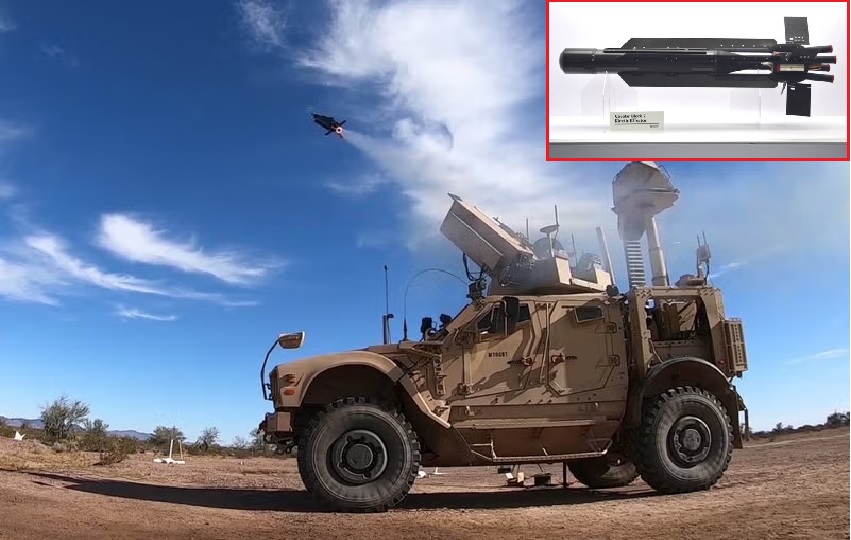
Army doctrine defines launched effects as autonomous or semi-autonomous aerial systems capable of conducting reconnaissance, electronic warfare, and kinetic strike missions. In parallel, the Army is advancing the Launched Effects Dispenser for Ground and Rotorcraft (LEDGR) program to establish a standardized launcher architecture across aviation and ground platforms.
Compared to the Apache-based demonstrations, the Chinook concept represents a higher-capacity, multi-role implementation. A heavy-lift platform equipped with internal launch cells could simultaneously execute route reconnaissance, decoy deployment, electronic support operations, and airborne relay functions while carrying troops, cargo, or sustainment supplies.
Autonomy and Long-Term Operational Evolution
Boeing projects that the Chinook platform will remain in operational service through 2060 and beyond. Autonomy is identified as a central component of its long-term development trajectory.
In addition to the existing DAFCS, Boeing is advancing the Active Parallel Actuator Subsystem (APAS), designed to enable supervised autonomy, reduce pilot workload, and improve safety during complex flight conditions. The integration of open mission systems and digital flight controls supports an optimally crewed or optionally crewed operational model.
Under this framework, the Chinook transitions from a transport-focused platform to a vertical maneuver node within a broader sensor-effector network. The aircraft would be capable of coordinating distributed sensing and deploying attritable systems while maintaining its primary lift and assault support roles.
Operational Status and Technical Considerations
As of April 15, 2026, the rear-ramp launched effects system remains a concept rather than an operational capability. Several technical factors require validation before implementation, including rotor downwash interaction, safe separation during deployment, launch envelope constraints, and electromagnetic compatibility.
Additional considerations include datalink resilience under electronic warfare conditions, onboard mission computing requirements, and human-machine interface workload management. Trade-offs between launched-effects payload capacity and conventional cargo or troop transport must also be addressed.
Program Developments and Production Status
On April 15, 2026, the U.S. Army awarded Boeing a contract for six additional CH-47F Block II helicopters, increasing the total number under contract to 24 units. Boeing has previously delivered six aircraft, with production continuing.
The concept presented at the summit establishes a baseline for evaluating future heavy-lift platforms. Beyond lift capacity, operational effectiveness is increasingly measured by the ability to deploy sensing systems, integrate unmanned capabilities, and sustain survivability in contested operational environments.
——— End of Article ———