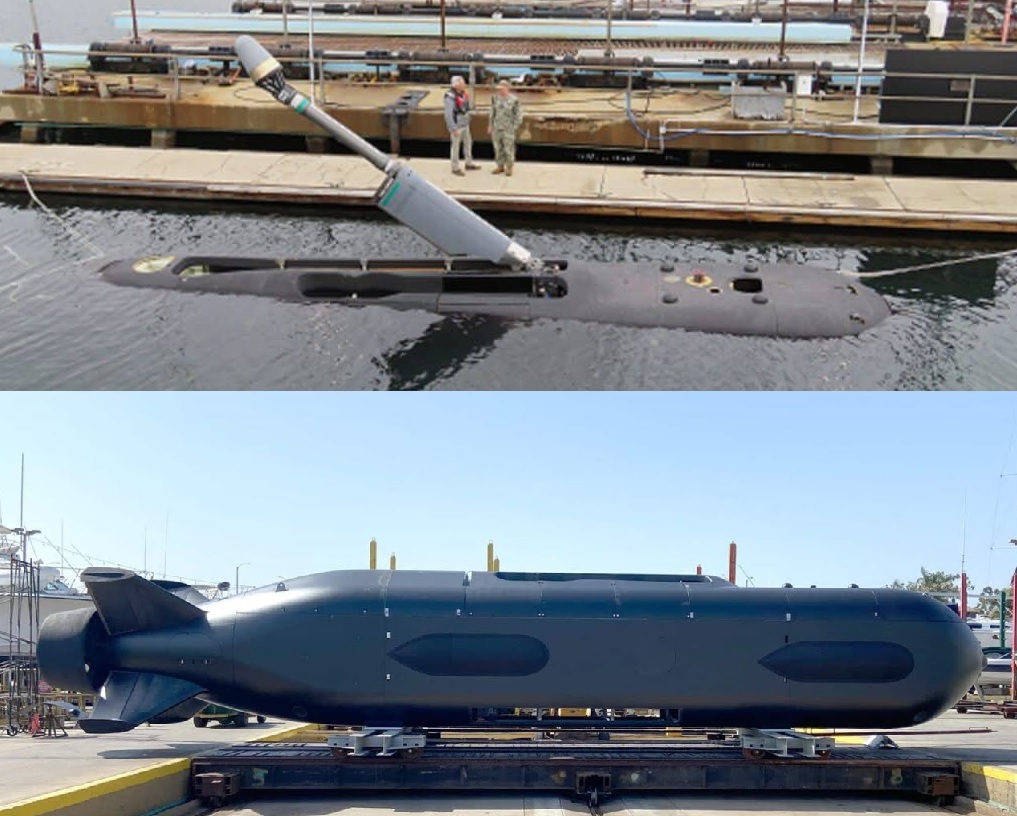
WASHINGTON — March 8, 2026 : Boeing has commissioned the second full-size Orca Extra Large Uncrewed Undersea Vehicle (XLUUV) for the United States Navy, marking another milestone in the service’s effort to expand autonomous undersea capabilities. The newly completed vehicle, designated XLE2, was formally christened during a ceremony at Boeing’s manufacturing facility in Huntington Beach, California.
The commissioning was publicly revealed in a LinkedIn post by Christine Clark, who shared images from the bottle-breaking ceremony that traditionally marks the launch of a naval vessel. XLE2 represents the second full-scale operational vehicle within the Orca program and the third overall delivery in the XLUUV family.
Autonomous Undersea Platform for Long-Duration Missions
The Orca XLUUV is designed as a large, highly autonomous submarine drone capable of conducting long-duration underwater missions without the need for a crew or dedicated support vessel. The platform is intended to operate under the Navy’s Unmanned Undersea Squadrons (UUVRON), where each vehicle can be managed by a single operator.
Unlike conventional unmanned underwater vehicles that often require specialized launch platforms, the Orca system is engineered to deploy and recover directly from pier-side facilities. This capability allows the vehicle to operate independently without a manned mothership, reducing logistical requirements and enabling greater operational flexibility.
The system is intended to perform a range of undersea mission sets, including intelligence, surveillance and reconnaissance (ISR), mine warfare operations, seabed warfare tasks, and expeditionary support missions.
Size, Endurance and Payload Capacity
The Orca class represents one of the largest uncrewed underwater vehicles developed for the U.S. military. Its physical dimensions and performance characteristics are significantly larger than most existing unmanned submarine platforms.
The vehicle measures 85 feet (26 meters) in length and has a displacement of approximately 85 tons. It is powered by a hybrid electric propulsion system, enabling an operational endurance of roughly 6,500 nautical miles.
A defining feature of the platform is its modular internal mission bay. Out of the vehicle’s total length, more than 33 feet (10 meters) is allocated for payload space. This modular compartment can carry up to eight tons of mission equipment, allowing the Navy to configure the system for different operational tasks.
The modular architecture enables the integration of a variety of payloads, including sensors, surveillance equipment, mine warfare systems, and other specialized undersea mission packages.
Development History and Program Origins
The Orca XLUUV program builds on Boeing’s earlier development of the Echo Voyager, a proof-of-concept unmanned submarine that demonstrated extended endurance and autonomous underwater operation. The Echo Voyager platform served as the technological foundation for the Orca system before Boeing secured the Navy’s production contract.
In February 2019, the U.S. Navy awarded Boeing a $43 million contract to fabricate, test and deliver four Orca XLUUV vehicles along with associated support systems. One month later, in March 2019, the contract was expanded through a $46.7 million modification that added a fifth prototype vehicle. The combined value of the contract increased to approximately $274 million after subsequent adjustments.
The Navy has stated that the long-term objective of the program is to field up to nine Orca vehicles, depending on operational requirements and future procurement decisions.
Sequence of Deliveries
The Orca program has produced three vehicles so far.
The first vehicle, XLE0, was a smaller testing asset designed specifically for evaluation and developmental trials. It was delivered to the Navy in December 2023 following acceptance testing. Prior to that delivery, the platform had already begun in-water testing during spring 2023 off the coast of Huntington Beach, California. Data gathered during those trials informed design adjustments and improvements for subsequent vehicles.
The next delivery was XLE1, the first full-size operational Orca platform. Testing for this vehicle continued through 2025, focusing on validating autonomous navigation, mission systems integration, and long-endurance performance.
The newly commissioned XLE2 follows approximately one year after the delivery of XLE1, representing the second operational vehicle in the class.
Program Delays and Revised Timelines
Although development has progressed steadily, the Orca program has experienced significant scheduling delays since the original contract was issued.
Initial program planning in 2019 anticipated that the first four vehicles would be delivered to the Navy by the end of 2022. That target was not met due to manufacturing challenges, integration complexity, and extended testing requirements.
The timeline between successive deliveries illustrates the delays encountered during the program’s development phase.
The gap between XLE0 (2023) and XLE1 (2024–2025) was approximately one and a half to two years. By contrast, the interval between XLE1 and XLE2 has narrowed to roughly one year, indicating a gradual improvement in production cadence.
Earlier projections released in 2024 suggested that the remaining vehicles could be delivered within a year following the first operational Orca. However, those expectations were not realized, and the schedule for future hulls has not yet been publicly specified.
Pentagon Oversight and Future Outlook
The U.S. Department of Defense has increased scrutiny on major defense acquisition programs in recent years, placing greater emphasis on adherence to initial delivery schedules and the reduction of manufacturing delays. This oversight could affect the future pace and procurement decisions associated with the Orca program.
Despite the extended timeline, the Navy continues developmental and operational testing of the delivered vehicles. Boeing has stated that the Orca platform provides a new level of autonomy, endurance and payload flexibility for undersea missions.
The vehicle’s open architecture design allows future upgrades and integration of new payloads, while its modular construction enables adaptation to evolving operational requirements. The Navy views the system as a key component in expanding autonomous undersea operations, particularly in contested maritime environments where persistent unmanned presence may be required for extended periods.
——— End of Article ———