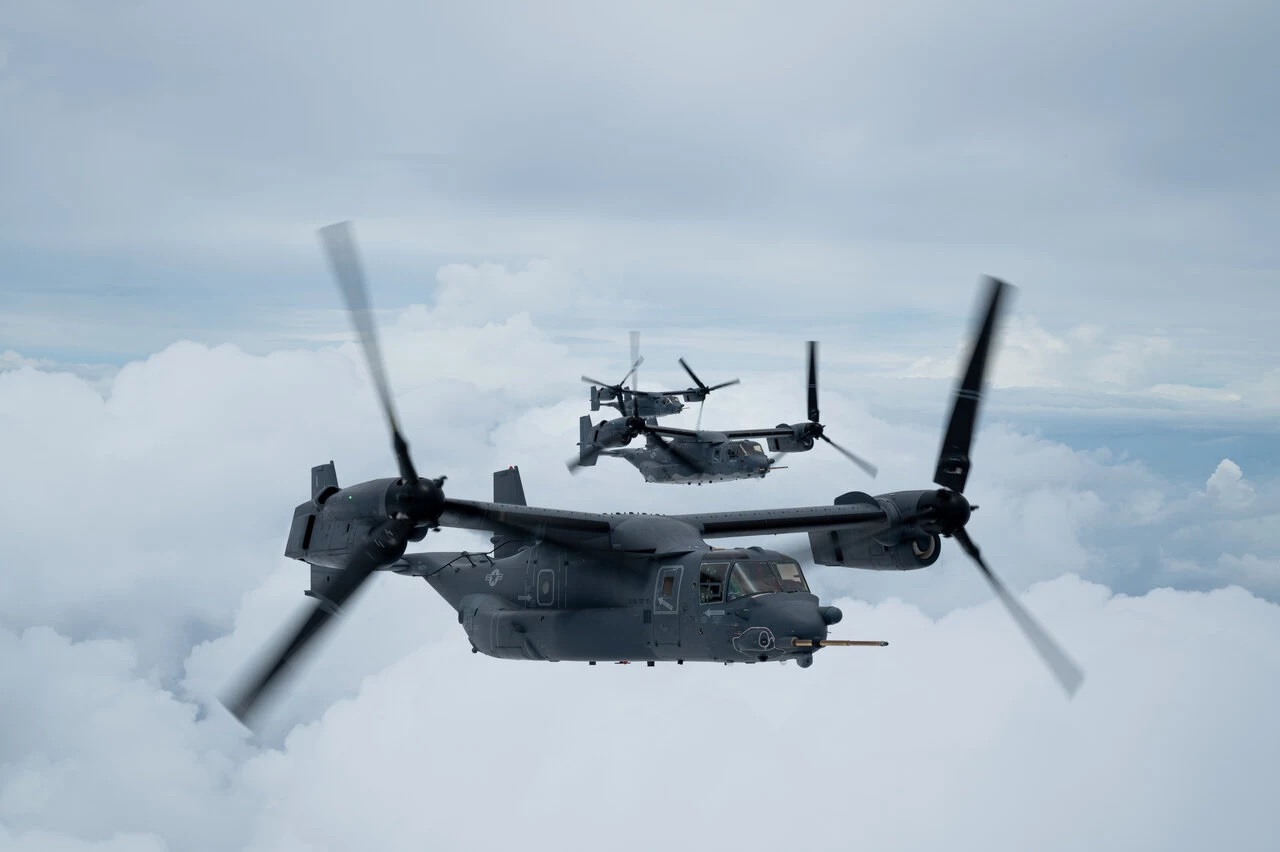
AMARILLO, Texas — April 21, 2026 : Bell Textron Inc., a subsidiary of Textron Inc. (NYSE: TXT), has reported substantial improvements in maintenance efficiency and operational readiness for the U.S. Air Force’s CV-22 Osprey fleet following implementation of its Nacelle Improvement (NI) Program. The company released performance data based on more than 10,000 flight hours of upgraded aircraft operated by Air Force Special Operations Command (AFSOC).
According to the data, the upgraded nacelle configuration has reduced maintenance hours by approximately 75 percent, while increasing overall aircraft readiness by more than 10 percent. The results are based on operational use since the first modified CV-22 was delivered in 2021 to the 20th Special Operations Squadron at Cannon Air Force Base, New Mexico.
Nacelle System as Primary Maintenance Driver
The V-22 Osprey’s nacelle, located at the wingtips, houses critical propulsion components including the engine, transmission, and proprotor system. These nacelles rotate to enable vertical takeoff and landing as well as conversion to forward flight. Due to the complexity and concentration of systems, approximately 60 percent of total maintenance actions across the V-22 fleet are associated with the nacelle.
The NI Program was developed to address this maintenance concentration through targeted redesign and system simplification, using fleet performance data and direct input from maintainers.
Technical Modifications and Design Changes
The upgrade introduces a simplified point-to-point wiring architecture, replacing legacy systems that relied on complex junctions and dense wiring bundles. This change reduces the number of potential failure points and improves fault isolation during troubleshooting. More than 1,300 individual parts were redesigned or eliminated as part of this effort, lowering overall system complexity.
Structural improvements were also implemented in areas identified as high-wear zones. These include reinforced hinges, latches, access panels, and internal structural elements such as frame stations and baffles. The modifications are intended to reduce the frequency of fatigue-related damage and unscheduled repairs.
Access to internal components was reconfigured based on maintainer feedback. The updated layout allows faster inspection and servicing by improving physical accessibility to critical systems. In addition, the design increases the reuse rate of repairable components, reducing replacement demand.
The program also extends the replacement interval for key components by a factor of four, contributing directly to reduced maintenance frequency.
Measured Maintenance and Reliability Outcomes
Performance data from the NI-equipped aircraft show a significant reduction in required maintenance labor. Over the initial 4,000 flight hours, upgraded nacelle components recorded zero failures, compared to an estimated 140 failures projected under the legacy configuration.
Maintenance labor associated with NI-specific components was reduced to 12 man-hours over the same 4,000-hour period, compared to a projected 2,195 man-hours for the previous design. These reductions contribute directly to increased aircraft availability.
Across the AFSOC CV-22 fleet, the NI Program has saved more than 24,000 maintenance hours. This corresponds to over 1,000 days of maintainer time that can be reassigned to other operational requirements.
Impact on Operational Readiness
The reduction in maintenance time has increased the number of mission-capable aircraft available for deployment and training. According to the V-22 Joint Program Office, CV-22 readiness rates improved by more than 10 percent following implementation of the upgrades.
A senior official from the program office stated that the maintenance time savings have enabled greater aircraft availability on the flight line, supporting both operational readiness and safety through increased training opportunities.
Production and Fleet Implementation
All nacelle modifications are carried out at Bell’s Amarillo Assembly Center in Texas, which also serves as the primary production site for all variants of the V-22 platform, including the MV-22, CMV-22, and CV-22.
The NI Program was initiated under a 2021 contract and has since expanded with congressional support, including a $160 million authorization to accelerate fleet-wide upgrades. As of late 2025, 31 out of 51 CV-22 aircraft assigned to AFSOC had received the modification.
Long-Term Sustainment and Fleet Expansion
The improvements are designed to extend the operational viability of the CV-22 fleet for at least the next 30 years. While initially applied to the Air Force variant, the program’s design framework supports broader integration across the joint V-22 fleet.
The U.S. Navy and Marine Corps are incorporating similar nacelle improvements into their midlife upgrade programs, with a focus on addressing component obsolescence, improving safety, and sustaining long-term readiness.
Bell stated that the NI Program reflects a data-driven and maintainer-informed approach to modernization, targeting high-impact reliability issues while maintaining cost efficiency. The company indicated that further collaboration with the Department of Defense will continue to focus on safety, sustainability, and operational performance of the V-22 platform.
——— End of Article ———