ISTANBUL — March 14, 2026 : Turkish defense manufacturer Baykar has unveiled a new long-range loitering munition platform known as the K2 Kamikaze Unmanned Aerial Vehicle (UAV). The system was revealed on March 14, 2026 through company statements and a promotional video following recent multi-sortie test flights conducted over the Saros Gulf from Baykar’s Flight Training and Test Center in Keşan, located in Edirne Province.
The K2 is designed as a long-range strike loitering munition with advanced autonomous functions and artificial intelligence-supported mission systems. Developed using indigenous resources, the platform is intended to provide extended-range strike capability while maintaining operational flexibility and resistance to electronic warfare conditions.
Technical Specifications and Mission Profile
According to Baykar, the K2 represents the largest kamikaze UAV in its specific class and is designed for strategic-range missions involving high-value or hardened targets.
The aircraft has a maximum take-off weight of approximately 800 kilograms and carries a 200-kilogram warhead, which allows it to engage reinforced structures or critical infrastructure targets. The platform is capable of exceeding 2,000 kilometers in operational range, giving it deep-strike capability far beyond the immediate battlefield.
Performance characteristics include speeds exceeding 200 kilometers per hour and endurance of more than 13 hours, enabling extended loitering time before target engagement. The K2 utilizes both Line-of-Sight (LOS) and Beyond-Line-of-Sight (BLOS) communications, the latter supported through satellite data links for long-distance command and control.
Artificial Intelligence Navigation and Targeting
A key element of the K2 system is its onboard artificial intelligence architecture designed to operate in contested electronic warfare environments. The drone incorporates GPS-independent navigation capability, allowing it to continue missions in areas where satellite navigation signals are degraded or jammed.
Instead of relying solely on satellite positioning, the platform employs visual terrain navigation. Using an electro-optical/infrared (EO/IR) gimbal combined with a fuselage-mounted night-vision camera, the system scans terrain features below the aircraft. Artificial intelligence algorithms analyze these visual inputs to estimate position and guide navigation without reliance on GNSS signals.
The targeting system is capable of identifying coordinates for strike missions while also supporting visual lock-on functionality, enabling the UAV to track and engage moving targets with precision.
Autonomous Swarm Operations
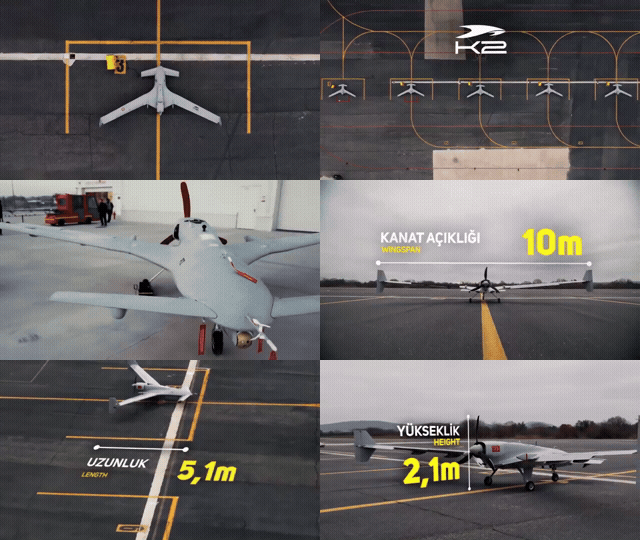
Testing conducted at Baykar’s Keşan Flight Training and Test Center demonstrated the K2’s capability to operate in coordinated multi-vehicle formations. During trials over the Saros Gulf, five UAVs performed autonomous swarm flights, maintaining formation and adjusting positions without direct human control.
The drones communicated with one another to sustain several formation patterns including V-shape, line, wall, and Turan configurations. Such coordinated formations are intended to enable multiple UAVs to approach defended targets simultaneously, increasing the likelihood of penetrating conventional air defense systems.
Airframe Design and Flight Characteristics
The K2 features a tailless aerodynamic configuration with swept wings, combined with lifting canards and wingtip rudders. This configuration is designed to enhance lift, maneuverability, and aerodynamic efficiency during long-range missions.
The aircraft also incorporates short take-off and landing (STOL) capability, allowing it to operate from short or unprepared airstrips rather than requiring fully developed airbase infrastructure. This feature provides flexibility for deployment from dispersed or austere locations.
Unlike traditional single-use loitering munitions, the K2 includes landing gear and a reusable design framework. If a mission does not require weapon release, the aircraft can return to base, land, and be prepared for subsequent surveillance or strike operations.
Testing and Demonstration
Flight testing took place across two days at Baykar’s test facilities in Keşan, with sorties conducted over the nearby Saros Gulf. Demonstrations included swarm flight operations, autonomous navigation, and formation maneuvering among multiple aircraft.
The public unveiling included a promotional video showing the aircraft in flight accompanied by “Waltz No. 2” by the composer Dmitri Shostakovich. Baykar has not yet provided details regarding production timelines, operational deployment, or export availability.
Integration within Baykar’s UAV Portfolio
The K2 expands Baykar’s existing family of unmanned systems, which includes the combat-proven Bayraktar TB2, the high-altitude Bayraktar Akıncı, the naval-capable Bayraktar TB3, and the jet-powered unmanned combat aircraft Bayraktar Kızılelma.
Within this lineup, the K2 introduces a long-range loitering munition platform designed to combine extended endurance, heavy payload capacity, autonomous swarm operation, and resistance to electronic warfare environments.
Baykar has not released further information regarding procurement plans or integration with Turkish military units. The company also did not announce potential export customers at the time of the system’s unveiling.
——— End of Article ———