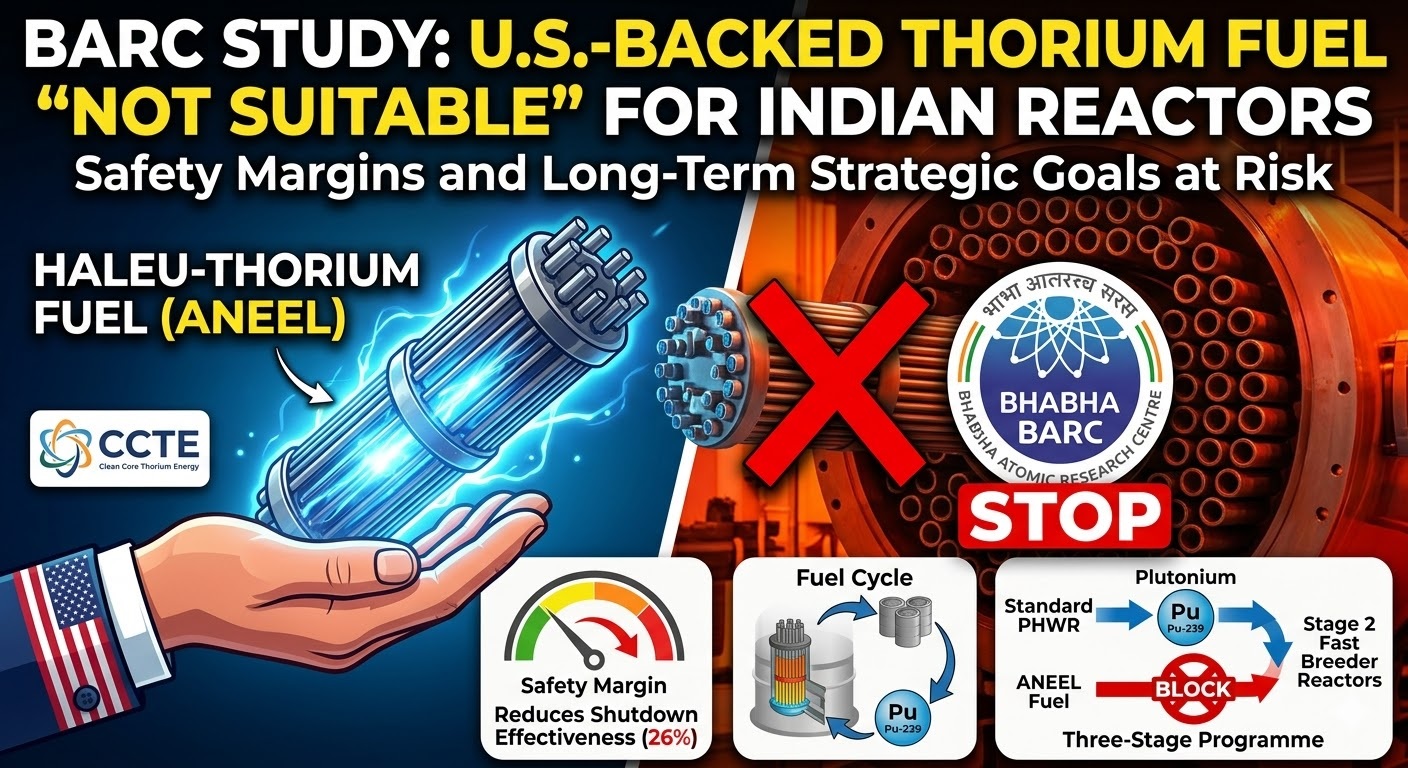
NEW DELHI — March 10, 2026 : A new scientific assessment by researchers at the Bhabha Atomic Research Centre (BARC) has raised technical and strategic concerns about a proposal to introduce a U.S.-developed thorium-based fuel blend into India’s existing nuclear power reactors. The analysis concludes that the proposed High-Assay Low-Enriched Uranium (HALEU) and thorium fuel combination cannot be directly used in India’s Pressurized Heavy Water Reactors (PHWRs) without significant design changes and could interfere with the country’s long-standing nuclear fuel strategy.
The findings were published in the journal Current Science by a BARC research team led by K.P. Singh of the Reactor Research Division. The study evaluates the performance of a HALEU-thorium fuel mixture intended for India’s standard 220 MWe PHWR reactors, which form a major part of the country’s nuclear power fleet.
Fuel Concept Developed by U.S. Companies
The fuel concept analyzed in the study forms the basis of ANEEL (Advanced Nuclear Energy for Enriched Life), a thorium-based nuclear fuel under development by the Chicago-based company Clean Core Thorium Energy (CCTE) in collaboration with Centrus Energy Corporation.
ANEEL combines thorium with High-Assay Low-Enriched Uranium (HALEU)—uranium enriched to levels up to 19.75% uranium-235. Developers have presented the fuel as a potential “drop-in” replacement for the natural uranium currently used in Indian PHWRs, suggesting it could allow earlier utilization of thorium while improving fuel efficiency and reducing spent nuclear fuel volumes.
Fuel pellets of the ANEEL design have undergone irradiation testing at the Advanced Test Reactor at Idaho National Laboratory in the United States to examine their behaviour under reactor conditions.
Some Indian power producers have shown interest in the technology. NTPC Ltd., the country’s largest power generation company, has explored potential collaboration with CCTE for possible deployment in domestic reactors, subject to approval by the Government of India and the Department of Atomic Energy (DAE).
Reactor Safety and Neutronics Concerns
The BARC analysis compared the HALEU-thorium fuel cycle with the existing natural uranium fuel used in PHWRs by evaluating cluster-level optimization and full-core reactor performance parameters.
According to the researchers, introducing the HALEU-thorium mixture would significantly alter the reactor’s neutronic behaviour and reactivity control characteristics.
One key finding of the study is a reduction of approximately 26% in the effectiveness of the PHWR shutdown systems. These systems are designed to rapidly stop the nuclear chain reaction during abnormal operating conditions. The reduction results from changes in neutron flux distribution and reactivity coefficients caused by the different fuel composition.
Because PHWRs are engineered specifically for natural uranium fuel moderated by heavy water, the study concludes that the proposed fuel blend would require substantial modifications to the reactor core design and control systems before safe operation could be achieved.
As a result, the researchers state that the HALEU-thorium fuel cannot be considered a direct “drop-in” replacement for the existing fuel configuration in India’s operational reactors.
Resource Utilisation and Uranium Consumption
The study also examined resource utilisation associated with HALEU production. HALEU requires enrichment of uranium to levels approaching 20% U-235, significantly higher than the enrichment required for conventional light-water reactors and far above the natural uranium used in PHWRs.
BARC scientists calculated that producing HALEU at 19.75% enrichment would increase the total amount of mined natural uranium required per unit of energy generated when compared with India’s current natural uranium fuel cycle.
Although the HALEU-thorium mixture is designed to achieve higher burn-up levels—around 50 gigawatt-days per tonne (GWd/t)—and thereby reduce the total volume of spent fuel, the enrichment process introduces additional upstream resource demands.
Impact on Plutonium Production
Another major conclusion of the study relates to the production of plutonium in PHWR spent fuel.
Under India’s current nuclear fuel cycle, PHWR reactors operating on natural uranium generate plutonium-239 as a byproduct. This plutonium is separated during reprocessing and used as the primary fissile material for the country’s Fast Breeder Reactor (FBR) programme.
The BARC analysis indicates that the HALEU-thorium fuel cycle would produce significantly less plutonium compared with the natural uranium cycle. Reduced plutonium generation would limit the availability of fissile material required for India’s breeder reactors.
The study also notes that the uranium-233 produced during thorium irradiation in the HALEU-thorium cycle would not be easily integrated into the existing closed fuel cycle system used by India’s PHWRs and breeder reactors.
Interaction With India’s Three-Stage Nuclear Programme
India’s nuclear power strategy is based on the three-stage nuclear programme originally developed by Dr. Homi J. Bhabha in the 1950s. The programme is designed to utilize the country’s limited uranium reserves and large thorium resources—estimated to account for roughly 25% of global thorium reserves.
The three stages are structured as follows:
- Stage 1: Pressurized Heavy Water Reactors use natural uranium fuel to generate electricity and produce plutonium in spent fuel. India currently operates several PHWR units, including 220 MWe and 700 MWe reactors, which form the foundation of the programme.
- Stage 2: Fast Breeder Reactors use the plutonium recovered from PHWR spent fuel to breed additional fissile materials, including uranium-233 derived from thorium.
- Stage 3: Advanced thorium-based reactors are intended to operate primarily on U-233 fuel derived from thorium, enabling a self-sustaining nuclear energy cycle with reduced reliance on imported uranium.
The BARC study concludes that introducing HALEU-thorium fuel in existing PHWRs would reduce plutonium accumulation, which is required for Stage 2 breeder reactors. This would slow the transition toward thorium-based energy systems envisioned in the final stage of the programme.
Reactor Design Implications
Because the HALEU-thorium fuel significantly changes reactor physics parameters, BARC researchers state that its implementation would require modified PHWR designs, including adjustments to safety systems and reactivity control mechanisms.
Such modifications could involve changes to fuel bundle geometry, shutdown system design, and control rod configurations to compensate for the altered neutron spectrum and reactivity behaviour.
The study indicates that these redesign efforts would involve additional engineering complexity and costs and could delay progress toward the long-term objectives of the national nuclear programme.
India’s Ongoing Thorium Development Efforts
India has been actively developing indigenous thorium-based reactor technologies within its own three-stage framework.
One of the key projects in this effort is the Advanced Heavy Water Reactor (AHWR) design, which uses thorium-plutonium fuel combinations and incorporates passive safety systems intended to support large-scale thorium utilization in the future.
The Department of Atomic Energy continues to pursue domestic thorium technologies alongside expansion of nuclear generation capacity. India has set a target of expanding nuclear power generation to around 100 gigawatts of installed capacity by 2047 as part of its long-term energy strategy.
Policy Status
The BARC study does not indicate that any official decision has been made regarding the adoption of HALEU-thorium fuel in Indian reactors. The proposal remains under technical evaluation, and any deployment would require approval from Indian nuclear authorities.
The analysis concludes that while thorium-based fuels remain central to India’s long-term nuclear strategy, the specific HALEU-thorium configuration examined in the study is not compatible with current PHWR designs without significant modifications and could affect the fuel cycle structure underlying the country’s three-stage nuclear programme.
——— End of Article ———