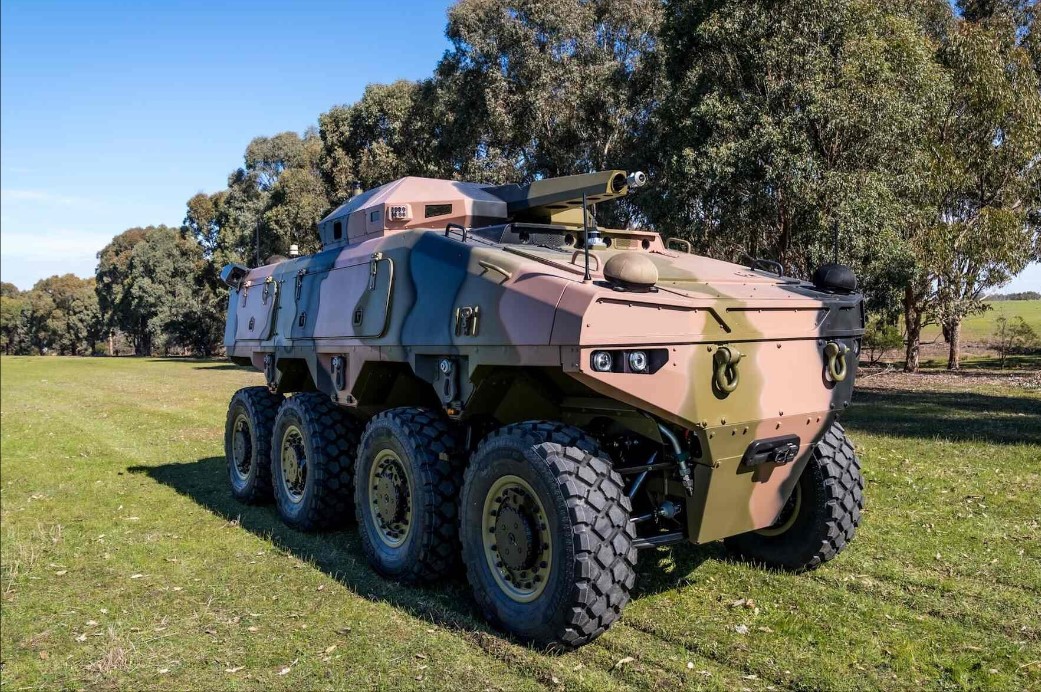
MELBOURNE : BAE Systems has completed a series of field autonomy trials for its Autonomous Tactical Light Armour System (ATLAS) Collaborative Combat Variant, marking a key milestone in the development of a modular uncrewed ground vehicle (UGV) designed to operate alongside crewed main battle tanks and combat reconnaissance platforms.
The ATLAS programme forms part of a broader effort to establish a next-generation autonomous land capability capable of supporting conventional armoured forces in complex operational environments. The platform is intended to undertake high-risk and repetitive battlefield tasks while remaining under human oversight.
Development Timeline and Trial Programme
The ATLAS Collaborative Combat Variant was first introduced at the Land Forces exhibition in September 2024. Within 16 months of its public launch, the programme advanced to a fully operational prototype demonstrator, culminating in recent field-based autonomy trials.
According to BAE Systems, the vehicle was tested across multiple levels of autonomous functionality, including:
-
Remote teleoperation, allowing operators to control the vehicle from a distance.
-
Waypoint-based navigation, enabling pre-programmed route movement.
-
Full “sense and avoid” autonomy, under which the vehicle independently detects obstacles and navigates around them without direct human steering input.
The trials were designed to validate the platform’s operational reliability, autonomous navigation systems, and integration with combat payloads under realistic field conditions.
Platform Design and Technical Characteristics
The ATLAS is configured as an 8x8 wheeled, 10-tonne modular drive vehicle. It is designed to serve as a combat multiplier by increasing available combat mass within a formation and undertaking roles such as direct fire support, obstacle clearance, and reconnaissance.
By assigning high-risk tasks to the uncrewed system, the platform is intended to reduce exposure of personnel to hostile fire and hazardous operating environments.
The vehicle was developed in collaboration with industry partners Supacat, Marand, and Slovenia-based Valhalla Turrets. The design emphasises manoeuvrability and mobility, enabling the ATLAS to operate in conjunction with both tracked and wheeled crewed vehicles across varied terrain, weather conditions, and environmental settings.
For transport and logistics flexibility, the ATLAS can be deployed using a standard 20-foot ISO shipping container or transported on a flat-rack platform.
VANTAGE Automated Turret System
In its primary assault configuration, the ATLAS Collaborative Combat Variant is equipped with the VANTAGE Automated Turret System. The turret has been developed as a lightweight, highly automated medium-calibre system specifically for integration with uncrewed platforms.
The current prototype is fitted with a 25mm M242 Bushmaster chain gun, with an architecture that is scalable to larger calibre systems if required. During prior factory acceptance testing in Slovenia, the turret demonstrated accuracy by successfully engaging targets at ranges of up to 750 metres.
The VANTAGE system incorporates BAE Systems’ passive Multi-Spectral Automatic Target Detection, Tracking and Classification System (ATTCS). This enables automated target detection, tracking, and classification, while retaining a strict “human-in-the-loop” requirement for the final firing decision.
The turret features a low-profile design under 450 millimetres in height, reducing visual signature and supporting shorter target engagement times. High levels of automation are built into the system to reduce operator cognitive load and enable a one-to-many operational model, allowing a single operator to supervise multiple vehicles simultaneously.
Operational Role and Integration
The ATLAS Collaborative Combat Variant is intended to operate within a combined-arms formation, supporting main battle tanks and reconnaissance units. Its modular architecture allows for multiple payload configurations beyond the primary assault role, enabling adaptation to different mission requirements.
The system is designed to maintain pace with conventional armoured formations and operate effectively in difficult terrain and varied environmental conditions. Its integration of autonomous navigation, automated targeting support systems, and scalable weapon architecture positions it as a platform focused on distributed, network-enabled land operations.
Programme Outlook
Andrew Gresham, Managing Director of Defence Delivery at BAE Systems Australia, stated that the platform progressed from its Land Forces 2024 debut to a fully functional prototype demonstrator within sixteen months. He said the system has been developed to perform tasks in combat environments that are repetitive, hazardous, or high-risk.
BAE Systems confirmed it is currently engaged in international marketing and customer engagement activities related to the ATLAS platform.
The completion of the autonomy trials represents a developmental milestone for the ATLAS Collaborative Combat Variant as the company continues further evaluation and engagement with potential operators.
——— End of Article ———