LONDON — March 18, 2026 : UK-based BAE Systems is progressing the development of a new multi-domain counter-uncrewed aerial system (C-UAS) designed to address the growing threat posed by hostile drones across military and civilian environments. The program, known as the BAE Systems Anti Threat System (BATS), combines software-driven command and control, electronic warfare capabilities, and kinetic countermeasures within a single, scalable architecture.
The initiative, launched in October 2025, is being developed under an accelerated timeline in response to increasing demand from defense and civil security customers. Initial system testing is expected to begin in April 2026, followed by live-fire trials scheduled for early summer. These evaluations are intended to validate the system’s ability to detect, classify, and neutralize drone threats across different operational scenarios.
Cost-Efficient Approach to Countering Drone Threats
A central objective of the BATS program is to address the cost imbalance associated with countering low-cost drones using high-value missile interceptors. Current air defense systems often rely on expensive surface-to-air missiles to neutralize relatively inexpensive uncrewed aerial systems, creating sustainability challenges in prolonged operations.
BATS is designed to introduce multiple response layers, enabling operators to deploy more cost-effective countermeasures depending on the threat profile. These include electronic warfare techniques such as jamming and disruption, as well as low-cost kinetic interceptors currently under development. The system is intended to protect a wide range of targets, including national borders, critical infrastructure, airports, urban environments, and deployed military assets, while preserving traditional air defense inventories.
Software-Defined Architecture and Decision Support
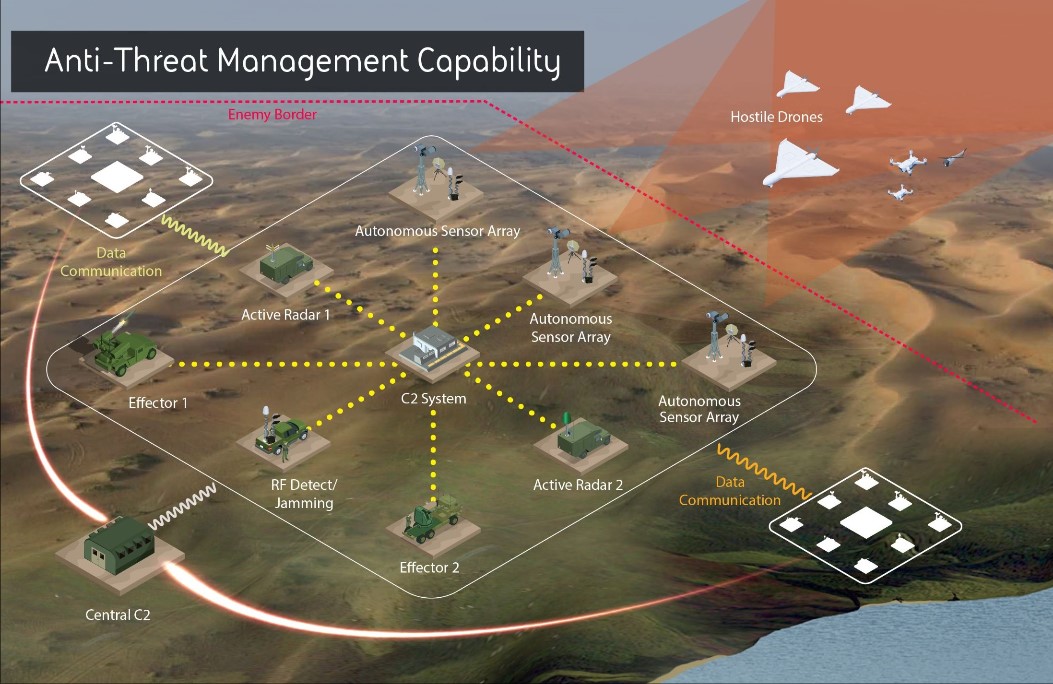
At the core of BATS is a software-defined command-and-control (C2) decision engine that integrates data from multiple sensors into a unified operational picture. Rather than functioning as a standalone weapon system, BATS operates as an open-architecture platform capable of incorporating both existing and future counter-drone technologies.
Sensor inputs—ranging from radar and radio frequency detectors to electro-optical systems—are fused into a central data environment. The system processes this information in real time to identify and classify aerial threats, assess intent, and recommend appropriate responses. Depending on operational settings and rules of engagement, BATS can either provide decision support to human operators or enable automated responses through connected effectors.
This sensor-to-effector integration allows continuous monitoring and rapid mitigation, improving situational awareness and response times in complex threat environments.
Electronic Warfare Integration and System Resilience
BATS incorporates advanced electronic warfare capabilities supported by recent corporate developments within BAE Systems. In late 2024, the company acquired Kirintec, a UK-based specialist in cyber and electromagnetic activities (CEMA), enhancing its ability to deliver electronic jamming and spectrum-based countermeasures against drones.
In February 2026, BAE Systems also entered into a partnership with Frankenburg Technologies to develop low-cost, mass-producible kinetic interceptors. These interceptors are designed to integrate directly into the BATS ecosystem, providing an additional layer of defense alongside electronic warfare tools.
The system is engineered for operational flexibility and resilience. It can be deployed for localized point defense or scaled to provide wide-area coverage. Command-and-control functions can be hosted on-premise, at the tactical edge, or via cloud-based infrastructure. To maintain effectiveness in contested electromagnetic environments, BATS includes fallback communication protocols using secure, high-bandwidth military networks if local spectrum access is disrupted or degraded.
Multi-Domain Development and Operational Scope
Development of BATS involves collaboration across BAE Systems’ air, land, and maritime divisions, reflecting the need for integrated responses to drone threats that can emerge across multiple domains simultaneously. The system is designed to interoperate with existing air defense and command networks, allowing seamless integration into current operational frameworks while supporting future upgrades.
Andrea Thompson, Group Managing Director of BAE Systems’ Digital Intelligence business, emphasized the importance of adaptability in countering rapidly evolving drone technologies. She noted that uncrewed systems continue to develop new operational behaviors, payload configurations, and tactics at a pace that challenges traditional defense systems, necessitating a software-led and modular approach.
Testing Timeline and Future Deployment
Following initial software validation and integration testing scheduled for April, the BATS program will proceed to live-fire trials in early summer 2026. These trials will assess the system’s end-to-end performance, including detection accuracy, decision-making speed, and the effectiveness of integrated countermeasures.
Upon successful completion of testing, BAE Systems is expected to position BATS for deployment with military customers and civil authorities. The system is intended to support both defense operations and domestic security requirements, particularly in protecting critical infrastructure and managing airspace security in urban environments.
While detailed technical specifications remain limited at this stage, BATS is being developed as a modular, scalable, and interoperable platform capable of adapting to evolving uncrewed threats, including hybrid and increasingly autonomous drone systems.
——— End of Article ———