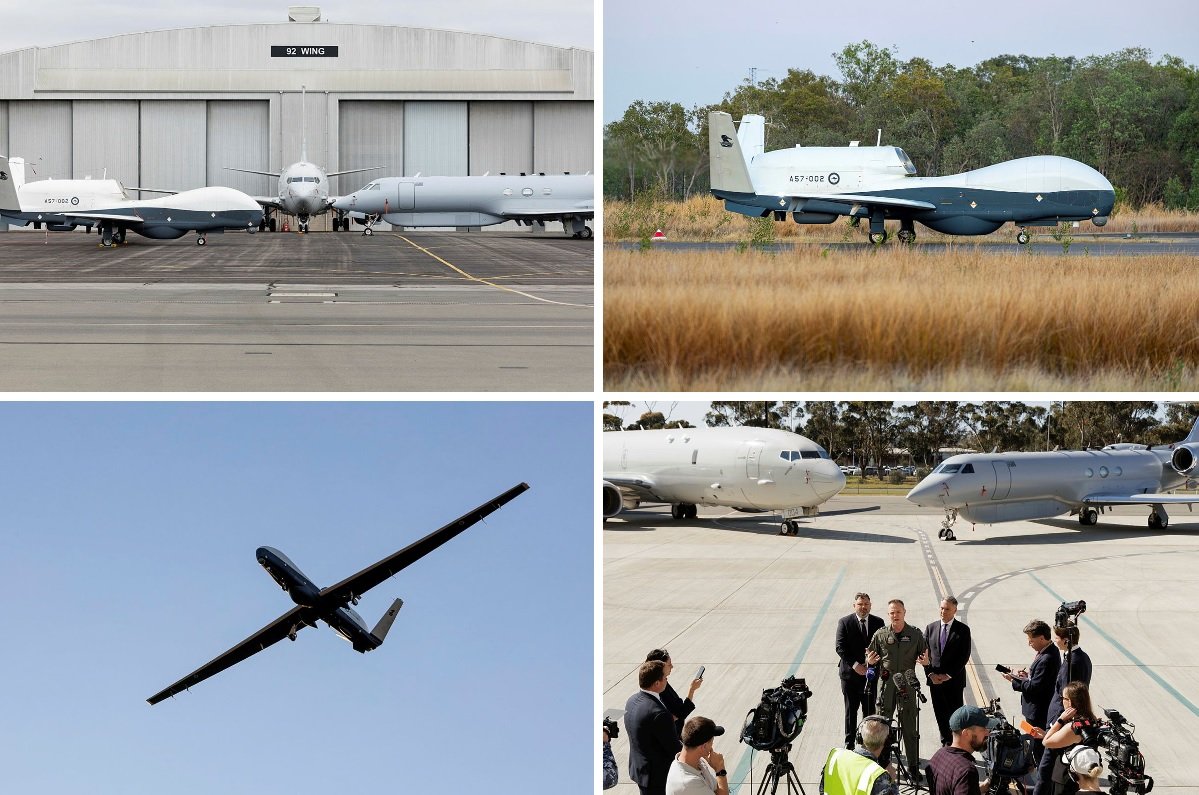
CANBERRA — The Royal Australian Air Force (RAAF) has achieved Initial Operational Capability (IOC) for both the MQ-4C Triton and MC-55A Peregrine, expanding Australia’s long-range intelligence, surveillance and reconnaissance (ISR) capabilities.
The Australian Department of Defence announced the milestones on September 22, 2026, following extensive operational testing and evaluation.
MQ-4C Triton Enters Operational Service
The MQ-4C Triton, supported by Northrop Grumman Australia, will provide persistent long-range ISR across Australia’s primary area of military interest.
The aircraft are based at RAAF Base Tindal in the Northern Territory, while Number 9 Squadron, based at RAAF Base Edinburgh in South Australia, operates the system. Northrop Grumman Australia supports operations from both locations.
Australia is acquiring four Tritons through a cooperative program with the U.S. Navy. The first aircraft arrived in July 2024, followed by the second and third in May 2025. The fourth remains in production and is scheduled for delivery in 2028.
New Triton facilities at Tindal were delivered under a A$355.7 million project and opened earlier in 2026.
Triton to Work With Poseidon and Peregrine
The Triton is part of the broader 2026 National Defence Strategy investment in complementary crewed and uncrewed aircraft.
It will operate alongside the RAAF’s P-8A Poseidon maritime patrol aircraft and MC-55A Peregrine to support persistent surveillance, intelligence collection, maritime patrol and electronic warfare.
Australia received its 14th and final P-8A Poseidon in May 2026, completing the fleet used for maritime patrol, anti-submarine warfare and anti-surface warfare.
The first two P-8As have received Increment 3 Block 2 enhancements. The remaining 12 aircraft will receive the upgrades in Australia with support from Boeing Defence Australia and local industry partners.
The work will be conducted at the newly opened A$200 million Deep Maintenance and Modification Facility at RAAF Base Edinburgh. The 14 Poseidons are based at Edinburgh and operated by Numbers 11, 12 and 292 Squadrons.
MC-55A Peregrine Achieves IOC
The MC-55A Peregrine has also achieved IOC after completing operational testing and evaluation.
The aircraft is an airborne intelligence, surveillance, reconnaissance and electronic warfare platform based on the Gulfstream G550 airframe and extensively modified by L3Harris.
Australia has received three of four Peregrines, with the fourth and final aircraft expected later in 2026. The fleet is based at RAAF Base Edinburgh and operated by Number 10 Squadron.
Edinburgh Becomes Key ISR Hub
The concentration of the Triton, Poseidon and Peregrine fleets at RAAF Base Edinburgh is increasing South Australia’s role in Australia’s air intelligence and surveillance enterprise.
South Australia’s defence industry generated A$2 billion in economic activity in the last financial year, according to the Australian Government.
Acting Prime Minister and Defence Minister Richard Marles said South Australia is becoming an important hub for advanced Defence capabilities and highly skilled Australian jobs.
The Albanese Government is investing approximately A$5.5 billion over the decade to enhance the Australian Defence Force’s air ISR and maritime patrol and response capabilities, with further opportunities expected for Australian industry.
Chief of Air Force Air Marshal Stephen Chappell credited military personnel, public servants and defence industry partners for bringing the new systems into service.
He said the Triton’s IOC represents an important step in delivering persistent, long-range maritime surveillance and strengthening Australia’s air intelligence, surveillance and reconnaissance capability.
——— End of Article ———