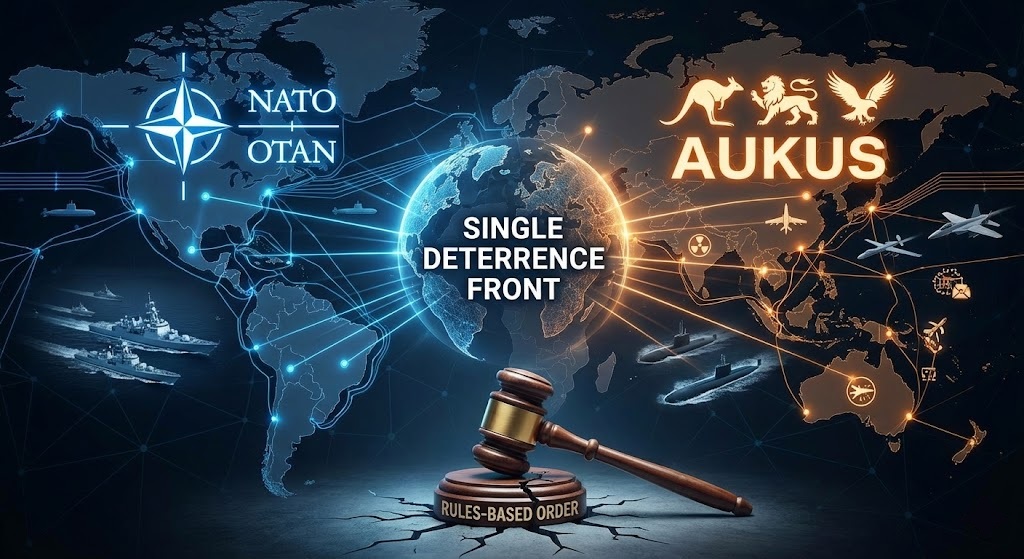
LONDON/WASHINGTON : As Western officials increasingly concede that the post–Cold War “rules-based international order” is fraying, a new strategic assessment argues that realism—not idealism— now governs global security. A report by the Council on Geostrategy, Britain’s World: The Strategy of Security in Twelve Geopolitical Maps, lays out how the United States, the United Kingdom and Australia are attempting to adapt by knitting together the Euro-Atlantic and Indo-Pacific theatres into a single deterrence architecture—an approach that places undersea power, Arctic geography and alliance cohesion at its core.
The study arrives amid renewed debate over the durability of NATO, the purpose of AUKUS and the political shockwaves that would follow any attempt at forced territorial revision among allies, including a hypothetical U.S. annexation of Greenland. While such a move could appear to strengthen American leverage in the Arctic, the report and allied analysts warn that the political damage would far outweigh any operational gain, potentially undermining the very partnerships designed to manage an increasingly hostile world.
AUKUS Beyond Asia
AUKUS, the trilateral defence and technology partnership launched by the United States, the United Kingdom and Australia, is often portrayed as a narrowly focused effort to counter China in the Indo-Pacific. The Council on Geostrategy report challenges that view, presenting AUKUS as a pillar of a broader Western response to a tightening alignment among China, Russia, Iran and North Korea—referred to by analysts as “CRINK.”
The partnership rests on two central tracks. The first is the expansion of Australia’s fleet of nuclear-powered attack submarines, a move intended to extend endurance, stealth and reach across vast maritime spaces. The second is deep cooperation on advanced military technologies—ranging from quantum systems and artificial intelligence to hypersonic weapons and undersea sensing—that are increasingly decisive in modern warfare.
Crucially, the report argues that AUKUS is not designed to “defeat” CRINK outright. Instead, it is meant to strengthen Western resilience by allowing pressure to be managed simultaneously in Europe and Asia, reducing the risk that the United States becomes strategically overstretched while facing coordinated challenges across multiple regions.
Linking NATO and AUKUS
At the heart of the report is a “NATO first, but not NATO only” formula. NATO, the authors stress, remains the cornerstone of European security. Yet large, consensus-based institutions often struggle to move at the pace demanded by technological change and grey-zone threats. As a result, smaller and denser formats such as AUKUS are seen as necessary complements, rather than competitors.
This linkage is most visible in the undersea domain. According to the report, British submarines developed under the AUKUS framework are likely to spend significant time in the Atlantic—possibly more than in the Indo-Pacific—reinforcing deterrence against Russia and strengthening control of critical maritime chokepoints. In this sense, AUKUS directly supports NATO’s core mission, even as it extends Western capabilities far beyond Europe.
The ‘Wide North’ and the Undersea Frontline
One of the report’s most detailed sections focuses on what it calls the “Wide North”: the Arctic approaches, the Greenland–Iceland–UK (GIUK) gap, and Russia’s heavily militarised bastion on the Kola Peninsula. This region, long central to Cold War planning, has re-emerged as a strategic fault line as melting ice opens new routes and undersea infrastructure becomes ever more vital.
The authors describe the Wide North as a classic grey-zone environment. Here, hostile actions—such as interference with undersea cables, pipelines or seabed sensors—can be conducted with plausible deniability, complicating attribution and response. In such a scenario, the decisive assets are not only warships and aircraft, but also persistent underwater surveillance, rapid repair capabilities and seamless intelligence sharing among allies.
Undersea cables, which carry the overwhelming majority of global data traffic, are singled out as a critical vulnerability. Disruption would have immediate economic, military and political consequences, making their protection a central task for both NATO and AUKUS partners.
Greenland and the Cost of Broken Trust
It is against this backdrop that the report assesses the implications of a hypothetical U.S. annexation of Greenland or a broader collapse of NATO cohesion. While direct American control over Greenland could, in theory, enhance U.S. military positioning in the Arctic, the authors argue that the political fallout would be catastrophic.
AUKUS depends on long-term trust: the sharing of nuclear propulsion technology, integrated production chains, the exchange of highly sensitive intelligence and sustained political support across multiple democracies. Any act of forced territorial seizure from a NATO ally would immediately cast doubt on U.S. reliability, fuelling domestic backlash in the United Kingdom and Australia and prompting calls for safeguards against excessive dependence on Washington.
Such a rupture would not only weaken AUKUS politically; it would also complicate Western strategy at a time when coordination is most needed. If NATO were to fracture, the United States would face an unenviable choice: divert scarce resources—including shipbuilding capacity, submarine maintenance, personnel and intelligence—back to Europe, or scale down its European commitments, creating openings for Russian exploitation.
A More Dangerous, Fragmented Order
In either scenario, the report concludes, the security environment would become more chaotic. Fragmentation among allies would be a gift to adversaries adept at operating below the threshold of open conflict. Grey-zone attacks on undersea infrastructure, already difficult to attribute, would become harder still to deter without unified political will and integrated military planning.
The Council on Geostrategy’s assessment offers a stark message for a post-order world. Even as realism replaces idealism, alliances cannot be treated as disposable tools of convenience. In an era defined by interconnected theatres, undersea competition and networked adversaries, the credibility of partnerships like NATO and AUKUS may prove as decisive as any submarine or missile system.
——— End of Article ———