HOUSTON, — April 5, 2026 : The four astronauts aboard NASA’s Artemis II mission have crossed the halfway point of their journey to the Moon, as the Orion spacecraft continues outbound toward a scheduled lunar flyby on Monday, April 6, 2026. The mission, which launched on April 1, 2026, from Kennedy Space Center in Florida, marks the first crewed flight beyond low Earth orbit since Apollo 17 in 1972, ending a gap of more than 53 years.
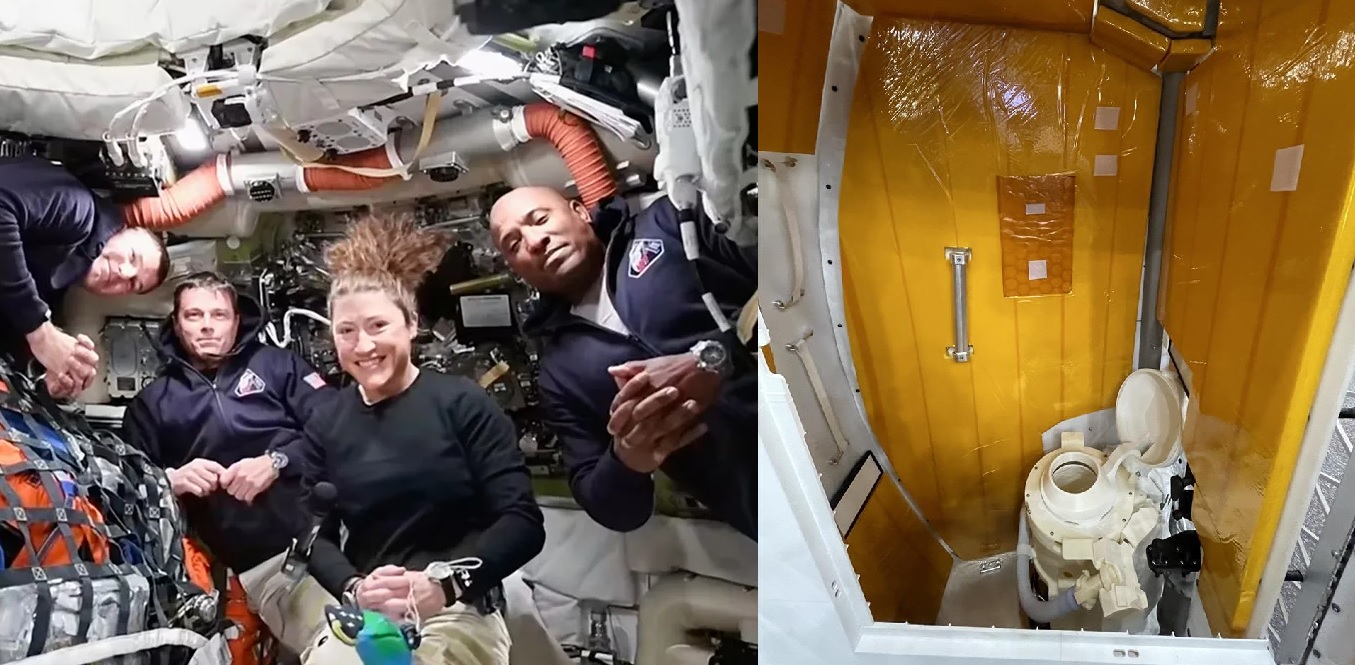
The crew—Commander Reid Wiseman, Pilot Victor Glover, Mission Specialist Christina Koch, and Canadian Space Agency astronaut Jeremy Hansen—is conducting system checks and observations during the transit. The spacecraft is expected to travel more than 252,000 miles (approximately 406,000 kilometers) from Earth, surpassing the human spaceflight distance record set by Apollo 13 in 1970.
Mid-Mission Operations and Flight Milestones
As Orion approaches the Moon, the crew is preparing to execute a lunar fly-around trajectory rather than entering orbit. The spacecraft will pass approximately 4,000 miles (6,400 kilometers) beyond the lunar surface and capture imagery of the Moon’s far side before performing a return trajectory to Earth.
Pilot Victor Glover reported during a transmission that Earth is now visibly distant, stating that “the Earth is quite small, and the Moon is definitely getting bigger.” The astronauts have also captured imagery of Earth during the outbound phase.
The Artemis II crew includes several historic firsts: Christina Koch is the first woman assigned to a lunar mission, Victor Glover is the first Black astronaut on a lunar trajectory, and Jeremy Hansen is the first non-U.S. astronaut to participate in a Moon-bound mission.
Waste Management System Malfunction
During transit, engineers and crew have been addressing a recurring issue with Orion’s Universal Waste Management System. The spacecraft’s toilet, responsible for venting liquid waste and storing solid waste, has experienced intermittent malfunctions since shortly after launch.
Mission controllers identified a suspected ice blockage in the wastewater vent line, which prevented proper venting of urine overboard. Artemis II Flight Director Judd Frieling confirmed that attempts to vent the wastewater tank overnight between April 4 and April 5 were unsuccessful due to the blockage.
As a contingency, astronauts have been directed to use collapsible urine collection devices, similar to procedures employed earlier in the mission on flight day one. Engineers instructed the crew to reorient the spacecraft to expose the affected vent line to solar radiation. This maneuver partially resolved the issue, allowing approximately half of the accumulated liquid waste to be vented.
The toilet system remains operational for solid waste but is not functioning at full capacity. NASA continues to monitor and troubleshoot the issue.
Debbie Korth, Orion program deputy manager, stated that astronauts also reported an odor originating from the bathroom compartment, which is located in the floor of the capsule and enclosed by a door and curtain. She noted that waste management systems have historically posed engineering challenges, including during the Space Shuttle program.
John Honeycutt, chair of the Artemis II mission management team, said the crew’s safety is not affected and emphasized that astronauts trained for such contingencies. He stated that the spacecraft remains in a stable condition, though efforts are ongoing to restore full toilet functionality.
Additional Technical Issues
In addition to the waste system problem, the crew previously resolved an early mission issue involving the toilet pump, which was attributed to insufficient water priming shortly after liftoff on April 1. That issue was corrected without further impact.
NASA also confirmed that one of the crew’s onboard laptop computers has become non-operational. The astronauts are continuing mission activities using the remaining three functional laptops.
International Participation and Mission Timeline
The Canadian Space Agency (CSA) highlighted Jeremy Hansen’s participation as a milestone for international collaboration. CSA President Lisa Campbell, speaking from Quebec, stated that Hansen’s role reflects Canada’s contribution to human space exploration. Hansen has reported observing “extraordinary” views from Orion during the journey.
The Artemis II mission is scheduled to conclude with a Pacific Ocean splashdown off the coast of San Diego on April 10, 2026, completing a flight duration of approximately 10 days.
Program Objectives and Future Plans
Artemis II serves as a crewed test flight of NASA’s Orion spacecraft and Space Launch System (SLS) rocket, validating systems required for future lunar missions. The mission does not include a landing but is designed to certify hardware and operational procedures.
NASA’s Artemis program aims to conduct a crewed lunar landing near the Moon’s south pole by 2028, as part of a broader objective to establish a sustained human presence on the lunar surface.
Aside from the ongoing waste management system issue, mission operations are proceeding as planned, with astronauts continuing scheduled activities and system evaluations during the outbound phase toward the Moon.
——— End of Article ———