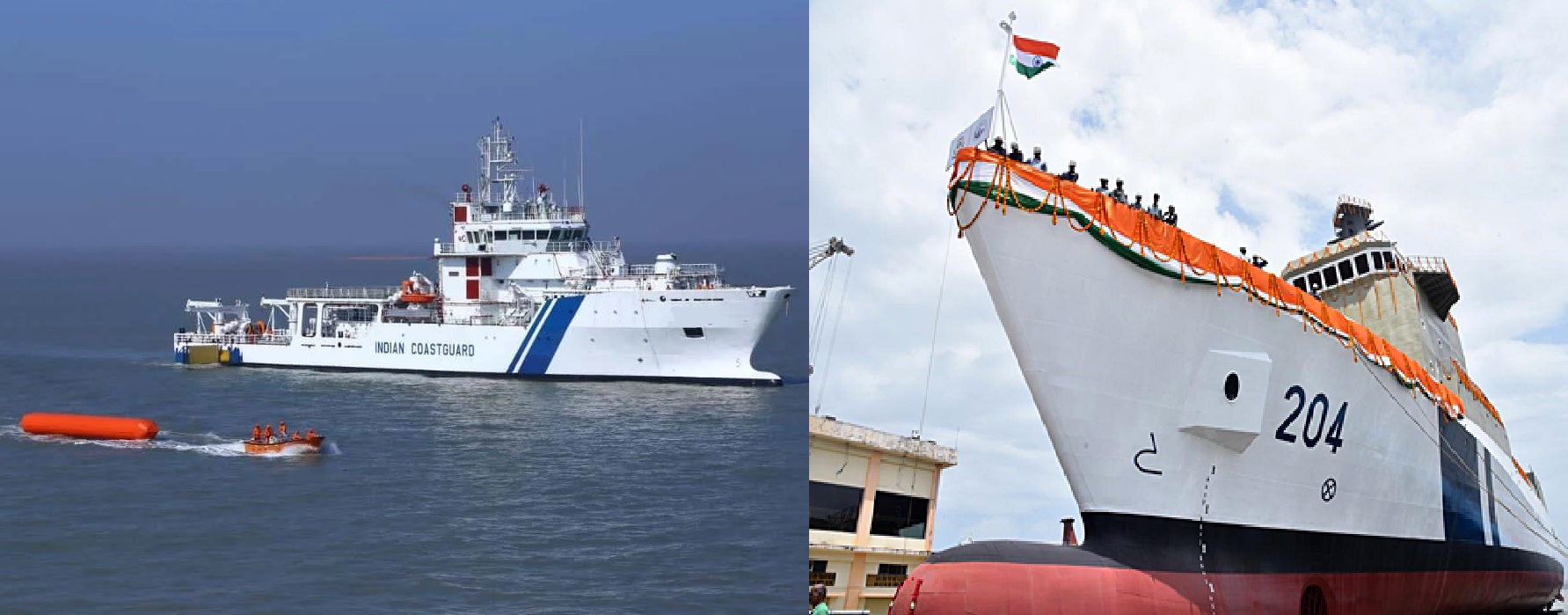
New Delhi / Goa: India is set to significantly strengthen its maritime environmental protection and coastal security architecture with the commissioning of Samudra Pratap, the first indigenously designed and built Pollution Control Vessel (PCV) of the Indian Coast Guard. The vessel will be formally inducted into service on January 5, 2026, with Defence Minister Rajnath Singh presiding over the ceremony at Goa Shipyard Limited (GSL), officials confirmed on Sunday.
Delivered to the Coast Guard in December 2025, Samudra Pratap is the largest and most advanced pollution control vessel ever operated by the ICG. The ship represents a major milestone for Aatmanirbhar Bharat, featuring over 60 per cent indigenous content, a figure expected to rise further as domestic systems mature.
Built for Speed, Endurance and Scale
Measuring 114.5 metres in length and displacing 4,200 tonnes, Samudra Pratap has been engineered for sustained operations across India’s vast maritime domain. The vessel can achieve speeds of more than 22 knots and boasts an operational endurance of 6,000 nautical miles, enabling long-range deployment deep into the Exclusive Economic Zone (EEZ) and beyond coastal waters.
Its size and endurance allow the ship to remain on station for extended periods during environmental emergencies, oil spill containment missions, or maritime safety operations, a capability India has historically lacked at scale.
How Samudra Pratap Controls Marine Pollution
At the core of Samudra Pratap’s mission is marine pollution response and mitigation. The vessel is equipped with advanced oil spill response systems capable of detecting, containing, and recovering hydrocarbons from the sea surface. Its oil fingerprinting machine allows authorities to scientifically identify the source of oil spills, a critical tool for enforcing international pollution laws and holding polluters accountable.
The ship carries gyro-stabilised stand-off active chemical detectors, enabling real-time identification of hazardous chemicals from a safe distance. This capability is particularly crucial during industrial accidents, tanker mishaps, or chemical discharges along busy shipping lanes.
In addition, Samudra Pratap can deploy specialised booms and recovery equipment to isolate oil slicks, prevent shoreline contamination, and support coordinated clean-up operations alongside other national agencies.
Firefighting, Law Enforcement and Search & Rescue
Beyond pollution control, Samudra Pratap is designed as a multi-role maritime asset. The vessel features a high-capacity external firefighting system, allowing it to combat fires aboard ships, offshore installations, or port infrastructure. This system significantly enhances India’s ability to respond to maritime disasters involving fuel or hazardous cargo.
For maritime law enforcement and security, the vessel is armed with a 30mm CRN-91 gun and two 12.7mm stabilised remote-controlled guns, all integrated with modern fire control systems. These provide precision engagement capability while ensuring crew safety during high-risk operations.
The ship also supports search and rescue (SAR) missions, carrying sea boats and pollution response (PR) boats with dedicated davits, enabling rapid deployment during emergencies involving distressed vessels or environmental incidents.
Advanced Indigenous Technology Suite
Samudra Pratap incorporates a range of indigenously developed systems, including an Integrated Bridge System, Integrated Platform Management System, and Automated Power Management System. The inclusion of a shaft generator improves fuel efficiency and reduces emissions during cruising operations, aligning operational capability with environmental responsibility.
These systems allow centralized monitoring of propulsion, power, navigation, and safety functions, reducing crew workload and improving operational reliability during complex missions.
Strategic Significance
The commissioning of Samudra Pratap marks a decisive upgrade in India’s maritime pollution response capabilities at a time of rising commercial traffic, offshore energy activity, and environmental risk in the Indian Ocean Region. Officials said the vessel will play a critical role in enforcing marine pollution control regulations, safeguarding sea lanes, and reinforcing India’s commitment to international maritime environmental standards.
As the first of two Pollution Control Vessels planned for the Indian Coast Guard, Samudra Pratap sets a new benchmark for indigenous shipbuilding and underscores India’s growing ability to design and deploy complex, mission-critical maritime platforms at home.
——— End of Article ———