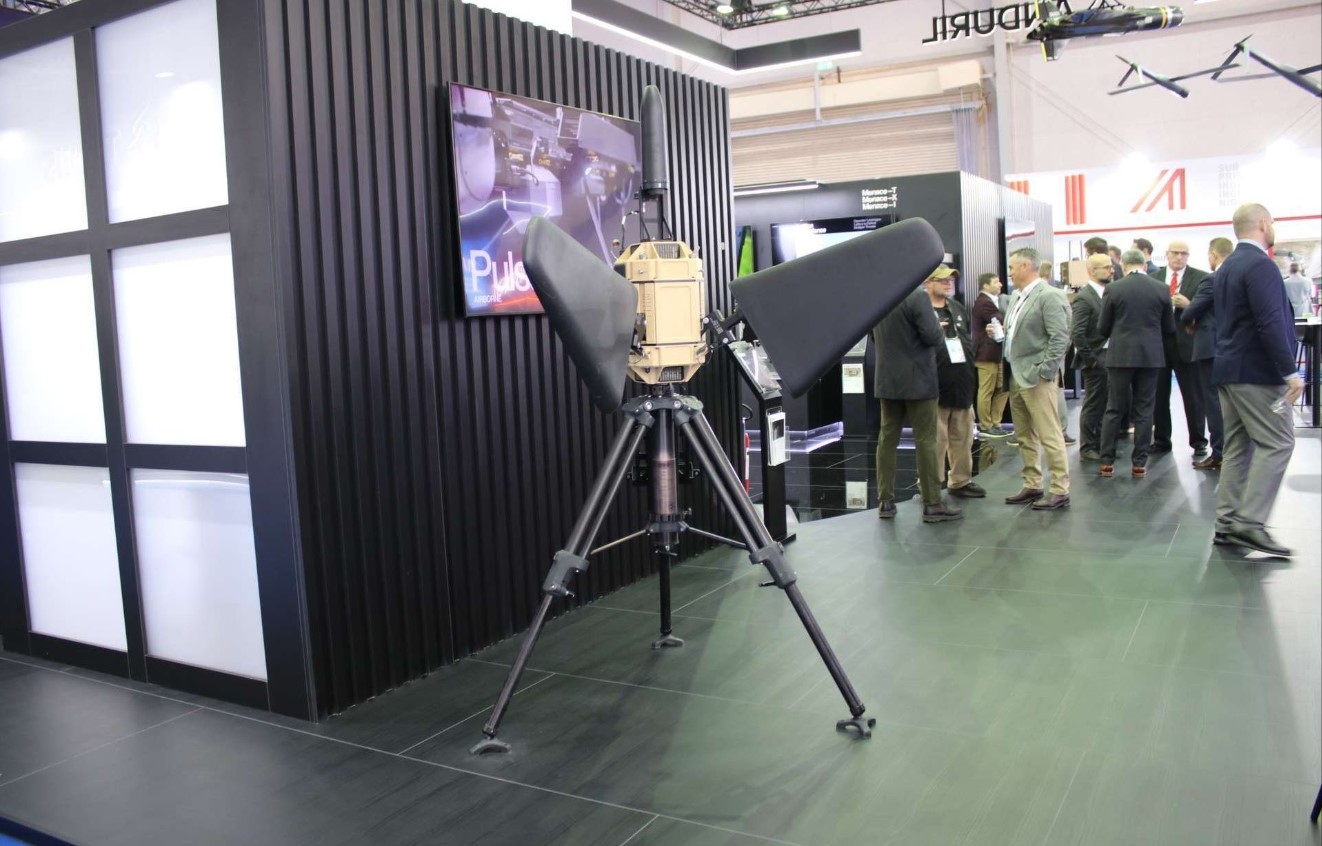
RIYADH : At the 2026 World Defense Show in Saudi Arabia, U.S.-based defense technology company Anduril Industries presented its Pulsar electronic warfare (EW) system, underscoring a growing shift among militaries toward networked, software-defined counter-unmanned aerial system (C-UAS) architectures.
The Pulsar system was displayed as a tripod-mounted, 360-degree radio frequency (RF) detection and jamming node designed to counter small unmanned aerial systems and radio-triggered threats at the tactical edge. The exhibition reflected a broader procurement transition from single-purpose, handheld counter-drone devices toward integrated electromagnetic systems capable of operating within layered defense networks.
System Configuration and Technical Specifications
The Pulsar system shown in Riyadh was configured as an expeditionary, fixed-site effector with an effective range of up to 2 kilometers against Group 1 unmanned aerial systems. These targets typically include small, low-altitude drones that pose short-range threats to tactical deployments, forward operating bases, and critical infrastructure.
The system is engineered for deployment in demanding environmental conditions. It carries an IP65 environmental sealing rating and operates within a temperature range of –30°C to +65°C, supporting operations in high-altitude cold regions as well as desert climates.
Power requirements remain below 4 kilowatts. The system accepts 110 to 240 VAC at 50/60 Hz, enabling operation from standard generators, shore power connections, or vehicle-based inverters. This configuration reduces logistical requirements compared to legacy electronic warfare shelters and vehicle-mounted EW suites.
Development and Operational Use
According to company representatives, the Pulsar product line has been internally funded and under development since 2020. Although publicly revealed in 2024, the system is already in operational use by U.S. forces across multiple global theaters. Specific deployment locations and additional international operators have not been publicly disclosed.
In 2022, United States Special Operations Command awarded an integration contract involving Pulsar capabilities. The system has also been incorporated into U.S. Marine Corps installation-level counter-small UAS planning, where its RF sensing and electronic warfare functions are integrated within Anduril’s Lattice command-and-control architecture.
Networked Architecture and Rapid Reprogramming
A central feature of Pulsar is its software-defined, networked architecture. The system is designed to passively sense and classify RF activity in its operating environment. It provides direction finding and geolocation data that can cue external radar systems, electro-optical sensors, or ground patrol units.
When a novel signal or waveform is detected by one deployed unit, the collected detection data and associated countermeasures can be analyzed and distributed across other deployed Pulsar systems within hours or days. This update cycle contrasts with older electronic warfare platforms that required months to incorporate new threat libraries.
The architecture addresses rapidly evolving drone control links, navigation aids, and data transmission methods. Through fleet-wide software updates, the system seeks to mitigate obsolescence caused by changing adversary waveforms.
Operational Role in Counter-UAS and Counter-IED Missions
Operationally, Pulsar conducts passive RF sensing before initiating electronic attack functions. Once a threat is identified and classified, the system delivers focused electronic disruption to sever command-and-control links or interfere with mission execution.
Beyond counter-UAS operations, the Pulsar family is used to counter radio-frequency-triggered improvised explosive devices (IEDs). By targeting RF triggers, the system enhances force protection during convoy operations and base security missions.
Commanders employing the system gain spectrum awareness, attribution data related to threat controllers, and the ability to shape the local electromagnetic environment, supporting continued friendly communications and maneuver while degrading adversary-controlled systems.
Layered Defense Integration
Pulsar is designed to function within a layered defense architecture rather than as a standalone solution. It integrates with radar sensors, electro-optical systems, and kinetic interceptors to provide overlapping coverage of protected sites.
The system is positioned to defend air bases, naval facilities, ammunition depots, border installations, and other critical infrastructure. Compared with man-portable drone disruption devices and traditional vehicle-based EW suites, Pulsar emphasizes autonomous spectrum analysis and networked coordination among multiple nodes.
Future Development
Reporting on a newer Pulsar L variant indicates efforts to reduce size, weight, and power (SWaP) requirements while scaling production. This approach aims to expand access to dense electronic warfare coverage for a broader range of military forces.
Operational planning assumes continued adaptation by adversaries, including increased use of autonomous drones and alternative navigation schemes. As a result, systems such as Pulsar are structured for continuous software updates and integration within multi-layer counter-UAS architectures, rather than reliance on static jamming capabilities alone.
The presentation of Pulsar at the 2026 World Defense Show reflects an ongoing shift in electronic warfare doctrine, emphasizing networked, updateable spectrum operations tailored to emerging unmanned and radio-triggered threats.
——— End of Article ———