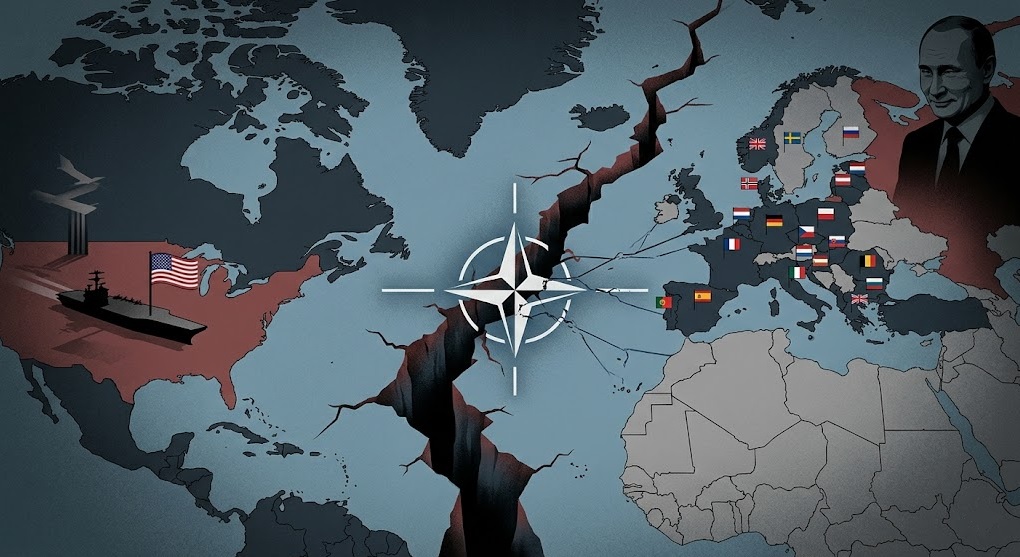
WASHINGTON — April 1, 2026 : A growing policy debate in Washington over the future of the North Atlantic Treaty Organization (NATO) has moved into the mainstream, with senior U.S. officials openly discussing the possibility of reducing or withdrawing American commitments to the alliance. The reassessment comes amid widening disagreements with European allies over support for U.S. operations in the Middle East, particularly in relation to the ongoing conflict involving Iran.
Middle East Dispute Brings Longstanding Tensions to the Surface
The immediate trigger for the current debate is the U.S.-Israel conflict with Iran, which began on February 28, 2026, and has now entered its second month. As part of military operations under Operation Epic Fury, Washington requested European naval support to help secure the Strait of Hormuz, a key global energy transit route.
Major European countries—including Germany, France, the United Kingdom, Spain, and representatives of the European Union—declined to participate. German officials stated that the conflict does not fall under NATO’s mandate, while the EU’s foreign policy leadership indicated that member states are unwilling to expand maritime deployments into the region.
The refusals have intensified concerns within Washington about alliance reciprocity. U.S. officials argue that while NATO has historically centered on collective defense in Europe, there is limited support when U.S. strategic priorities shift beyond the continent.
U.S. Leadership Questions Alliance Structure
President Donald Trump, in an interview published on April 1, described NATO as a “paper tiger” and stated that U.S. withdrawal from the alliance is now “beyond reconsideration.” His remarks reflect a broader shift in how parts of the U.S. political leadership assess the alliance’s utility.
Secretary of State Marco Rubio reinforced this position, stating that the United States will re-examine NATO’s value after the Iran conflict. He noted that the current arrangement appears imbalanced, with the U.S. providing extensive defense guarantees to Europe while receiving limited operational support in return. Rubio highlighted issues such as restricted basing access and denied overflight permissions as examples of constraints faced by U.S. forces.
Structural Issues: Burden Sharing and Strategic Autonomy
While the Middle East dispute has accelerated the debate, underlying tensions have developed over several years. Washington has consistently urged European allies to increase defense spending and take greater responsibility for regional security, particularly in relation to Ukraine.
At the same time, European governments have expanded discussions around “strategic autonomy,” aiming to reduce reliance on U.S. military support. This has included limiting participation in certain U.S.-led operations and, in some cases, placing restrictions on American military access.
U.S. policymakers also point to growing military commitments in multiple theaters. Ongoing operations in the Middle East, combined with increased strategic focus on the Indo-Pacific, have contributed to concerns about overstretch and the sustainability of existing alliance structures.
Potential Impact on European Security
A significant reduction in U.S. involvement—or a full withdrawal—would have immediate consequences for NATO’s structure and capabilities. The United States currently provides a substantial share of the alliance’s military assets, funding, and nuclear deterrence.
Without this support, the balance of power in Europe would shift. Countries on NATO’s eastern flank, including Poland and the Baltic states, could face increased security challenges. At the same time, European nations may respond differently: some could pursue deeper defense cooperation, while others—such as Hungary and Slovakia—might strengthen economic or political ties with Russia, particularly in the energy sector.
Strategic Implications for Russia
Analysts assess that a reduced U.S. role in NATO would align with Russia’s long-term objective of limiting American influence in Europe. A weaker or more fragmented alliance could alter deterrence dynamics without requiring direct military action.
Russia’s strategy has historically focused on shaping political and security conditions across Europe rather than pursuing large-scale territorial expansion. Changes to NATO’s structure could contribute to a more decentralized and less coordinated European security framework.
Ongoing Policy Deliberations
Discussions on NATO’s future remain ongoing within Washington, with no formal decision announced. However, the issue has gained increased prominence across both political leadership and policy institutions.
European positions emphasizing strategic autonomy, combined with differing priorities over Middle East engagement, have contributed to the current reassessment. U.S. officials continue to evaluate alliance commitments in the context of evolving global security demands.
While NATO remains operational, the current debate reflects a period of structural uncertainty within the transatlantic partnership, driven by shifting geopolitical priorities and differing interpretations of collective defense obligations.
——— End of Article ———