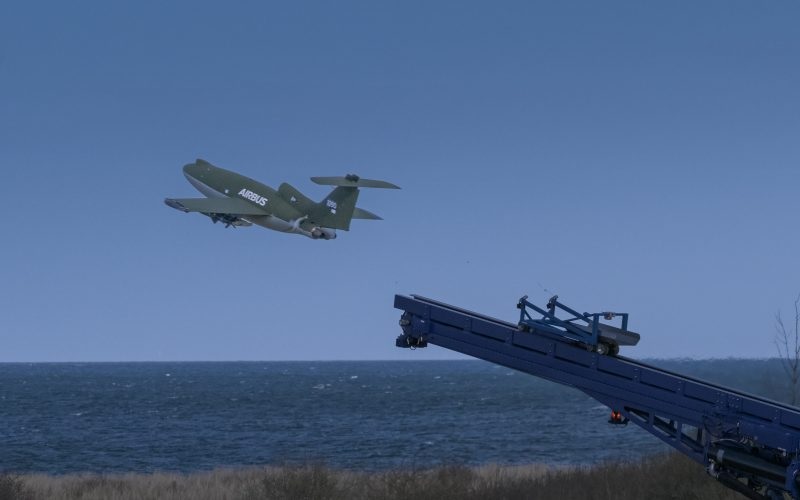
Northern Germany, — March 30, 2026 : Airbus Defence and Space has completed the first demonstration flight of its “Bird of Prey” unmanned interceptor drone at a military training range in northern Germany, marking a significant step in the development of low-cost counter-unmanned aerial systems (C-UAS). The test validated the platform’s ability to autonomously detect, classify and engage a medium-sized one-way attack drone using a guided missile system developed by Estonia-based Frankenburg Technologies.
Demonstration Flight and Autonomous Engagement
The demonstration, conducted nine months after the program’s initiation, involved a fully autonomous mission profile. The interceptor drone independently searched for the target, identified and classified it, and subsequently engaged it using a Mark I guided missile. This test also marked the first recorded launch of the Mark I missile from an airborne platform.
The trial was designed to simulate real-world threats posed by one-way attack drones, commonly referred to as kamikaze or loitering munitions. The successful engagement demonstrated the system’s capability to operate without direct human intervention during the targeting and interception phases.
Platform Design and Specifications
The Bird of Prey is derived from a modified Airbus Do-DT25, a jet-powered aerial target drone that has been in operational service since 2002 for missile training purposes. The adapted interceptor platform measures 3.1 metres in length, with a wingspan of 2.5 metres and a maximum take-off weight of 160 kilograms.
During the demonstration flight, the prototype configuration carried four Mark I missiles. Airbus has indicated that the planned production variant will be capable of carrying up to eight missiles, allowing the platform to engage multiple aerial threats within a single mission.
The reuse of the Do-DT25 platform is part of Airbus’ approach to accelerate development timelines while reducing costs by leveraging an existing, proven airframe.
Mark I Guided Missile Characteristics
The Bird of Prey’s interception capability is enabled by the Mark I guided missile developed by Frankenburg Technologies. The missile is 65 centimetres long and weighs less than two kilograms, making it one of the lightest guided interceptors currently in development.
It operates at high-subsonic speed with an engagement range of up to 1.5 kilometres, with some configurations extending toward 2 kilometres. The system follows a fire-and-forget principle, enabling the missile to autonomously navigate toward its target after launch.
Guidance is supported by inertial navigation for mid-course correction and onboard sensors for terminal targeting, allowing the system to function in contested electromagnetic environments with resistance to electronic warfare interference. The missile is equipped with a fragmentation warhead designed to detonate in close proximity to the target.
Frankenburg Technologies has adopted a manufacturing approach based largely on commercially available components, aimed at achieving low production costs and enabling high-volume output.
Integration into Air Defence Networks
The interceptor system is designed for integration into NATO-compatible air defence frameworks. It operates in conjunction with Airbus’ Integrated Battle Management System (IBMS), which provides centralized command and control, enabling coordinated operations with other air and missile defence assets.
This integration allows the Bird of Prey to function as part of a layered defence architecture, contributing to the interception of low-cost aerial threats that may otherwise saturate traditional air defence systems.
Industry Statements
Mike Schoellhorn, Chief Executive Officer of Airbus Defence and Space, stated that countering one-way attack drones has become a key operational requirement in current conflict environments. He noted that combining an unmanned interceptor platform with low-cost guided munitions offers a practical and scalable response to emerging threats.
Kusti Salm, Chief Executive Officer of Frankenburg Technologies, described the system as a new approach to air defence, emphasizing the combination of affordability, scalability and autonomous operation.
Development Timeline and Next Steps
Following the initial demonstration, Airbus and Frankenburg Technologies plan to conduct additional test flights throughout 2026. These trials will include engagements using live combat ammunition to further validate system performance under operational conditions.
The ongoing test campaign is intended to complete the development cycle and demonstrate readiness for potential military customers. The program also reflects a broader industry trend toward rapidly deployable, cost-efficient solutions for countering unmanned aerial threats.
——— End of Article ———