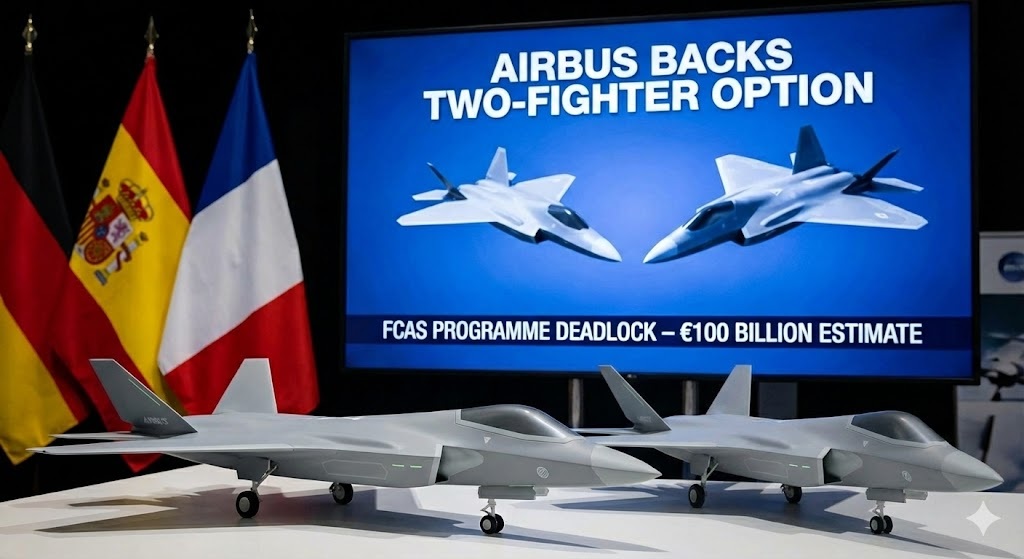
TOULOUSE / BERLIN / PARIS : Airbus has stated it would support the development of two separate fighter jets under the €100 billion Future Combat Air System (FCAS) programme if participating governments formally request such an arrangement, as disagreements over governance and industrial leadership continue to delay progress on Europe’s flagship sixth-generation combat aircraft initiative.
The FCAS programme, launched in 2017 by France and Germany, with Spain joining later, aims to develop a next-generation air combat system to replace France’s Rafale fighter jets and the Eurofighter Typhoons operated by Germany and Spain. The project includes not only a new fighter aircraft — the Next Generation Fighter (NGF) — but also remote carrier drones and a combat cloud network designed to connect assets across air, land and sea domains.
Airbus Chief Executive Guillaume Faury said the company would adapt to a revised structure if governments opt for parallel fighter developments. He stated that Airbus is prepared to assume a leading role under a two-fighter configuration, if mandated by partner nations. At the same time, he emphasized that disputes affecting one component should not undermine the broader high-technology defence framework.
Governance Dispute Between Dassault and Airbus
The programme has faced repeated delays due to governance disputes between Dassault Aviation and Airbus, which represents German and Spanish industrial interests in the aircraft pillar of FCAS.
The disagreement centres on leadership structure, workshare allocation and intellectual property control during the NGF development phase. Airbus has indicated that expectations differ regarding what constitutes leadership and cooperation in managing the aircraft component.
German political and industrial stakeholders have raised concerns that Dassault Aviation has sought to revise previously agreed arrangements in a manner that would increase its authority over fighter development. Dassault, which leads the NGF pillar, has maintained that clear leadership is required to ensure technical coherence and timely execution.
In September 2025, Dassault Aviation Chairman and Chief Executive Eric Trappier stated publicly that his company could develop the future fighter independently if necessary, indicating that differences with German partners would not prevent Dassault from proceeding on its own.
Divergent Military Requirements
Differences in national defence requirements have added complexity to the programme.
France requires a fighter capable of carrying nuclear weapons as part of its airborne nuclear deterrent and operating from an aircraft carrier. Germany and Spain do not share identical operational requirements, particularly regarding carrier-based operations.
German Chancellor Friedrich Merz recently signalled that Berlin could consider abandoning the unified fighter element of the FCAS programme if structural disagreements persist. His remarks reflected concerns about alignment between German military requirements and the current project framework.
France and Spain Reaffirm Commitment
France has reiterated its support for the FCAS programme. The office of President Emmanuel Macron described the ongoing inability to resolve governance disputes as “incomprehensible”, especially at a time when European defence cooperation is considered strategically important. Paris continues to describe FCAS as central to Europe’s long-term defence autonomy.
Spain’s defence ministry has confirmed that Madrid remains fully committed to the programme in accordance with the 2019 framework agreement signed by the participating countries.
Scope and Cost of the Programme
The FCAS initiative is estimated to cost approximately €100 billion over its development lifecycle.
The programme is structured around several key pillars:
-
Next Generation Fighter (NGF) — the core crewed aircraft.
-
Remote carrier drones — designed to operate alongside the fighter.
-
Combat cloud system — enabling secure, networked data exchange.
-
Advanced enabling technologies — including sensors and propulsion systems.
While the NGF pillar remains stalled due to governance issues, Airbus has stated that progress continues in other areas, including drone systems development and the digital combat cloud infrastructure.
Strategic Implications
FCAS is regarded as a central component of European defence cooperation and efforts to maintain advanced aerospace capabilities within Europe. The programme also aims to preserve industrial competitiveness for participating nations in the global combat aircraft sector.
Airbus indicated that a formally adopted two-fighter solution could potentially open the door to additional international participation, subject to decisions by the partner governments.
Any structural modification to the programme would require agreement among France, Germany and Spain. The future configuration of Europe’s next-generation air combat system remains dependent on ongoing political and industrial negotiations among the participating states.
——— End of Article ———