BRUSSELS — March 13, 2026 : Airbus Defence and Space is accelerating development of an operational Uncrewed Collaborative Combat Aircraft (UCCA) capability for the German Air Force, targeting initial operational availability by 2029.
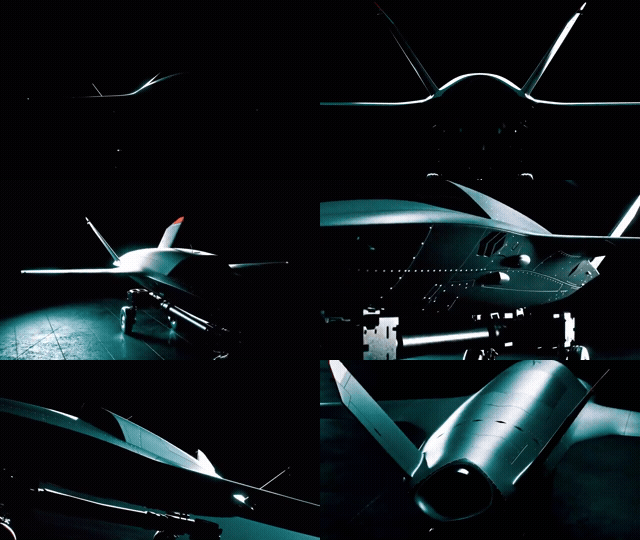
The program centers on integrating a European-designed autonomous mission architecture into the XQ-58A Valkyrie, an uncrewed combat drone developed by Kratos Defense & Security Solutions. Airbus has acquired two Valkyrie aircraft that are currently undergoing modification and systems integration at the company’s defense facility in Manching, Germany, located near Munich.
The first flight of the Airbus-modified Valkyrie variant is scheduled for later in 2026, marking the start of flight testing for the European mission system integrated into the American-built platform.
Integration of European Autonomous Mission Architecture
Airbus is equipping the Valkyrie aircraft with its Multiplatform Autonomous Reconfigurable and Secure (MARS) mission system, a modular architecture designed to enable autonomous operations and coordinated mission execution across multiple platforms.
A key element of the system is MindShare, an artificial-intelligence-supported software framework developed to perform functions traditionally handled by human pilots. The system enables autonomous navigation, mission execution, and decision support while maintaining the option for human oversight or direct command.
MindShare is designed to operate across both crewed and uncrewed aircraft, allowing the creation of distributed mission networks in which multiple drones and fighter jets share data, coordinate flight operations, and execute assigned tasks collectively.
The architecture also enables the aircraft to conduct sensitive or high-risk missions—including electronic warfare, surveillance operations, and strike tasks—while minimizing exposure of human pilots to contested environments.
Flight Testing Program in Germany
The integration and testing work is being conducted at Airbus facilities in Manching, one of Germany’s primary defense aviation centers.
Engineers are installing the MARS mission system and associated avionics into the two Valkyrie airframes before beginning ground testing and flight trials. The upcoming maiden flight of the modified aircraft in 2026 will validate the integration of the European mission system with the Valkyrie’s flight control architecture.
The test campaign will focus on several key objectives:
-
Verifying autonomous mission execution through the MindShare system
-
Evaluating secure communications and mission coordination across multiple aircraft
-
Testing integration with command platforms such as fighter aircraft
-
Demonstrating the ability to perform both kinetic and non-kinetic missions
Data from these tests will support further development of the UCCA system intended for the German Air Force.
Integration with Eurofighter Command Aircraft
The UCCA program is designed to operate in Manned-Unmanned Teaming (MUM-T) configurations with the Eurofighter Typhoon, which will serve as a command platform for coordinating drone operations.
To enable this capability, Airbus is collaborating with Rafael Advanced Defense Systems to enhance the Litening 5 Advanced Targeting Pod, which has already been contracted for the Eurofighter fleet.
The upgraded pod will include cross-platform connectivity functions, allowing fighter pilots to communicate with and control uncrewed aircraft during missions. These capabilities will be supported by targeted upgrades to the Eurofighter’s onboard avionics, enabling real-time data sharing and command coordination between crewed fighters and autonomous drones.
Under this operational model, the fighter aircraft can function as a mission command node, directing multiple Valkyrie drones to perform tasks such as reconnaissance, electronic attack, or precision strike operations.
Valkyrie Platform Characteristics
The XQ-58A Valkyrie was selected as the baseline platform because it is already flight-proven and in limited production, allowing Airbus to accelerate development timelines by avoiding the need to design a new airframe.
The aircraft conducted its first flight in the United States in 2019 and has since completed numerous test flights demonstrating its operational performance.
Key specifications of the Valkyrie include:
-
Length: 9.1 meters
-
Wingspan: 8.2 meters
-
Maximum take-off weight: approximately 3 tons (around 2,700–2,800 kg depending on configuration)
-
Operational range: more than 5,000 kilometers
-
Service ceiling: approximately 45,000 feet
The platform is designed to support both kinetic missions, such as strike operations, and non-kinetic missions, including intelligence gathering, surveillance, and electronic warfare.
The Valkyrie can operate independently, in coordinated groups of unmanned systems, or in direct cooperation with crewed aircraft.
Strategic Objectives of the Airbus–Kratos Partnership
The collaboration between Airbus and Kratos was originally announced in July 2025 as a means of accelerating European access to a collaborative combat drone capability.
Instead of developing a new aircraft platform from the ground up, Airbus opted to integrate its own mission system into the existing Valkyrie airframe. This approach reduces development timelines and costs while allowing European operators to maintain sovereign control over mission software and operational data systems.
Marco Gumbrecht, Head of Key Account Germany at Airbus Defence and Space, stated that combining the Valkyrie platform with the MARS system allows the program to deliver a combat-ready uncrewed aircraft with a European mission architecture within a relevant operational timeframe.
He noted that the program aims to deliver credible combat capability at a comparatively affordable cost, which has become a key requirement for modern air forces seeking to field large numbers of collaborative drones.
Concept of “Affordable Mass” in Modern Air Warfare
According to Steve Fendley, President of the Kratos Unmanned Systems Division, the resulting platform is designed to support the concept of “affordable mass”—a procurement and operational strategy increasingly emphasized in modern military planning.
The concept focuses on deploying large numbers of relatively low-cost systems capable of operating together in coordinated formations. In military simulations and operational analyses, such massed systems can complicate adversary defenses and increase mission survivability.
Under this model, Valkyrie drones could be deployed in groups to perform tasks such as:
-
Reconnaissance and targeting
-
Electronic warfare and suppression of enemy air defenses
-
Precision strike operations
-
Decoy and sensor extension missions
These roles allow the drones to support crewed aircraft while reducing the risk faced by human pilots in contested airspace.
Planned Role in the German Air Force
For the German Air Force, the initial UCCA capability is expected to focus on specific operational roles that extend combat air power while keeping pilots outside the most dangerous mission areas.
The system will allow the Eurofighter fleet to deploy uncrewed aircraft ahead of crewed fighters to conduct reconnaissance, electronic warfare, or strike tasks.
If the current development timeline is maintained, Airbus aims to deliver a fully operational collaborative combat drone capability by 2029, providing Germany with a domestically integrated autonomous combat system based on a proven unmanned aircraft platform.
——— End of Article ———