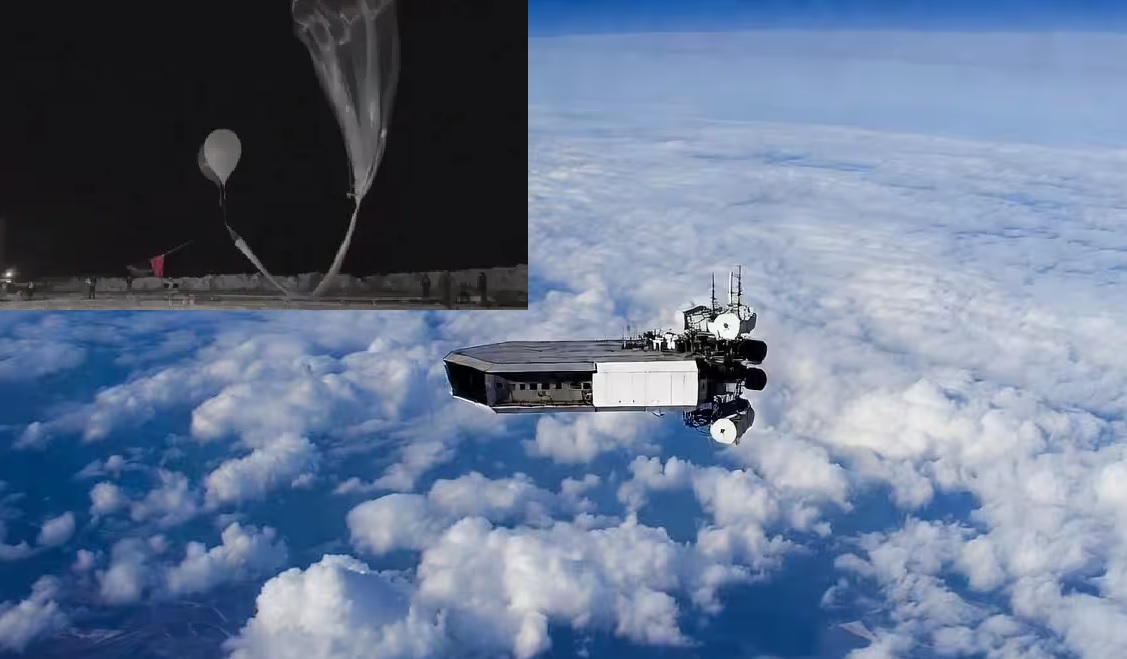
MOSCOW : Russia has commenced flight testing of a new high-altitude unmanned aerial platform known as the “Barrage-1,” designed to operate in the stratosphere and provide an alternative to low-Earth orbit (LEO) satellite constellations for broadband connectivity. The system is intended to function as an aerial relay for 5G Non-Terrestrial Network (NTN) communications and ultra-high-speed internet services.
The first launch marks the beginning of operational evaluation trials for the platform, which is positioned as a domestic communications solution following recent blockages of Starlink communication terminals. Officials describe the project as part of broader efforts to develop locally controlled infrastructure for telecommunications coverage across remote and strategically important regions.
High-Altitude Operating Profile
The Barrage-1 operates at an altitude of approximately 20 kilometers within the stratosphere. At this height, the platform remains above commercial air traffic and most weather systems, enabling stable, long-duration missions. The 20-kilometer operating ceiling provides an extended line-of-sight horizon, allowing a single platform to cover large geographic areas with 5G NTN signals.
Engineers involved in the program state that the high-altitude position allows the system to function as a persistent aerial communications node. By maintaining station over designated areas, the drone can act as a floating telecommunications tower, relaying signals between ground users and network infrastructure.
Aerodynamic Balance and Endurance
Unlike conventional high-altitude aircraft that rely primarily on continuous engine propulsion, the Barrage-1 incorporates an aerodynamic balance system based on pneumatic ballasting principles. This mechanism enables the platform to adjust altitude and utilize natural stratospheric air currents to maintain its position.
By altering buoyancy and altitude rather than depending on high-power propulsion systems, the platform is designed to remain over a specific geographic location for several days during initial operations. Development plans indicate a target endurance extending to multiple weeks in future iterations.
The system’s operating concept emphasizes reduced energy consumption and extended station-keeping capability, which are central to its role as a persistent communications relay.
Payload and Technical Capacity
The Barrage-1 is capable of lifting payloads of up to 100 kilograms to its 20-kilometer operational altitude. This capacity allows integration of telecommunications relays, high-frequency transmitters, and supporting electronic systems required for 5G NTN deployment.
The payload configuration is intended to support broadband internet distribution, secure communications links, and potentially dual-use civil and state communication requirements. Engineers note that the available mass allowance permits installation of heavy communication modules without compromising flight stability at high altitude.
Domestic Development and Manufacturing
The project is a joint effort between the Novgorod-based manufacturing company Aerodrommash and Bauman Moscow State Technical University. Development, engineering design, and production are reported to rely entirely on domestically manufactured components.
A central structural element of the platform is its outer casing, constructed from a specialized Russian-engineered film material. The material is designed to withstand temperature fluctuations, low atmospheric pressure, and ultraviolet exposure characteristic of prolonged stratospheric operations.
Program representatives state that the use of locally produced materials and subsystems ensures supply chain independence and supports national manufacturing capabilities.
Intended Deployment and Coverage Strategy
The Barrage-1 is designed to operate as part of a networked constellation of stratospheric platforms. When deployed in multiple units, these systems could create layered communications coverage across wide areas.
The primary deployment focus is on remote and geographically challenging regions where construction and maintenance of traditional ground-based cellular towers are impractical or economically inefficient. This includes sparsely populated territories and areas with limited infrastructure access.
By operating in the stratosphere rather than orbit, the system is positioned as a lower-cost alternative to satellite constellations. Officials indicate that launch and maintenance expenditures are significantly reduced compared with orbital platforms, while still enabling large-area broadband coverage.
Strategic Communications Role
The platform’s development follows disruptions affecting access to foreign satellite communication systems. In response, domestic alternatives are being prioritized to ensure continuity of civilian and secure communications services.
As flight testing progresses, engineers are expected to evaluate endurance performance, altitude stability, payload integration, and signal relay efficiency. Further operational assessments will determine scalability and long-term deployment feasibility.
The Barrage-1 program reflects a broader shift toward High-Altitude Platform Systems (HAPS) as complementary infrastructure to terrestrial and orbital communications networks. If testing milestones are achieved, the system could serve as a persistent, stratosphere-based component of Russia’s 5G NTN and broadband connectivity framework.
——— End of Article ———