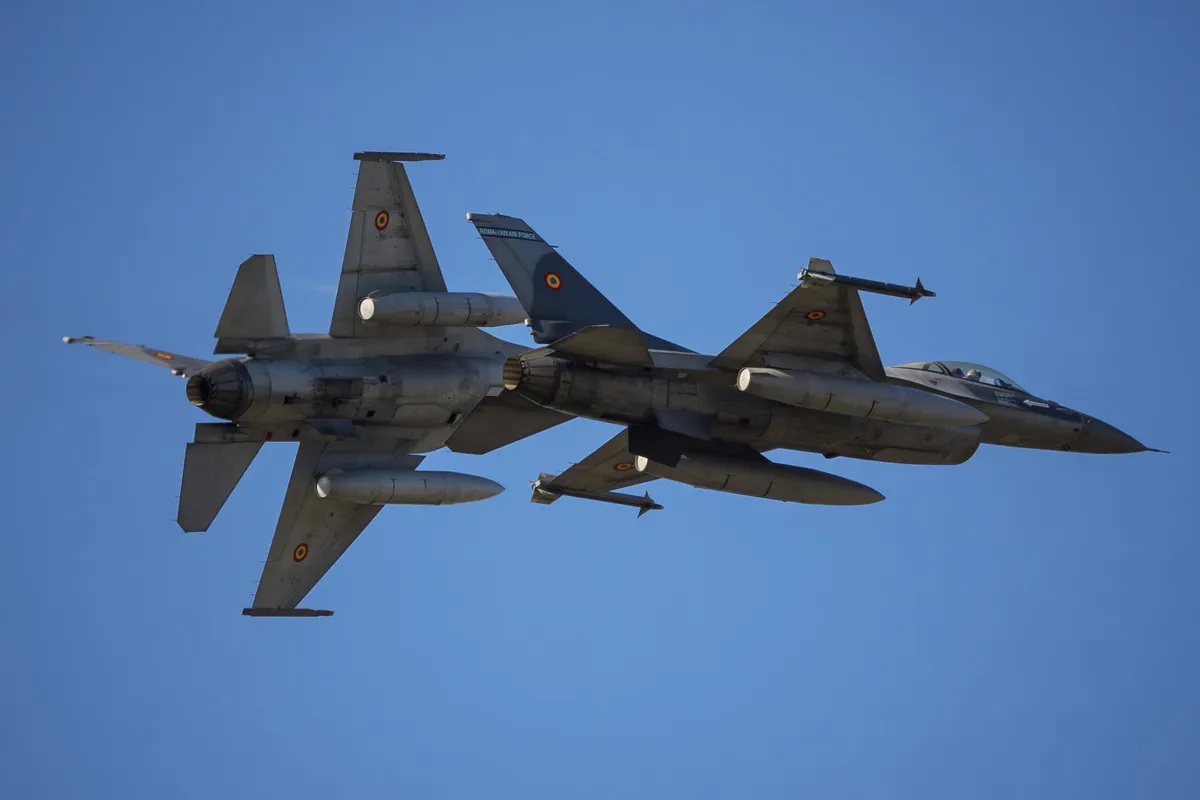
TALLINN / ŠIAULIAI, — May 19, 2026 : A Romanian Air Force F-16 Fighting Falcon operating under NATO’s Baltic Air Policing mission shot down a drone that entered Estonian airspace from Russian territory on Tuesday, after regional air defense authorities determined the aircraft posed a potential threat to air traffic safety and national security.
Estonian authorities assessed the unmanned aerial vehicle as likely Ukrainian in origin and said it may have deviated from its intended route due to Russian electronic warfare measures, including GPS spoofing and jamming activity near the border region.
Drone Entered Estonian Airspace From Russia
According to the Estonian Defense Forces, the drone was detected at approximately 12:00 p.m. local time entering the south-eastern corner of Estonian airspace from Russia before continuing north-east toward central Estonia.
Initial tracking information was provided by Latvian authorities after the drone was observed moving near Latvian-controlled monitoring sectors. Estonian radar systems subsequently confirmed the airspace violation, prompting the activation of agreed NATO and national air defense procedures.
At the time of the incident, two Romanian F-16 fighters assigned to NATO’s Baltic Air Policing mission were already airborne on a routine training sortie from Šiauliai Air Base in Lithuania. NATO command redirected the aircraft to intercept the target as the closest available allied assets in the region.
The intercept operation was coordinated through the Latvian Control and Reporting Center in cooperation with Estonian air defense authorities.
Romanian F-16 Conducted Missile Engagement
The Romanian fighters intercepted the drone south of Põltsamaa near Lake Võrtsjärv. Following visual identification conducted under standard peacetime engagement procedures, one of the F-16s launched a single air-to-air missile at the target.
The drone was destroyed at approximately 12:14 p.m. local time.
Romanian and Estonian defense officials did not disclose the exact missile type used during the engagement. Romanian F-16s deployed for Baltic Air Policing missions normally carry two AIM-120C AMRAAM missiles and two AIM-9X Sidewinder missiles as part of their standard air defense configuration.
Romanian Acting Defense Minister Radu Miruță identified the pilot involved in the interception as Lieutenant Colonel Costel-Alexandru Pavelescu. The Romanian Ministry of Defense stated that all NATO identification, verification, and engagement authorization procedures were completed before the missile was launched.
Romanian officials described the interception as the first kinetic engagement conducted by the current Romanian Baltic Air Policing detachment, known as the “Carpathian Vipers.” Miruță announced that he would propose awarding the pilot the First Class Peace Envoy Emblem.
Wreckage Fell Near Residential Area
The wreckage of the drone fell in a marshy and wooded area near Kablaküla village in Põltsamaa Municipality, close to Lake Võrtsjärv in southern Estonia.
Authorities stated that debris landed approximately 30 meters from the nearest residential building. No injuries, fires, or property damage were reported.
Bomb disposal teams, rescue services, police units, and security personnel secured the impact area shortly after the incident. Estonian authorities warned residents not to approach or touch any debris and instructed the public to report findings directly to emergency services.
Search and recovery operations continued throughout Tuesday afternoon as investigators worked to collect wreckage fragments and assess the drone’s technical characteristics. Officials have not publicly released photographs or identified the drone model.
The Estonian Internal Security Service opened a criminal investigation under statutes concerning attacks against air traffic safety.
Estonia and Latvia Issued Air Threat Alerts
Following confirmation of the airspace breach, Estonia activated its EE-Alarm warning system for several southern counties, including Tartu, Jõgeva, Viljandi, Valga, Võru, and Põlva.
The alert remained active until approximately 12:45–12:55 p.m. local time, after authorities confirmed the airspace was secure.
Latvia also issued temporary airspace threat warnings for several municipalities near its eastern border during the operation.
Estonian Defense Minister Hanno Pevkur confirmed that Latvian authorities had provided advance information regarding the drone’s movement before it entered Estonian territory.
Pevkur stated that Ukraine’s defense minister later apologized during a telephone conversation regarding the incident and welcomed the successful interception. He reiterated that Estonia has not granted permission for non-allied countries to use its airspace for military operations and noted that Ukraine had not requested authorization.
Ukrainian Foreign Ministry spokesperson Heorhii Tykhyi also issued a public apology, describing the incident as unintended.
Romanian Detachment Operating From Lithuania
Romania deployed its current Baltic Air Policing detachment to Šiauliai Air Base in early April 2026. The deployment includes approximately six F-16 aircraft and around 100 personnel.
The Romanian contingent operates alongside a French Air and Space Force Rafale detachment stationed at the same Lithuanian base and replaced a previous Spanish Air Force rotation.
The deployment supports NATO’s Baltic Air Policing and Eastern Sentry activities, which maintain continuous Quick Reaction Alert coverage over the airspace of Estonia, Latvia, and Lithuania from bases including Šiauliai and Ämari.
According to NATO Allied Air Command, the current mission marks Romania’s fourth Baltic Air Policing deployment from Lithuania. Romania first contributed to the mission in 2007 using MiG-21 LanceR aircraft before transitioning to F-16 operations after the retirement of the MiG-21 fleet.
Incident Follows Previous Drone Violations
Tuesday’s interception occurred amid continuing Ukrainian strikes on targets inside Russia and coincided with Russian air defense activity and temporary flight restrictions at airports in Pskov and at Pulkovo Airport.
The incident also follows several previous drone incursions in the Baltic region.
On March 25, 2026, a drone entering from Russian airspace struck the chimney of the Auvere power plant in north-eastern Estonia. In September 2025, Polish and allied aircraft, including Dutch F-35 fighters, intercepted and destroyed Russian drones that crossed into Polish airspace during a large-scale Russian missile and drone attack against Ukraine.
Estonian Air Force Commander Brigadier General Riivo Valge stated that while the immediate threat had been neutralized, authorities continue monitoring the region for possible additional airspace violations linked to ongoing military activity near NATO’s eastern border.
No further unauthorized drones were reported in Estonian airspace following the interception.
——— End of Article ———