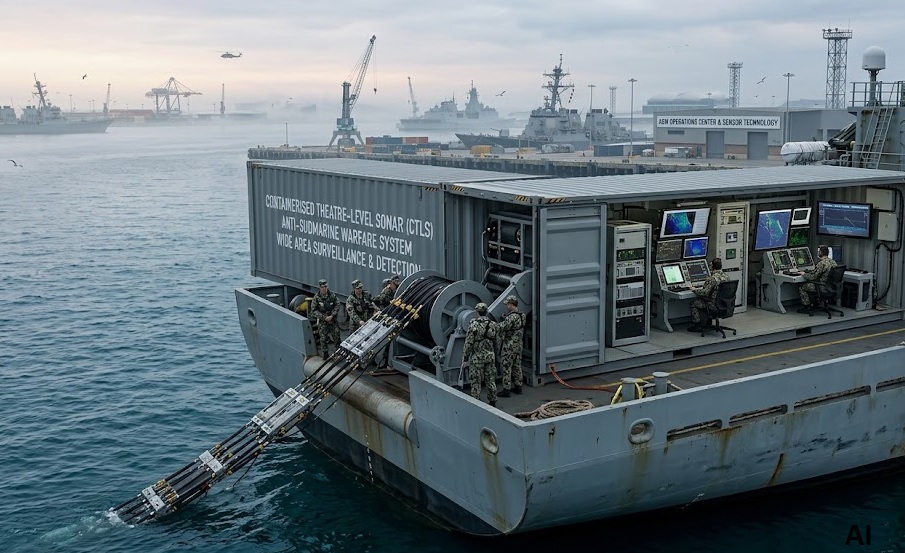
NEW DELHI — The Indian Navy has issued a Request for Information (RFI) for the procurement of a Containerised Theatre Level Sonar (CTLS), marking a significant step toward strengthening underwater surveillance and anti-submarine warfare (ASW) capabilities across its fleet.
The proposed system is intended to provide persistent Underwater Domain Awareness (UDA) and enable a wider range of naval vessels to carry advanced sonar capabilities without requiring permanent modifications. The move reflects the Navy's focus on improving operational flexibility as submarine activity in the Indian Ocean Region continues to grow.
The RFI has been issued by the Integrated Headquarters, Ministry of Defence (Navy) as part of efforts to develop a modular sonar system that can be rapidly deployed on suitable ships.
Containerised Design for Rapid Deployment
Unlike conventional hull-mounted sonar systems that are permanently integrated into warships during construction, the CTLS is designed as a self-contained system housed inside standard 20-foot or 40-foot ISO containers.
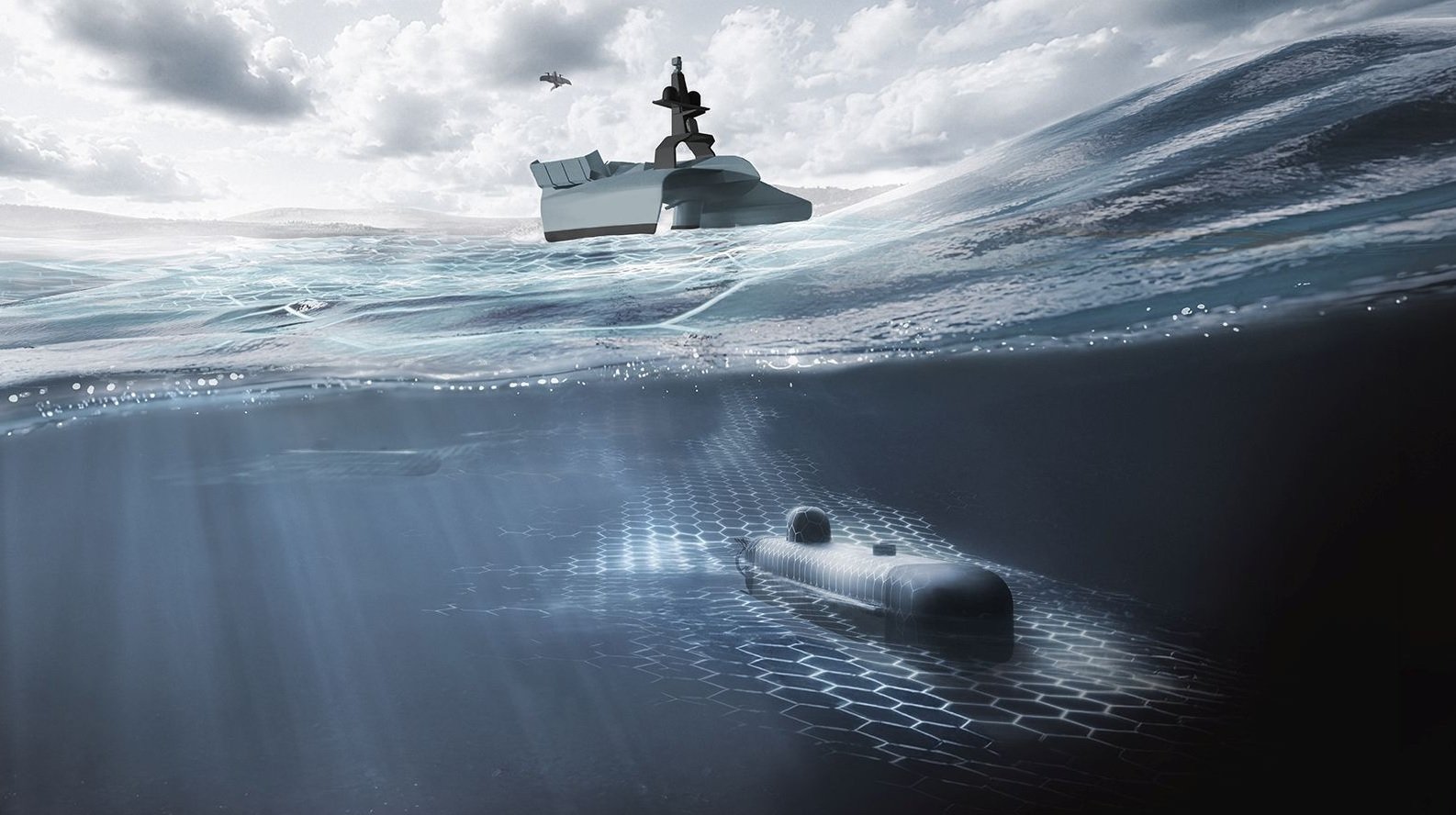
The containerised package will include a Variable Depth Sonar (VDS) and twin thin-line receiver arrays. According to the RFI, the host vessel will only require a certified A-frame and winch for deployment, while the remaining equipment will remain inside the containerised module.
This approach allows the sonar package to be installed on different platforms, including offshore patrol vessels, auxiliary ships and other naval vessels with sufficient deck space, providing greater operational flexibility compared with dedicated ASW warships.
Expanding Anti-Submarine Coverage
The CTLS is expected to serve as a force multiplier by allowing the Indian Navy to expand anti-submarine coverage without waiting for new frigates and corvettes to enter service.
Warship construction typically takes several years, while a containerised sonar system can be deployed on existing vessels capable of supporting the equipment. This allows additional ships to function as temporary anti-submarine warfare platforms whenever operational requirements demand.
The Navy's concept also supports the development of a ship-agnostic underwater sensor network, where multiple vessels equipped with CTLS can operate together to detect, classify and track underwater contacts over larger areas.
The system will support mono-static, bi-static and multi-static sonar operations, enabling ships to work together by transmitting and receiving sonar signals in different configurations to improve submarine detection and tracking over longer distances.
Technical Requirements
According to the RFI, the CTLS is expected to operate effectively in deep-water, shallow-water and littoral environments.
The Variable Depth Sonar will be capable of operating at depths of at least 200 metres, allowing operators to position the sonar below challenging acoustic layers where underwater sound propagation is more favourable.
The system will operate in both active and passive modes.
In active mode, the sonar will transmit low-frequency acoustic signals designed for long-range detection of submarines and underwater targets.
In passive mode, it will monitor underwater noise and detect acoustic signatures generated by submarines without transmitting signals.
The passive detection system will use twin thin-line receiver arrays, each containing at least 180 acoustic elements capable of monitoring frequencies ranging from 10 Hz to 2 kHz. The Navy has specified advanced digital signal processing, adaptive noise suppression and target motion analysis to improve detection performance in environments with high ambient noise and reverberation.
The RFI also calls for the integration of Artificial Intelligence (AI) to assist operators in target identification and tracking, helping improve the speed and accuracy of operational decisions.
In addition, the system is expected to include predictive modelling software that analyses environmental conditions before deployment. The software will evaluate factors such as water depth, temperature, sound velocity profiles, seabed characteristics and ambient noise to estimate expected sonar performance and detection probability.
The CTLS has been specified with a minimum service life of 15 years and is expected to feature a modular architecture that allows future hardware and software upgrades as sonar technologies evolve.
Integration with Existing Naval Systems
The Navy has stated that the containerised sonar should integrate with existing combat management and navigation systems, allowing it to operate alongside current fleet assets while remaining portable between platforms.
The modular design is intended to simplify transportation, storage and installation while reducing the need for extensive ship modifications.
Strategic Context
The procurement comes as regional underwater capabilities continue to expand.
Pakistan has recently inducted the first of its Chinese-built Hangor-class submarines, part of an order for eight boats, while China operates one of the world's largest submarine fleets, with around 60 submarines.
The Indian Navy is seeking to strengthen underwater surveillance by increasing the number of platforms capable of contributing to anti-submarine operations, rather than relying solely on dedicated ASW ships.
The Navy currently operates the Hull Mounted Sonar Array (HUMSA), developed by the Naval Physical and Oceanographic Laboratory, which has been in service since 2016.
Separately, the Defence Acquisition Council has approved the procurement of six additional Boeing P-8I maritime patrol aircraft. The Indian Navy currently operates 12 P-8I aircraft, which are used for long-range maritime surveillance and anti-submarine warfare missions.
The CTLS RFI represents an early stage of the procurement process. Industry responses will help the Indian Navy refine technical requirements and shape the programme before moving toward future acquisition decisions.
Source: timesofindia
——— End of Article ———