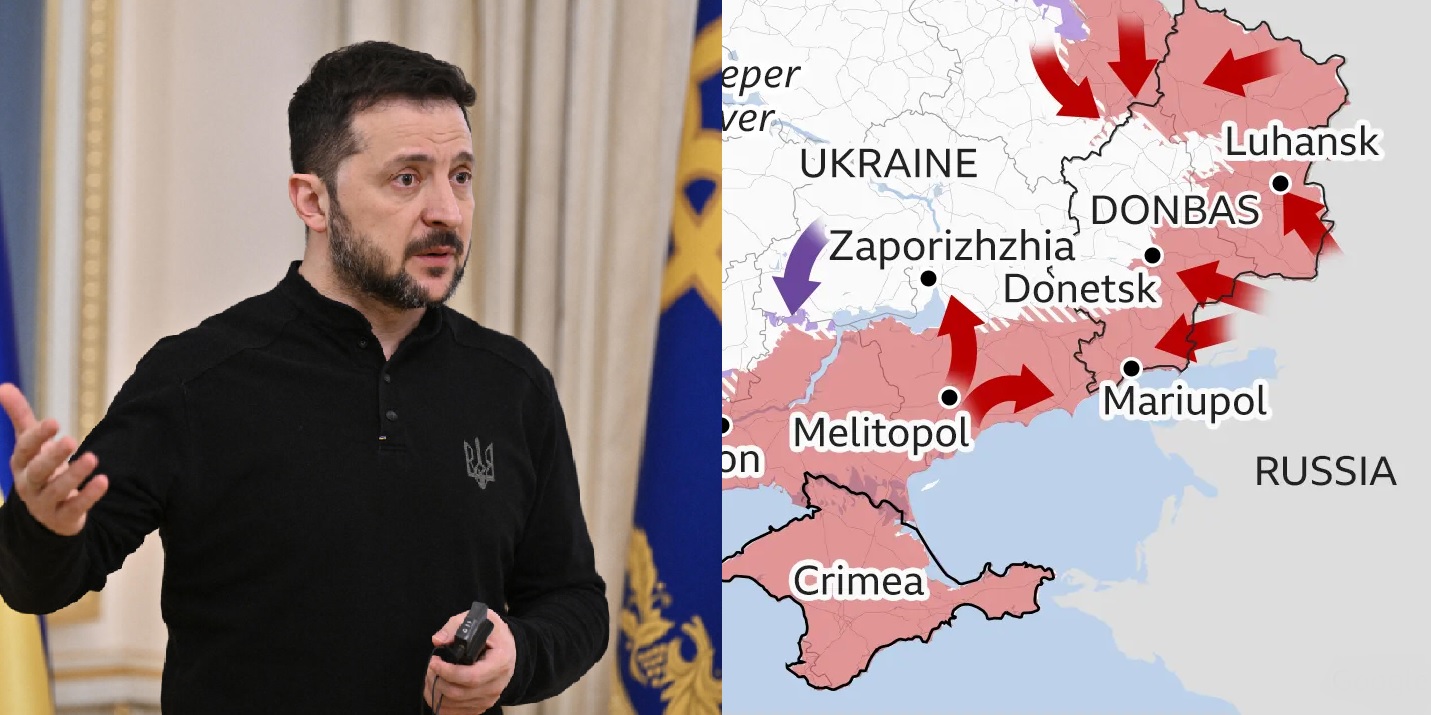
Peace negotiations involving the United States, Ukraine, and indirect channels to Russia have reached a critical impasse, with Ukrainian President Volodymyr Zelensky confirming that talks remain stalled over the future of the eastern Donbas region. The hardening positions come amid growing frustration in Washington and open irritation from former President Donald Trump, who has pushed for a rapid settlement to end the nearly three-year war.
Disagreement Over Donbas Remains the Central Obstacle
In an interview with Bloomberg, Zelensky said negotiators “do not have a shared view” on the status of Donetsk and Luhansk, the two provinces that make up the broader Donbas region and where some of the most intense battles of the war have taken place. He emphasized that Kyiv will not accept any arrangement that formally hands over territories still under Ukrainian control.
Ukrainian forces retain roughly 30% of Donbas, including major population centers and key defensive lines. According to officials familiar with the talks, Washington’s proposed framework would require Ukraine to relinquish the entire region, effectively recognizing Russian administrative control even though Moscow has failed to capture it fully since the invasion began.
The proposal is part of a broader US initiative aimed at rapidly reducing hostilities, stabilizing NATO’s eastern flank, and redirecting American focus toward Asia. But it has run into firm resistance in Kyiv, where leaders argue that conceding land would reward aggression and undermine Ukraine’s long-term security.
Kyiv Insists on Freezing the Conflict Along Present Front Lines
Ukraine’s negotiators maintain that any peace deal must formalize the current line of contact, preventing Russia from claiming additional territory beyond what its forces presently occupy. Officials say this approach would prevent Moscow from using negotiations to legitimize unachieved military objectives.
Zelensky also highlighted unresolved issues around security guarantees, including long-term Western military support, air-defense commitments, and a pathway to eventual NATO membership. Without such assurances, Kyiv fears any ceasefire could merely give Russia time to regroup and launch a future offensive.
Rising Frustration from Trump and Shifting US Pressure
Former President Trump, who has taken a dominant role in shaping US messaging on the conflict since the election, has voiced impatience with Kyiv’s negotiating stance. According to US media reports, Trump believes Ukraine’s refusal to cede Donbas is preventing what he views as an achievable deal, and he has privately urged advisers to press Kyiv more aggressively.
Inside Washington, the policy debate has sharpened. Supporters of the US proposal argue that the war has reached a strategic stalemate, Ukrainian manpower shortages are worsening, and Western defense stockpiles cannot sustain another year at current consumption rates. Critics, however, warn that forcing Kyiv into concessions could destabilize Ukraine’s domestic politics and weaken Western credibility globally.
Moscow Watches as Negotiations Struggle
Russia, which claims to have annexed Donetsk and Luhansk despite not fully controlling either region, has shown little incentive to compromise. The Kremlin continues to insist on “irreversible” recognition of its territorial claims, along with demilitarization demands Kyiv has already rejected.
Analysts note that Moscow may view the widening US-Ukraine divide as an opportunity to extract more favorable terms or prolong the conflict until Western cohesion deteriorates.
A Peace Process in Limbo
For now, the diplomatic track appears to be at a standstill. Zelensky stressed that any peace framework must be acceptable to the Ukrainian people, who overwhelmingly oppose territorial concessions in recent polls. Western officials, meanwhile, acknowledge the growing difficulty of balancing Kyiv’s security needs with Washington’s push for a negotiated settlement.
With front-line fighting still ongoing and winter conditions slowing large-scale operations, the future of the US-brokered peace plan remains uncertain. What is clear, however, is that the Donbas question has become the defining barrier to any near-term ceasefire—and a test of unity among Ukraine, its allies, and the shifting political dynamics shaping US foreign policy.
——— End of Article ———