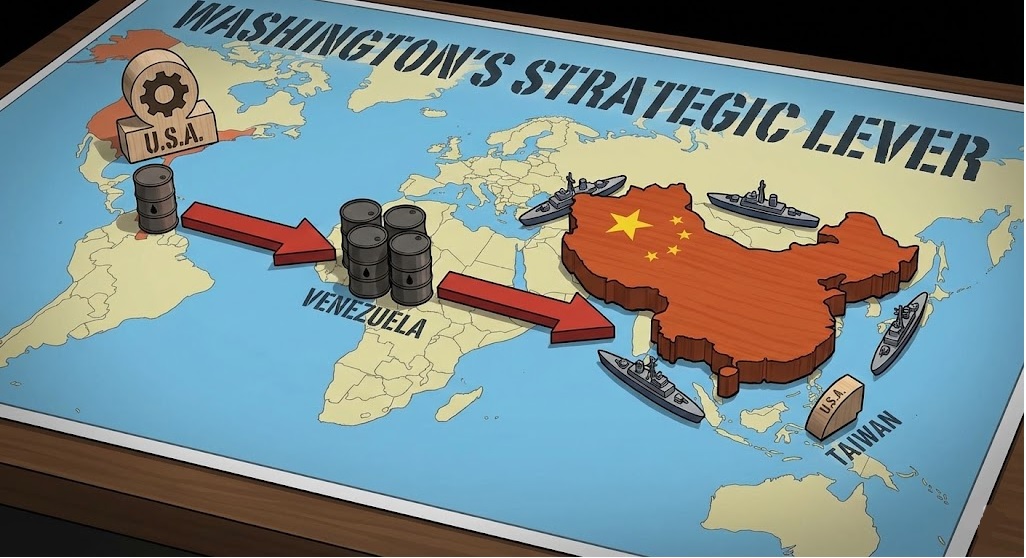
World : In strategic circles in Washington, a long-running question has acquired new urgency: if China were to capture Taiwan and gain decisive influence over the world’s most advanced Semiconductor Supply Chain, how could the United States respond without triggering an immediate Great-Power War? One answer increasingly discussed in Policy and Security Assessments is Energy—specifically, the ability to disrupt or reshape China’s Access To Oil. Within that framework, Venezuela emerges as a Critical, if often overlooked, piece of the puzzle.
Chips Versus Crude
Taiwan sits at the heart of Global Semiconductor Manufacturing, producing a dominant share of the world’s most Advanced Chips used in Military Systems, Artificial Intelligence, Telecommunications, and Civilian Electronics. Were those capabilities to fall under Beijing’s Control, Washington and its allies would face a Structural Vulnerability that could not be resolved quickly.
Analysts argue that in such a scenario, the United States would look for Asymmetric Pressure Points—domains where American Naval Power, Alliances, and Financial Leverage remain overwhelming.
Energy is one such domain. China is the world’s Largest Importer Of Crude Oil, bringing in More Than 11 Million Barrels Per Day in recent years. Unlike semiconductors, Oil Supply depends on Long Maritime Routes, Insurance Markets, and Politically Sensitive Producer States. Any disruption along those lines would not halt China’s economy, but it could significantly Raise Costs, Strain Logistics, and Complicate Military Planning.
The Venezuelan Lever
Venezuela holds the Largest Proven Oil Reserves In The World, estimated at around 300 Billion Barrels, surpassing Saudi Arabia. Years of Mismanagement, Sanctions, and Underinvestment have reduced output to a fraction of its historical peak, yet the country still exports Hundreds Of Thousands Of Barrels Per Day.
Importantly, China has been one of the Primary Destinations for Venezuelan crude, often purchased at Steep Discounts and sometimes used to repay earlier Oil-For-Loan Agreements.
From a U.S. Strategic Perspective, reasserting influence over Venezuelan Oil Flows would have two immediate effects. First, it could Deny China a politically friendly, discounted supplier in the Western Hemisphere. Second, it could Redirect Crude toward U.S. Gulf Coast Refineries or allied markets, tightening the availability of Alternative Barrels for Chinese buyers. Even without restoring Venezuelan production to former highs—a process that would take Years and Tens Of Billions Of Dollars—changing the direction of existing exports could deliver Short-Term Geopolitical Leverage.
Maritime Choke Points And Pressure Corridors
Energy pressure would not rely on Venezuela alone. Any U.S. response to a Taiwan Crisis would likely involve monitoring and, in extreme scenarios, constraining oil flows through key Maritime Corridors.
The Strait of Malacca, through which a large share of China’s Middle Eastern and African Oil Imports transit, has long been described by Chinese strategists as a Strategic Vulnerability. The Red Sea and the Suez Canal form another Critical Artery linking Asian markets to Gulf and Russian Supplies.
Control over Insurance, Port Access, and Naval Presence along these routes would allow Washington and its partners to Raise Risks And Costs for tankers bound for China. Such measures fall short of a Formal Blockade but can still have a Chilling Effect on trade during periods of Heightened Military Tension.
Iran, Guyana, And The OPEC+ Factor
Beyond Venezuela, China has cultivated energy relationships with sanctioned or politically distant producers such as Iran, as well as emerging suppliers like Guyana, where Chinese state firms hold stakes in Offshore Oil Projects. U.S. Pressure on these channels could further narrow Beijing’s Options, though at the cost of Increased Diplomatic Friction.
The role of OPEC+ adds another layer of complexity. While several Gulf Producers maintain close Security Ties with the United States, they also prioritize Price Stability and Market Share. A coordinated effort to squeeze China’s oil supplies would test those relationships and could Destabilize Global Markets, driving Oil Prices Higher Worldwide.
Russia As The Fallback Supplier
If Venezuelan, Iranian, and other alternative supplies were curtailed, Russia would become China’s most important remaining Large-Scale Supplier. Moscow already accounts for roughly One-Fifth Of China’s Crude Imports, delivered via Pipelines and Tankers operating outside traditional Western Insurance Systems.
The United States could attempt to restrict this flow through Secondary Sanctions and Maritime Enforcement, but analysts caution that such moves would be Difficult To Enforce Fully and could trigger Severe Market Disruptions.
High Leverage, High Risk
For Washington, the appeal of Energy Leverage lies in its Flexibility. Oil pressure can be Scaled, Signaled, and Negotiated in ways that direct Military Confrontation cannot. Venezuela, with its Vast Reserves and proximity to U.S. Infrastructure, offers a particularly potent Bargaining Chip in that strategy.
Yet the risks are substantial. Reviving Venezuelan production to levels that meaningfully reshape Global Supply would take Years, not months. Aggressive interference in Global Oil Flows could Alienate Allies, accelerate China’s search for Overland Energy Routes, and deepen the Beijing–Moscow Strategic Partnership. Most importantly, Energy Coercion would not compensate for a Permanent Loss Of Semiconductor Leadership if Taiwan were absorbed.
The Strategic Bottom Line
In any future crisis triggered by a Chinese Takeover Of Taiwan, oil would not be Washington’s only response—but it would likely be a Central One. Control over Venezuelan Exports, combined with influence over key Maritime Choke Points and Allied Producers, could impose Real Costs on China’s economy and Strategic Planning.
Whether those costs would be sufficient to alter Beijing’s Behavior remains uncertain. What is clear is that in the shadow of a Semiconductor Shock, Energy—and Venezuela in particular—would move from the Periphery to the Center Of U.S. Grand Strategy.
——— End of Article ———