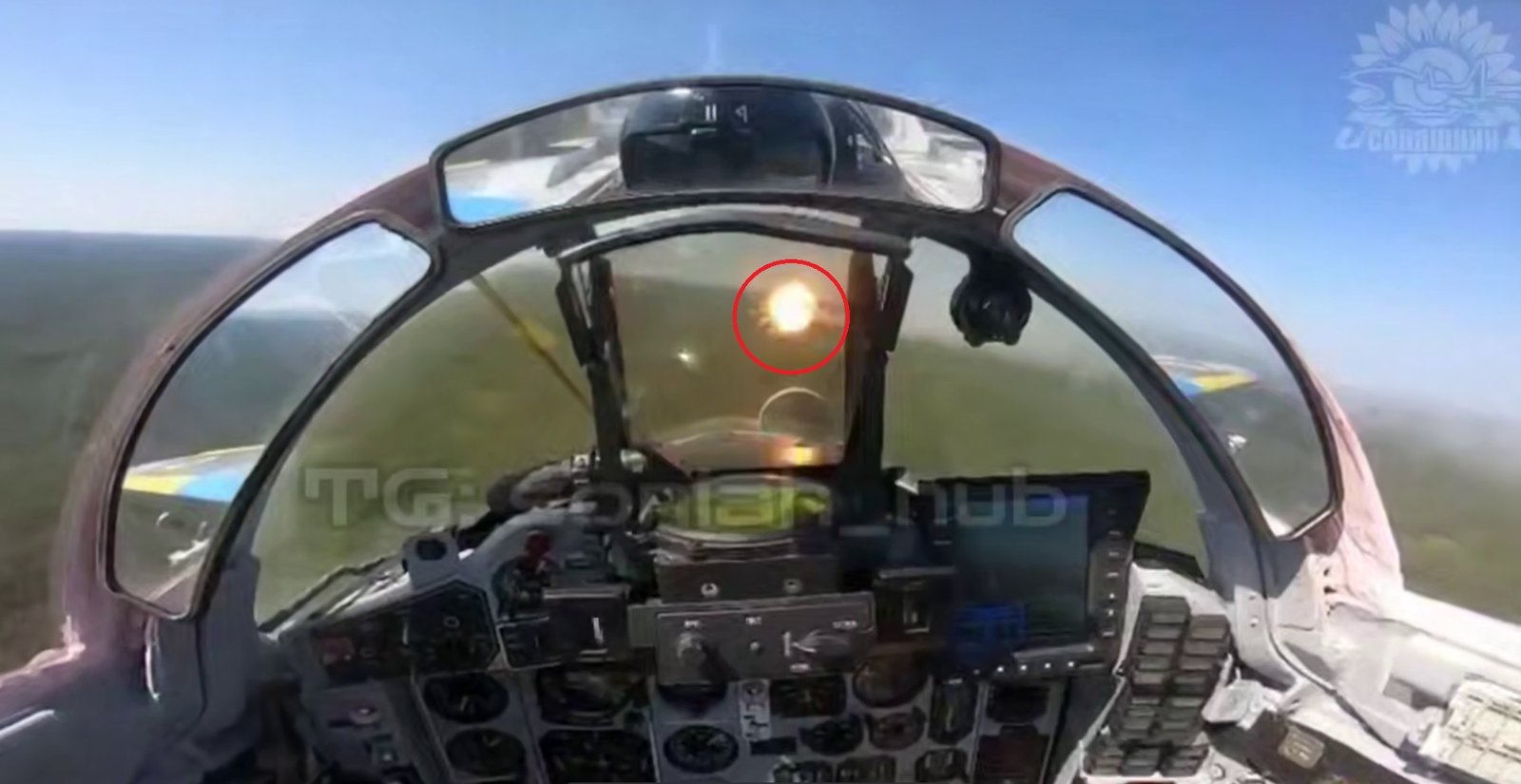
KYIV, Ukraine, — A Ukrainian Air Force MiG-29MU1 fighter jet reportedly intercepted and destroyed a Russian S8000 Banderol lightweight cruise missile while flying at extremely low altitude. The fighter used an R-60 short-range air-to-air missile during the engagement.
The aviation-focused Telegram channel Sonyashnyk reported the incident and published video footage of the interception. The low-altitude engagement required rapid target acquisition, precise maneuvering and quick execution by the pilot.
R-60 Modernization
The R-60, a Soviet lightweight guided air-to-air missile, entered service in 1973. It uses an infrared seeker and was designed for short-range attacks against maneuvering aircraft and helicopters. The missile weighs about 44 kg, carries a 3–3.5 kg high-explosive fragmentation warhead and reaches approximately Mach 2.5. Its practical range is generally a few kilometers, with published figures of up to about 8 km under favorable high-altitude conditions.
Before Russia's full-scale invasion, Ukraine considered the R-60 largely obsolete because newer R-73 missiles were available. Continued Russian attacks using cruise missiles and Shahed/Geran-2 drones, however, have increased demand for modern interceptors.
Ukraine subsequently began modernizing remaining R-60 missiles. In November 2025, Ihor Fedirko, executive director of the Ukrainian Council of Defense Industry, said the work involved replacing legacy analog components with digital systems and improving infrared seeker sensitivity. Some Ukrainian companies have reported approximately a tenfold increase in sensitivity for certain variants. The missiles have also been adapted for possible use from ground-based launchers, with the modernization described as a temporary way to return aging weapons to service.
S8000 Banderol
The S8000 Banderol was developed and manufactured by Russian JSC Kronstadt and formally introduced in 2025. Russian forces have increasingly used the missile against Ukrainian cities as production expands.
The Banderol has a cruising speed of 520–560 km/h and a maximum speed of 620–650 km/h. When launched from airborne platforms, it has a reported range of up to 500 km.
Its OFBCh-150 high-explosive fragmentation warhead weighs 114.3 kg, including 49.5 kg of explosives. The weapon has primarily been associated with launches from the Kronshtadt Orion UAV and can also be integrated with Mi-28 helicopters. Ground-based launchers have also been observed in recent operations.
The Banderol has been described as a hybrid system combining characteristics of a cruise missile and loitering munition. Its low-altitude flight profile can complicate detection and interception by some ground-based air-defense systems. Ukrainian reports also indicate that the weapon uses commercially available foreign components, including a Chinese turbojet engine.
The reported interception highlights Ukraine's continued use of modernized Soviet-era fighters and older air-to-air missiles as part of its air-defense efforts against Russia's evolving missile and drone threats.
——— End of Article ———