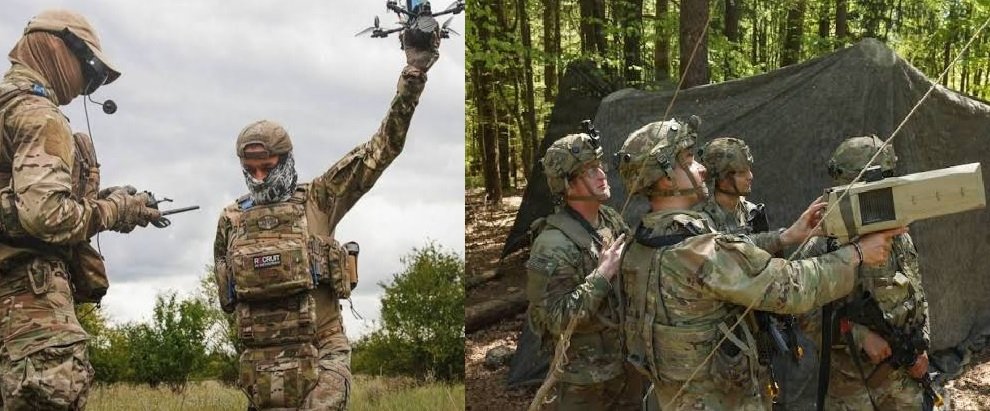
HOHENFELS, Germany — Ukrainian drone operators outperformed U.S. Army forces during the Combined Resolve exercise in Germany earlier this year, highlighting the difference in battlefield experience between Ukrainian drone units and American troops.
The exercise was held in April and May 2026 at the Joint Multinational Readiness Center in Hohenfels. Around 3,500 U.S. personnel participated, mainly from the 3rd Armored Brigade Combat Team of the 1st Cavalry Division, which was rotating from Fort Hood, Texas. Their mission was to advance against positions held by the training center's opposition force, which was reinforced by Ukrainian troops from the 412th Regiment of Unmanned Systems Forces, known as Nemesis.
U.S. forces used standard electronic warfare and counter-drone systems, while Ukrainian operators used combat experience gained during the war with Russia. Ukrainian reconnaissance drones located U.S. vehicles, with heavy armored vehicles also becoming easier to detect because they raised dust while moving.
The reconnaissance drones were followed by systems simulating munition drops and first-person-view (FPV) kamikaze drones. No live ammunition was used. A simulated hit was recorded when a drone flew extremely close to or hovered over a target.
The Ukrainian operators eliminated the attacking U.S. armored brigade so quickly that vehicles and troops marked as destroyed had to be returned to the exercise as reinforcements, or "re-spawned," to keep the training going.
U.S. drone operators initially had less ability to quickly troubleshoot problems and prepare drones under conditions similar to combat. The scenario was repeated over roughly two weeks, allowing American forces to improve. They dispersed their forces more effectively, improved camouflage and made better use of electronic warfare systems.
Midway through the exercise, the Ukrainian operators switched sides and demonstrated how uncrewed systems could support offensive operations. U.S. troops then applied those methods with greater effect.
General Alexus Grynkewich, NATO's Supreme Allied Commander Europe, said this type of training experience cannot be replicated in the United States and highlighted the significant changes seen after NATO forces train with Ukrainian units.
The results were not isolated. In 2023, a U.S. officer involved in training Ukrainian troops recognized that American forces had much to learn about drone warfare and helped develop a program that was later introduced more widely. In May 2025, Ukrainian drone operators defeated a simulated force involving British, Estonian and U.S. troops during exercises in the Baltics. In spring 2026, Ukrainian UAV operators participating in NATO exercises on Gotland also outperformed Swedish troops opposing them.
Combined Resolve is a recurring U.S. Army Europe and Africa exercise focused on large-scale ground combat. The participation of Ukrainian forces provides U.S. and NATO troops with practical experience against the smaller front-line drones that have become central to combat in Ukraine.
U.S. Army officials have also said that newer Mobile Brigade Combat Teams equipped with more recent equipment and tactics have performed better in similar exercises. The Pentagon has increased investment in drone and counter-drone technology, expanded efforts to study Ukrainian methods and tested Ukrainian drones for possible procurement.
The exercise highlighted the practical advantage Ukrainian units have gained through years of continuous combat adaptation, including the rapid repair and modification of drones under pressure. U.S. and NATO forces are using joint exercises with Ukrainian personnel to incorporate these battlefield lessons into their own training.
Source : wsj
——— End of Article ———