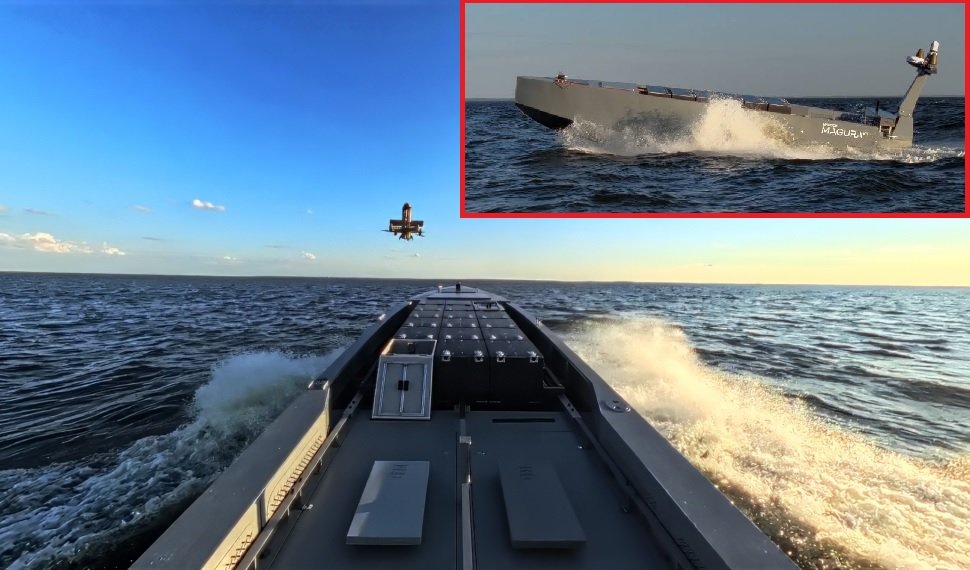
KYIV, Ukraine — Ukraine has publicly presented the Magura MV11, the largest unmanned surface vessel (USV) in the Magura family, during the country’s Independence Day unmanned systems parade on August 24. Developed by UFORCE, the MV11 is designed as an ocean-going carrier and support platform capable of transporting, launching and supporting other unmanned systems far from shore.
The MV11 represents a different role from earlier Magura vessels, which have primarily been used for strike and reconnaissance missions. UFORCE says the new platform is designed to operate in open-ocean conditions and can remain at sea for up to seven days. It has a payload capacity of up to 2,200 kilograms (4,850 pounds) and a stated overall length of up to 12 meters and width of 3.5 meters. UFORCE also lists more than 2,000 nautical miles of operating distance and about 10 cubic meters of available payload space.
MV11 Displayed With Sting Interceptors
The MV11 was shown carrying 18 Sting interceptor drones in individual box-style launchers. The configuration turns the USV into a mobile counter-drone platform that can carry aerial interceptors away from shore.
The Sting, developed by Ukraine’s Wild Hornets, is an electrically powered quadcopter equipped with a small explosive warhead. It weighs about nine pounds and makes extensive use of 3D-printed components. Reported production cost is around $2,100 per interceptor. Wild Hornets has stated that Sting can reach an altitude of nearly 7,000 meters (23,000 feet) and a maximum range of about 37 kilometers (23 miles), although actual flight time and range depend on factors including battery capacity, weather, payload and operator flight style.
The interceptor is manually operated through a wireless link. Wild Hornets has previously said that Sting can be controlled from distances of up to 2,000 kilometers using a laptop-based interface. The precise method used to operate the interceptors from the MV11 has not been publicly detailed. Sting has been used against Russian one-way attack drones, including variants and derivatives of the Iranian-designed Shahed-136.
If an interceptor does not engage its target, the Sting can be recovered for reuse, according to reporting on the system.
Sensors and Communications
Images of the MV11 show a rear mast carrying a camera turret, navigation radar and two horn-shaped antennas. A fixed forward-facing camera is also visible at the bow.
The vessel's main deck includes rectangular satellite communications terminals. These systems are part of the communications architecture needed to operate the vessel and its carried unmanned systems over long distances.
UFORCE says the MV11 is a modular platform that can be configured for different missions. Its stated roles include reconnaissance, surveillance, amphibious-operation support, and resupply of fuel and equipment to other unmanned surface vessels. The company says the platform is designed to operate around the clock and in varied weather conditions.
UFORCE has also described an air-defense configuration using several dozen aerial interceptors, a gyro-stabilized 12.7 mm turret, and sensors for radar surveillance and target tracking. This is a configuration described by the company rather than the specific configuration displayed during the Independence Day parade.
Part of the Expanding Magura Family
The MV11 is the latest addition to the Magura family, which UFORCE says has been produced since 2023. The company says the family has been used in hundreds of missions in the Black Sea and has contributed to the destruction of at least 12 Russian ships. Some Magura variants have also been configured with air-to-air missiles.
UFORCE says the MV11 was developed by its design and research-and-development bureau in Portugal, with international investment. The company is headquartered in London and has Ukrainian origins.
The company has also been expanding production cooperation outside Ukraine. In July 2026, UFORCE and U.S. manufacturer RECONCRAFT signed a memorandum of understanding covering production of Magura unmanned surface vessels in the United States. The agreement combines UFORCE's autonomous-vessel technology with RECONCRAFT's U.S. manufacturing capabilities.
A Carrier Rather Than a Conventional Strike USV
The main difference between the MV11 and earlier Magura vessels is its role as a carrier and support platform. Instead of carrying only its own weapons or sensors, the vessel is designed to transport other unmanned systems and deploy them at sea.
This allows the MV11 to serve as a mobile maritime base for aerial and surface drones. Its large payload capacity also provides space for mission equipment, fuel and other supplies.
The public unveiling does not establish the MV11's production quantity, unit cost or the complete set of sensors that will be installed on operational vessels. UFORCE has presented the platform as a modular system that can be adapted for different missions as development and integration continue.
Source : TWZ
——— End of Article ———