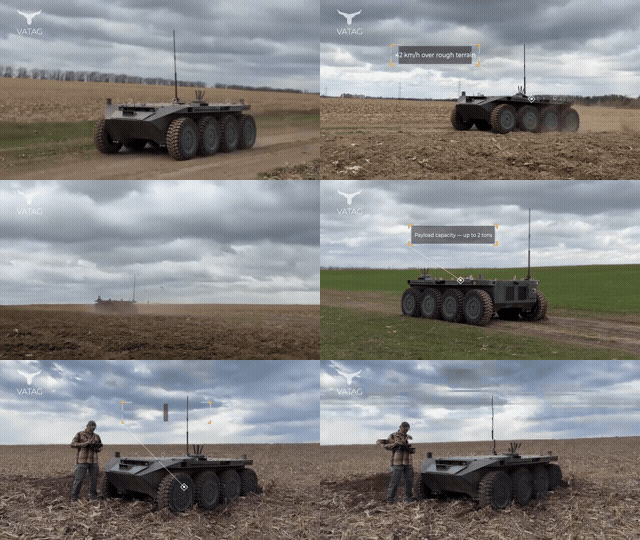
KYIV— Ukrainian robotics company VATAG has released new field-test footage showing its heavy unmanned ground vehicle (H-UGV) operating across rough, plowed terrain, providing one of the clearest demonstrations of the platform's real-world mobility and autonomous capabilities since its public debut in 2025.
The video, published on the company's official Facebook page, shows the 8×8 wheeled vehicle traveling over uneven off-road terrain while using onboard optical tracking systems. According to the company, the platform can reach speeds of up to 47 km/h (29 mph), while the newly released footage shows the vehicle operating at speeds of around 42 km/h (26 mph) during testing.
The VATAG heavy UGV was first introduced at the Brave1 Defense Tech Valley summit in Kyiv on September 16, 2025. The latest trials demonstrate the system in operational conditions rather than as a static exhibition vehicle, highlighting its ability to transport cargo across terrain where conventional trucks may face significant difficulties or increased risk.
Heavy Logistics Platform
VATAG is designed primarily as a heavy robotic logistics platform intended to reduce risks to personnel operating in frontline environments. The vehicle is capable of carrying more than 2,000 kilograms (4,410 pounds) of cargo, including ammunition, equipment, supplies, or wounded personnel.
The platform features armor protection for its hull and chassis designed to withstand shrapnel and mine threats. Its hybrid propulsion system combines fuel-efficient operation with a near-silent electric drive mode, allowing the vehicle to operate with a reduced acoustic signature during missions.
In addition to transportation, the hybrid power system enables the vehicle to function as a mobile power source capable of recharging frontline communications and electronic equipment.
Modular Combat Configuration
Although developed primarily for logistics, the VATAG platform also serves as the basis for armed variants using the same 8×8 chassis and control architecture. This approach allows different mission configurations without requiring separate vehicle designs or operator training systems.
The combat version is equipped with a proprietary remote-controlled weapon station (RCWS). The standard configuration mounts a 25mm automatic cannon, comparable to the M242 Bushmaster, while the universal weapon module can also be configured with:
- A cannon of up to 30mm
- A 40mm Mk19 automatic grenade launcher
- A 12.7mm heavy machine gun
- Anti-tank guided missile (ATGM) systems
For surveillance and engagement, the vehicle uses a multispectral optical targeting system capable of automatic target detection and tracking, supported by fire planning and fire-control algorithms.
Autonomous Navigation in GPS-Denied Environments
Autonomous operation is a central feature of the VATAG platform. Since satellite navigation can be disrupted by electronic warfare, the vehicle is designed to operate in GPS-denied environments.
Using machine vision, lidar, and onboard sensor arrays, the vehicle can independently navigate routes, detect and avoid obstacles, and maneuver without continuous operator input.
The system also supports convoy mode, allowing multiple VATAG vehicles to operate in a follow-the-leader configuration to transport supplies with minimal human supervision.
To improve reliability during electronic warfare, the platform uses redundant multi-channel communications that can automatically switch frequencies if interference or jamming is detected.
Civilian Applications
Beyond defense use, VATAG has also demonstrated the platform's commercial potential. Earlier this year, the company displayed a civilian transport version at the Ukrainian Pavilion during CES 2026 in Las Vegas.
The civilian configuration is intended for industries including mining, forestry, and emergency response, where autonomous cargo transport across difficult terrain can reduce risks to human operators.
The project reflects a broader trend among Ukrainian defense technology companies to adapt battlefield-developed robotic systems for commercial applications while continuing to expand unmanned capabilities for military logistics and support missions.
The newly released field-test footage provides further evidence of the VATAG platform's operational performance, demonstrating its mobility, autonomous navigation, and modular design in realistic off-road conditions.
——— End of Article ———