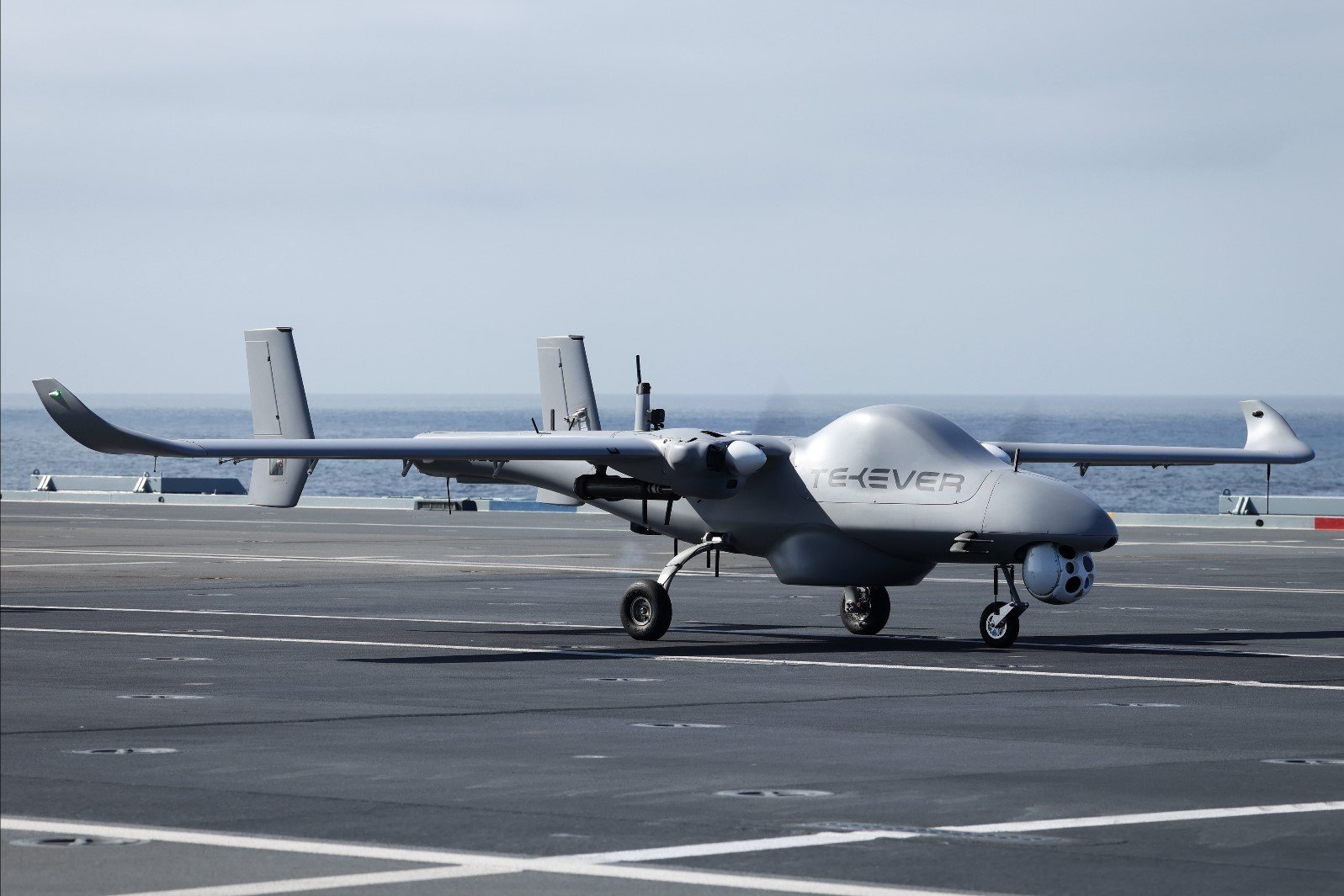
PORTSMOUTH, UK — The Royal Navy has successfully completed the first take-off and landing trials of the Tekever AR5 unmanned aerial vehicle (UAV) aboard the aircraft carrier HMS Queen Elizabeth. The trials took place during Heavy Lift Challenge 3 in the North Atlantic in October 2026, marking a step towards integrating fixed-wing drones into future carrier operations.
The AR5 flew approximately 90 minutes from Tekever's Flight Operations and Training Centre in Portugal to reach the carrier. It then completed two landings and two take-offs from the flight deck before returning to Portugal on a flight lasting around 120 minutes. This was the first time an AR5 had operated from a Royal Navy aircraft carrier.
Supporting Maritime Surveillance and Logistics
The demonstration examined how fixed-wing drones could support logistics, sustainment and intelligence, surveillance, target acquisition and reconnaissance (ISTAR) missions at sea. The trials also explored how the AR5 could operate alongside other systems within a carrier group.
The exercise took place alongside separate trials of Callen-Lenz Nyan one-way attack drones, which were launched from HMS Queen Elizabeth for the first time. The activities support the Royal Navy's plan to develop a hybrid carrier air wing combining crewed aircraft, including F-35B stealth fighters, with uncrewed systems.
Lieutenant Commander David Burton, the Royal Navy's trials sponsor for Navy Capability, said the trials provided valuable evidence on how autonomous aircraft could support future maritime operations and give commanders greater operational choices.
Tekever AR5: Technical Specifications
The AR5, developed by Portugal-based aerospace company Tekever, is a medium-altitude, medium-endurance fixed-wing UAV designed for extended surveillance and maritime operations.
Key specifications include:
-
Wingspan: Approximately 7 metres
-
Maximum take-off weight: 180 kg
-
Payload capacity: Up to 80 kg, according to the Royal Navy
-
Cruising speed: Approximately 100 km/h
-
Maximum flight altitude: 3,600 metres
-
Flight endurance: Up to 20 hours
-
Take-off distance: Approximately 200 metres on a prepared runway
-
Communications range: Approximately 230 km using radio line-of-sight communications
The aircraft can operate from conventional runways, unpaved airstrips and aircraft carrier decks. Its sensor options include electro-optical and infrared systems, synthetic aperture radar (SAR) and laser targeting capabilities.
Part of the Royal Navy's Hybrid Fleet Development
The carrier trials are part of the Royal Navy's wider effort to integrate autonomous aircraft into naval operations. By combining surveillance and logistics drones with crewed aircraft and uncrewed strike systems, the Navy aims to improve maritime surveillance, operational reach and flexibility.
The successful AR5 demonstration provides practical experience in operating fixed-wing uncrewed aircraft from a carrier and exploring their potential role in future naval deployments.
Note: The Royal Navy's published announcement gives the AR5 a 7-metre wingspan and 80 kg payload capacity. These figures differ from the 7.3-metre wingspan and 50 kg payload figures in the supplied technical data, so the official Royal Navy figures are used here.
——— End of Article ———