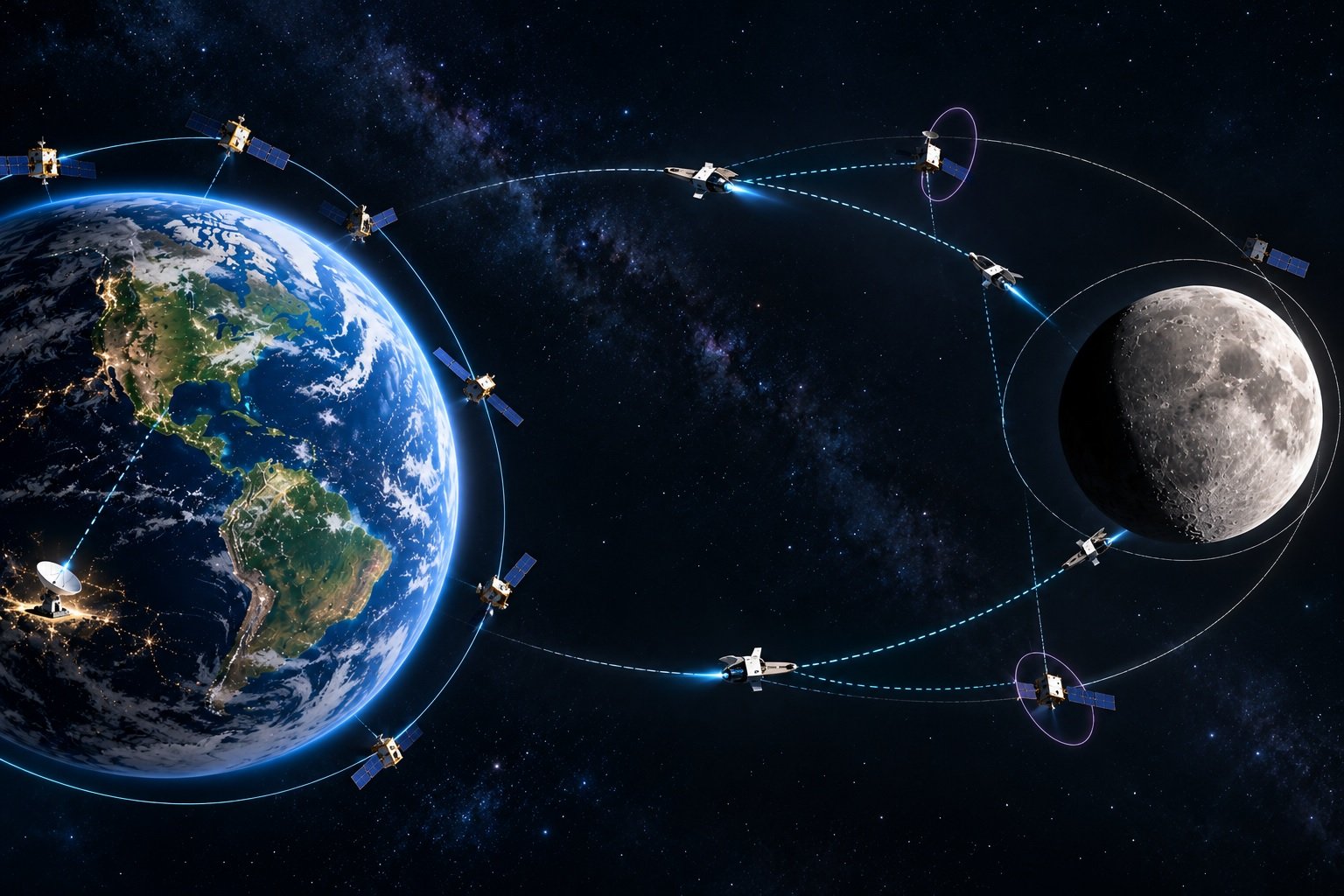
LOS ANGELES, USA — The U.S. Space Force is accelerating plans to develop spacecraft and autonomous systems for operations in cislunar space, the region between Earth and the Moon, with initial capabilities targeted by September 30, 2029.
The Space Force and the Air Force Research Laboratory (AFRL) are preparing a $30 million initiative called Lunar Prime, also known as Cislunar Prime, to demonstrate technologies for future cislunar operations. Maj. Gen. Stephen Purdy outlined the plans at the Space Industry Days conference in Los Angeles in October 2026.
Autonomous Spacecraft and Technology Development
The Space Force plans to issue two requests for information (RFIs). The first will seek commercial and near-commercial technologies for space domain awareness, communications, positioning, navigation and timing (PNT), and ground systems, with capabilities targeted by the end of fiscal year 2029.
The second RFI will focus on AI-powered autonomous software that can manage hardware failures, process sensor data, adjust missions and navigate without constant instructions from Earth. The long distances involved in cislunar space make continuous ground control impractical.
Through SpaceWERX, the AFRL is preparing to fund approximately 15 direct-to-Phase-II Small Business Innovation Research (SBIR) contracts, valued at around $2 million each. Officials plan to announce the initiative in December 2026, solicit proposals in January 2027 and begin awarding contracts in the spring. Flight demonstrations are targeted within two years of contract awards.
China’s Lunar Activities Drive U.S. Plans
The accelerated timeline reflects growing U.S. concerns about China’s expanding cislunar activities. China has conducted multiple uncrewed lunar missions and aims to send astronauts to the Moon by 2030. Recent Chinese CubeSat deployments near Earth-Moon Lagrange points and in lunar orbits have also drawn attention.
China has presented its recent cislunar project at UN-related meetings as a civilian scientific effort, while defense experts have raised concerns about its potential surveillance applications.
Senior U.S. defense officials, including Defense Secretary Pete Hegseth and Chairman of the Joint Chiefs of Staff Gen. Dan Caine, have described cislunar space as an important domain for future military operations. A December 2025 executive order also highlighted the need for capabilities in the region.
Existing Cislunar Programs
The Space Force established a Cislunar Coordination Office in April 2026, led by Jaime Stearns, to develop technology roadmaps and coordinate efforts involving space domain awareness, communications and lunar navigation. The office is also coordinating with NASA to align military and civilian infrastructure requirements where practical.
The AFRL’s Oracle programme is developing satellites for cislunar space domain awareness, mobility and navigation, with a pathfinder satellite planned for launch in December 2026.
The Space Systems Command has also launched the ACES initiative to address security-clearance bottlenecks that can prevent commercial space companies from participating in classified government programmes.
The Space Force is seeking mature commercial technologies rather than long-term research projects, aiming to demonstrate flight capabilities within two years of contract awards and field initial operational capabilities by September 30, 2029.
No contracts have been awarded under Lunar Prime or the new RFIs, and no operational military systems have been deployed in cislunar space. The current effort focuses on identifying available technologies, demonstrating capabilities and developing infrastructure for future operations in the Earth-Moon region.
——— End of Article ———