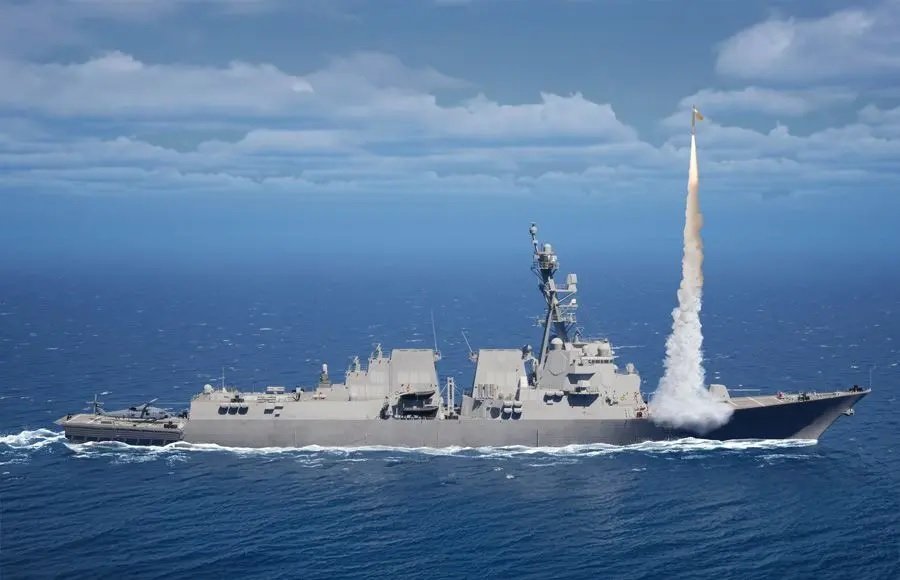
WASHINGTON — The U.S. Navy is moving forward with plans to integrate Lockheed Martin’s Patriot Advanced Capability-3 Missile Segment Enhancement (PAC-3 MSE) interceptor with the Aegis Combat System on guided-missile destroyers. The Navy is targeting initial operational capability (IOC) in 2028, according to an August 27 Congressional Research Service (CRS) report.
PAC-3 MSE Integration
The PAC-3 MSE is currently used with land-based Patriot air and missile defense systems and the U.S. Terminal High Altitude Area Defense (THAAD) system. The Navy plans to launch the interceptor from the Mk 41 Vertical Launching System (VLS) installed on its destroyers.
Lockheed Martin plans to conduct an initial land-based test in early 2027. The integration will require software modifications to both the Aegis combat system and the PAC-3 MSE.
The CRS report does not specify the number or class of destroyers that will receive the capability. It also does not provide the planned shipboard missile inventory, procurement cost or a timetable for at-sea testing.
Navy Contract and Missile Procurement
In April 2026, Lockheed Martin received a Navy contract to develop, integrate and test PAC-3 MSE within the Aegis architecture and Mk 41 launcher. The initial phase was reported at about $93 million, while the broader development, integration and testing effort could be worth up to about $200 million.
Lockheed Martin had previously invested its own resources in Mk 41 compatibility.
The Navy's fiscal year 2027 budget request includes 405 PAC-3 MSE interceptors. The Navy had ordered 12 missiles the previous year to support integration activities.
How the PAC-3 MSE Works
PAC-3 MSE is the current generation of the PAC-3 family and belongs to the MIM-104F branch of the Patriot system. It uses hit-to-kill technology, destroying targets through direct impact rather than a conventional explosive warhead.
The interceptor is designed to engage tactical ballistic missiles, cruise missiles, unmanned aerial systems and other air-breathing threats.
The missile has an onboard active millimeter-wave seeker for terminal guidance. Under the planned Aegis integration, the ship's AN/SPY-1 or AN/SPY-6 radar can provide midcourse updates before the missile's own seeker takes over during the terminal phase.
This differs from earlier Patriot interceptors. PAC-2 and PAC-2 Guidance Enhanced Missiles use blast-fragmentation warheads and were designed mainly to engage aircraft and cruise missiles, with a more limited role against tactical ballistic missiles.
Production and Supply Pressure
The PAC-3 MSE integration is taking place as demand for Patriot interceptors increases. The CRS report said Congress is examining Patriot costs, availability, production capacity and supply-chain issues, with demand affected by the conflicts in Iran and Ukraine.
Concerns include access to critical materials, supply-chain bottlenecks and whether production rates can meet U.S. and international requirements.
Lockheed Martin is expanding production under multiyear agreements, with annual output planned to increase from roughly 600 interceptors to more than 2,000 over seven years.
Army and International Demand
The U.S. Army currently operates 15 active-component Patriot battalions and plans to add three more between fiscal years 2029 and 2031.
A four-battery Patriot battalion equipped with the Integrated Battle Command System (IBCS) and Lower Tier Air and Missile Defense Sensor (LTAMDS) has an estimated procurement cost of $1.792 billion.
International demand is also putting pressure on delivery schedules. According to the CRS, Denmark abandoned a planned Patriot purchase in favor of the Franco-Italian SAMP/T system, partly because of shorter delivery times. Switzerland has also considered European alternatives amid potential Patriot delivery delays of four to five years.
2028 Operational Target
The CRS report does not determine whether production and supply-chain pressures will affect the Navy's Aegis integration schedule or its 2028 operational target.
It also does not confirm whether the Navy has established formal requirements for the shipboard PAC-3 MSE capability. Beyond the planned early-2027 land-based test, the report does not identify additional development milestones before the 2028 IOC target.
If the current schedule is maintained, PAC-3 MSE will add another interceptor option to Aegis-equipped Navy destroyers for defense against a range of missile and aerial threats.
——— End of Article ———