Pacific Submarine Force, U.S. Navy — The U.S. Navy’s Pacific Submarine Force is examining new roles for uncrewed undersea vehicles (UUVs), including operating them with aircraft carrier strike groups and using them to resupply submarines while they remain submerged.
The discussions follow RIMPAC 2026, which included more than 35 experiments involving uncrewed systems and emerging technologies. The exercise involved 30 nations, about 30,000 personnel, more than 30 surface ships, five submarines and over 190 aircraft.
After the at-sea phase of RIMPAC, Rear Adm. Chris Cavanaugh, commander of the U.S. Pacific Fleet Submarine Force, met with Rear Adm. Marcos Jasso, commander of Carrier Strike Group 9, aboard USS Theodore Roosevelt (CVN-71). Jasso assumed command of the carrier strike group in June 2026, and a Navy photo from the meeting was released on July 30.
Cavanaugh said the Pacific Submarine Force is investing in unmanned capabilities to augment manned submarines and maintain its undersea advantage as technology develops.
UUVs as Carrier Strike Group Extensions
The two commanders discussed how UUVs could support carrier operations as tactical extensions of a carrier strike group. The vehicles could potentially conduct reconnaissance, strike missions, minesweeping and anti-submarine warfare. They could be launched directly from aircraft carriers or from helicopters and could also contribute to defenses against incoming torpedoes.
Another concept involves using UUVs to transfer critical spare parts and components between aircraft carriers and submarines. The Navy faces difficulties resupplying submarines at sea, particularly in contested or denied environments where traditional submarine tenders could face limitations.
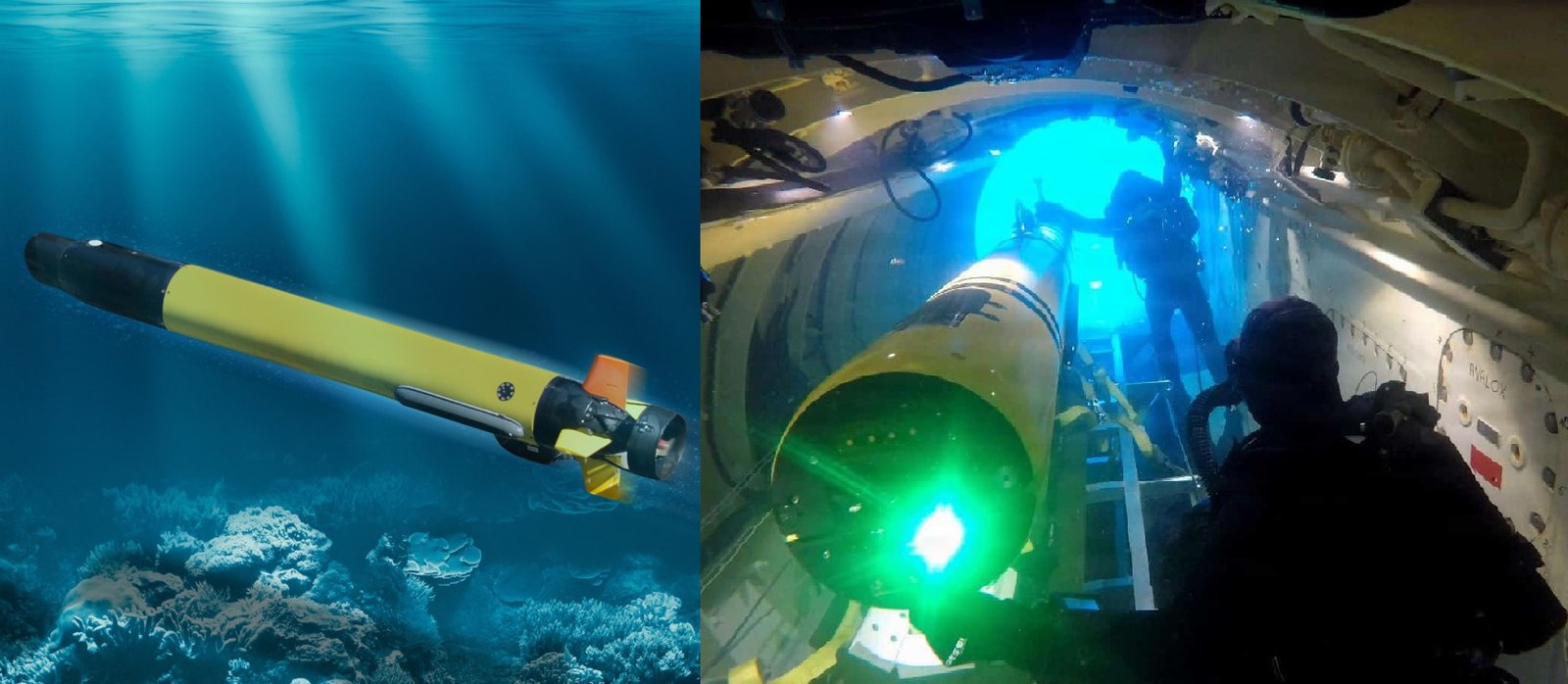
Under the concept discussed, submarines could deploy and recover UUVs while remaining completely submerged. This would allow critical parts and materials to be transferred without requiring the submarine to surface or return to port, supporting operational security and potentially extending the time a submarine can remain on station.
Revolver System to Increase Submarine Payloads
The Navy is also developing the Revolver system for Virginia-class attack submarines to increase the number of smaller weapons that can be carried in existing 21-inch torpedo tubes.
The system is designed to multi-pack smaller-diameter weapons, including the 6.75-inch Mark 58 Compact Rapid Attack Weapon (CRAW), which is being developed by RTX. Multiple CRAW torpedoes could be carried in a single standard tube, increasing the submarine’s available weapons without major hull changes.
The combination of improved underwater resupply and increased payload capacity is part of the Navy’s wider effort to extend submarine operational endurance and expand available capabilities.
UUV Production Expands
The Navy is also moving toward greater production and fielding of UUVs as the technology matures. In July 2026, the Orca Extra Large Uncrewed Undersea Vehicle completed its first 1,000-nautical-mile transit in the East Pacific, according to Cavanaugh.
Smaller systems are also entering operational use, including REMUS-family vehicles that can be launched and recovered through submarine torpedo tubes.
Huntington Ingalls Industries (HII) has a multi-year production agreement with Hitachi Ltd. to provide more than a dozen REMUS 300 UUVs to Japan. The modular REMUS 300, which serves as the commercial basis for the U.S. Navy’s Lionfish program, is designed to support mine-hunting missions and interoperability with U.S. and allied forces.
The Navy is continuing testing, evaluation and fielding of different UUV systems as it works to integrate unmanned vehicles more closely with manned submarines, aircraft carriers and other fleet assets.
——— End of Article ———